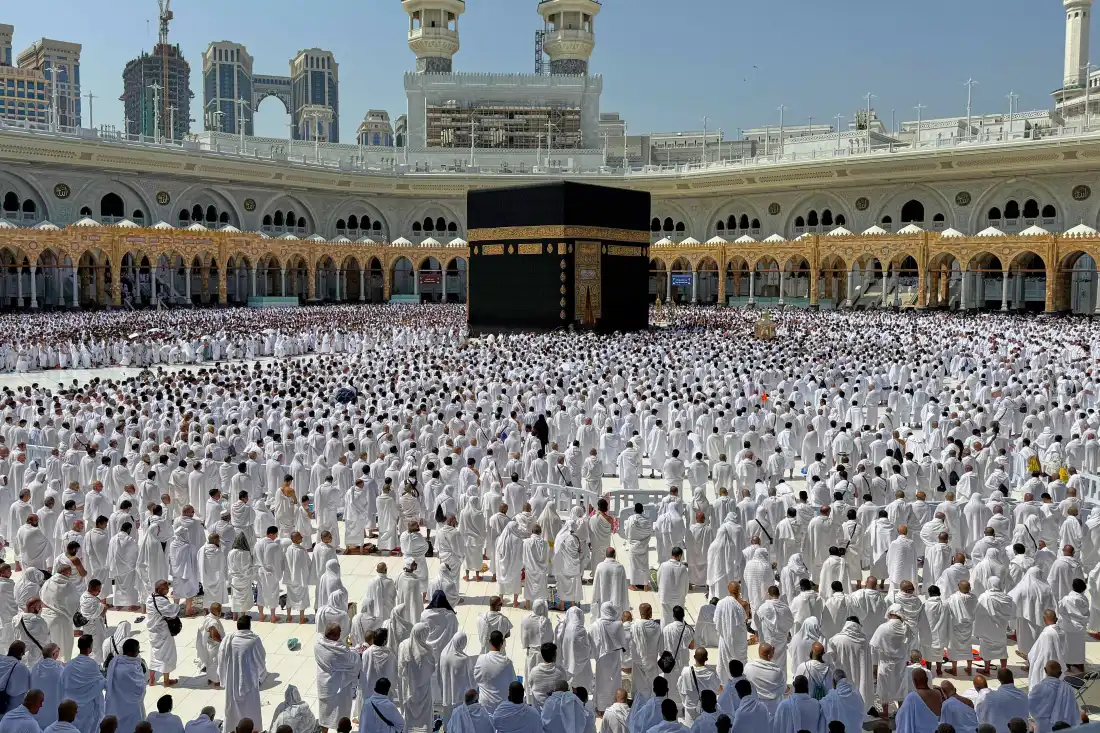
At the Grand Mosque in Mecca, Saudi Arabia, pilgrims gather to pray in front of the Kaaba, Islam’s holiest site. According to a report by the Pew Research Center, Muslims will soon outnumber Christians worldwide, becoming the largest religious group by 2035. Both religious populations are expected to grow, but Muslims are projected to increase at a faster rate.
Pew’s research suggests that if current trends persist, the global Muslim population will reach 3.6 billion by 2070, surpassing the Christian population, projected at just under 3 billion. These projections are based on national census data, fertility rates, religious switching patterns, migration estimates, and United Nations reports.
While Hindus and Jews are predicted to grow in numbers, their percentage of the world population will decline. In contrast, Buddhists are expected to decrease both in number and globally. Many of these changes can be attributed to overall population growth, especially in regions like sub-Saharan Africa, where both high fertility rates and extended lifespans contribute to the growth of Islamic and Christian populations.
Interestingly, by 2070, the Democratic Republic of the Congo is expected to have the largest number of Christians, surpassing the United States. This shift marks a significant change in what Alan Cooperman, Pew’s religion research director, describes as the “center of gravity” of Christianity.
Fertility rates are critical to these shifts. Globally, Muslims currently have an average of 3.1 children per woman, compared to about 2 children for non-Muslim women. Beyond Africa, other noteworthy trends include a significant decrease in the populations of China, Japan, and South Korea, with their Buddhist populations halving by 2070. The Jewish population will increasingly converge in Israel, expected to house 62% of the global Jewish community by 2070.
An intriguing aspect of the study reveals that even though more people will identify as having no religious affiliation in individual countries, the overall number of religiously unaffiliated individuals will decline. This is largely due to a projected population decline in China, where many of the world’s religious “nones” reside.
The Pew report also highlights changes in the United States. By 2070, the Christian majority will dwindle to just under 48% of the population. Meanwhile, those unaffiliated with any religion are expected to rise to 41%. This shift is more influenced by religious switching than birth rates, with many Christians converting to religiously unaffiliated status.
The U.S. will see increasing religious diversity. If trends continue, by 2070, Muslims and Hindus in the U.S. will outnumber Jews, reflecting broader global religious dynamics.
Leave a Reply