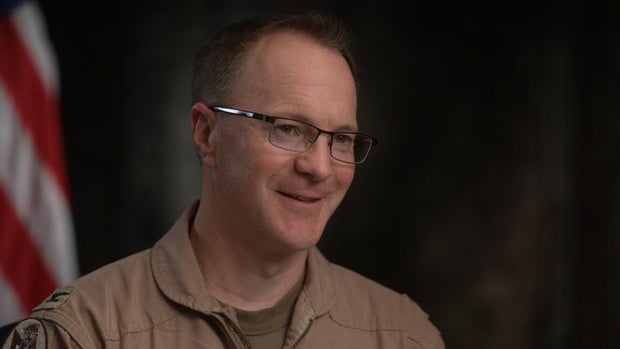
In April, five weeks into a costly and unpopular war, an American fighter jet was shot down over Iran, stranding two aviators behind enemy lines. The officers on board—a pilot and a weapons systems officer, referred to by mission call signs Alpha and Bravo for security reasons—ejected from their F-15E jet, call sign Dude 44, after an Iranian missile hit their aircraft. The crewmates found themselves stranded miles apart in a mountainous desert region, with bounties on their heads. What unfolded was one of the largest and most complex rescue operations in U.S. military history.
Bravo’s Story of Survival
In his first interview, Bravo provided 60 Minutes correspondent Norah O’Donnell new details about his harrowing story of survival. Bravo credited Alpha for the quick reaction that saved their lives and described the impact of the missile on their aircraft as feeling like a “freight train.” Damage to the fighter jet was catastrophic, leading to the ejection over the heart of Iran.
“I will be thankful, to my dying day, for my pilot and crewmate, Alpha, for saving our lives and ejecting us,” Bravo stated.
Remarkable Equipment Performance
Bravo praised the airmen responsible for maintaining the aircraft and equipment, noting that everything exceeded expectations despite the missile damage. The F-15E delayed their ejections slightly to ensure the safety of the crewmen upon landing.
“The airmen did an incredible job,” said Bravo, speaking of the professionalism exhibited by those responsible for the equipment that outperformed its design specifications.
Challenges During Descent
Bravo faced severe challenges during his descent, discovering his parachute had been damaged by the missile strike. Falling at an estimated speed of 70 to 100 miles per hour, Bravo relied on his training to tackle problems under such extreme circumstances.
“I wasn’t focused on the speed at which I was falling,” Bravo said. “I was instead focused on trying to correct the problems in front of me.”
Despite suffering from broken bones, Bravo described his survival from the fall as a “miracle,” attributing it to divine intervention.
Evading Capture
Upon reaching the ground, Bravo faced an immediate threat. Iranian forces were hunting him, closing to within a few hundred meters. He prioritized concealment and evasion over communication in the vast terrain akin to the size of Alaska.
Bravo scaled a 7,000-foot ridgeline, overcoming injuries and the difficult terrain through sheer determination.
“Never let a lack of motivation put you on Iranian TV,” he reflected.
A Rescue Like No Other
After 48 hours, Bravo experienced relief when U.S. forces arrived for the rescue. Known as one of the greatest moments in his life, he expressed profound gratitude for their efforts.
The operation met another obstacle at the makeshift airstrip, where the rescue plane’s landing gear became stuck in the desert sand. Ultimately, the U.S. bombed its own aircraft to prevent it from falling into enemy hands.
“It’s what we do,” Bravo concluded, underscoring his faith first in God and second in the men and women of the United States military.
Leave a Reply