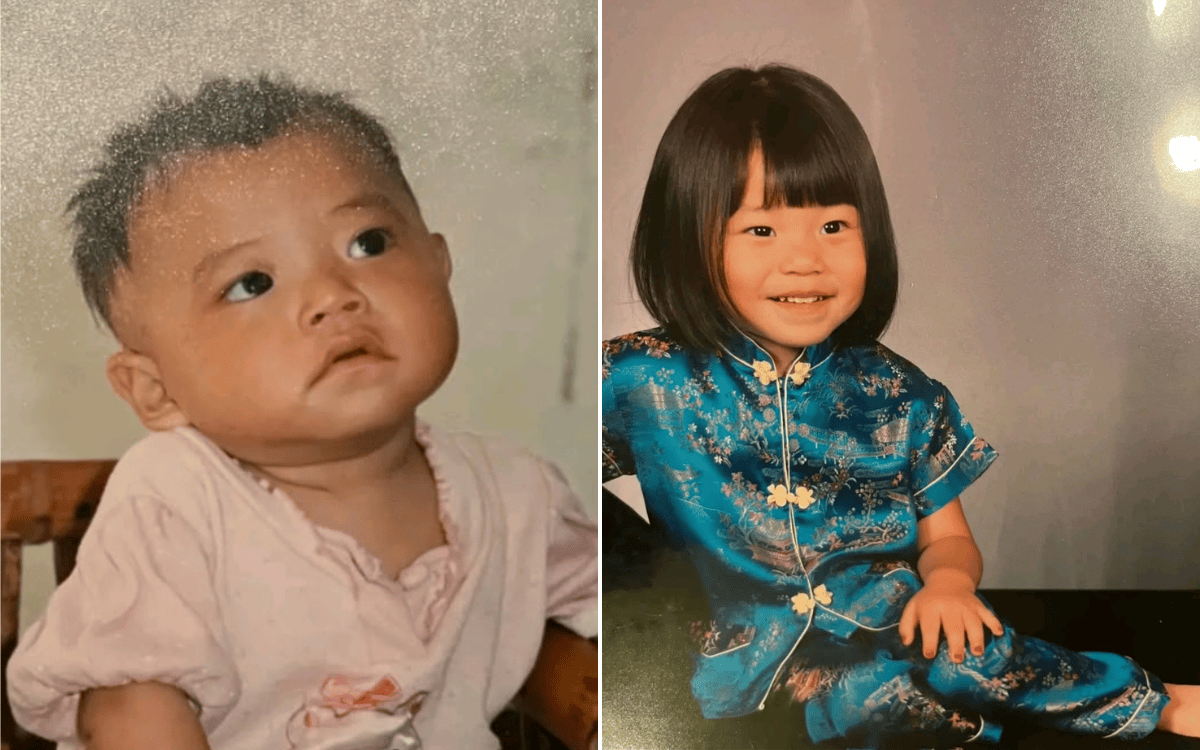
I grew up in Memphis, Tennessee, but my journey began in China. At just three days old, I was orphaned on a sidewalk in Nanchang, Jiangxi Province. My adoptive family always told me finding my birth parents was a long shot. That chapter seemed closed. But after I became a parent, I felt compelled to explore my roots. Social media connected us more than ever, making the once-impossible seem within reach.
Adoption was never a mystery in my life. There was no singular moment of revelation; it was a fact openly discussed in my family. However, reading documents labeling me as an ‘officially abandoned child’ shaped my understanding. I realized my biological family had left me, and it cast a shadow over my sense of being adopted.
My adoptive mother assured me my biological family wanted a better life for me. As a child, that belief provided comfort. As an adult, I became less certain. I questioned their love, imagining it as something different.
I was adopted from an orphanage at 14 months old, arriving in poor health. Pneumonia plagued my lungs, and I was physically underdeveloped from prolonged neglect. My adoptive mom remembers fearing for my survival when she met me. The overcrowded orphanage struggled to provide for sick babies. She believes our connection saved my life, as I received care with a family awaiting my arrival.
My childhood overflowed with joy: festivals in autumn, Christmas lights, beach trips, Disney World moments, and cozy Thanksgiving gatherings with cousins. My grandmother often expressed her love by saying, ‘Of all the beautiful girls, God brought you from China to be my precious angel.’ I never felt like I did not belong.
School wasn’t always straightforward. I faced teasing for being adopted, but as the story spread, the ridicule faded. In college, surrounded by new faces, I delved deeper into my Chinese identity. As a child, I fantasized about my birth family. My mental image involved a mother in yellow and siblings by my side.
For years, I regarded my past as static, beyond discovery. Searching for more felt daunting, and I only Googled Nanchang in college. Learning it was modern, unlike the poor, rural descriptions I’d heard, surprised me. I felt I needed validation to explore, even from myself.
At seven, I returned to China through a program for lost girls. Visiting cities like Beijing and Shanghai was eye-opening, but I was too young to absorb its significance. Today, my feelings about my origins are evolving. Being a parent made me more aware of the struggles my birth mother might have faced. I question whether I was truly abandoned or taken, contemplating issues I previously avoided.
Motherhood profoundly altered my perception of adoption. Cradling my children, a daughter born in 2021 and a son later, overwhelmed me. I could finally embrace a relative who resembled me. Grieving surfaced during postpartum phases, yet joy prevailed. I no longer felt solely like an adopted child with a Chinese-link. I identified as a Chinese mother nurturing Chinese offspring.
With my daughter in kindergarten, teaching her about her roots became important. We explore books, videos, and age-appropriate discussions about my adoption. I aim to familiarize our family with Chinese traditions and cuisine, lessons I’m still learning.
My past, once an untouchable void, now feels open to exploration. I’m taking early steps to find my birth family. Another woman from my orphanage joined this journey. We’re planning DNA tests and reaching out to networks like the Nanchang Project and Baobeihuijia to broaden our search once results arrive.
If reconnecting wouldn’t disturb them, I want to know my family’s history and understand my abandonment’s context. The one-child policy affects numerous narratives, but my focus remains on connecting and comprehending life’s tapestry—our shared stories.
Curiously, I avoided delving into the one-child policy, feeling too close to the experiences of birth mothers and daughters. Knowing my fate was fortunate makes it complex to face what others endured. I was among the fortunate ones, adopted by parents who cherished me.
Sometimes, I ponder the life I could have led if I stayed in China. Yet, given my abandonment, it seems unlikely to mirror my current path. Perhaps unwanted or facing China’s harsh past, my life is different. Despite the unanswered questions shadowing my beginnings, I cherish the outcome.
If I meet my biological parents someday, here’s my message: ‘I hope my life reflects the aspirations you had for me.’ Though the past can’t change or be fully understood, their choice influenced my path. Knowing the longing behind it, I trust my life honors their intention.
I once aspired to be a news producer in New York City. Time shifted that dream. Today, my family, my children, and my present fulfill me. Understanding this fuels hope for whatever the future holds.
Leave a Reply