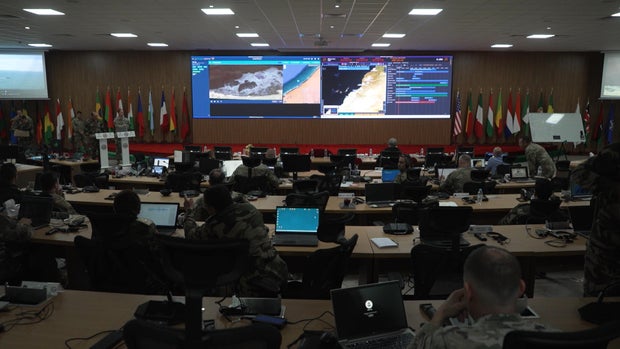
By late May 2026, the calm of southern Morocco’s desert merged with the Atlantic coast was interrupted by military maneuvers. Explosions and gunfire marked the African Lion 2026 exercise, the largest U.S.-led military activity in Africa, involving 30 partner nations. The drills emphasized preparing for future warfare increasingly dominated by artificial intelligence (AI).
Testing AI in Military Operations
During the exercise, the U.S. Army employed and evaluated various AI-driven systems. American forces tested these technologies in complex scenarios, aiming to modernize the military. Private defense firms displayed cutting-edge products and received feedback from soldiers, anticipating roles in future military upgrades.
Shortening the ‘Kill Chain’
The ‘kill chain’ involves several steps to deploy lethal force, from identifying targets to action deployment.
AI systems, showcased at the exercise, aimed to accelerate this process. Lieutenant Colonel Ramon Leonguerrero explained that the Palantir-developed AI platform in the Joint Operations Center in Agadir reduced decision-making times from hours to minutes. While humans remained at decision points, autonomy in trigger decisions was acknowledged.
Project Maven, a Pentagon AI project by Palantir, processed vast battlefield data to guide tactical choices. The system integrated Anthropic’s Claude language model, enabling operators to query data efficiently despite recent political tensions.
Ethical Concerns and Technological Advancements
Some military personnel expressed reservations about AI handling critical decisions. One soldier highlighted the irreplaceable human element in decision-making. Pentagon officials also voiced ethical concerns, ensuring AI does not independently make lethal decisions. General Dagvin R.M. Anderson urged consideration of AI advancements, recognizing their potential necessity despite ethical debates.
Anderson noted that ignoring technological advancements could place the U.S. at a significant disadvantage against adversaries progressing in AI weaponry.
Robotics and Soldier Safety
AI in military applications also included robotic systems, reducing forces’ exposure to risks. Overland AI’s ULTRA vehicle, part of the exercise, demonstrated autonomous navigation and combat capabilities, including carrying weapons and deploying mines.
With heightened safety and efficiency, the use of robots in dangerous operations emerged as a potential lifesaver. 1st Lt. Vincent Gasparri highlighted the life-saving possibilities of replacing humans with robotic counterparts in high-risk operations.
Gasparri, part of the 173rd Airborne Brigade, emphasized the focus on protecting soldiers. The adoption of AI and robotics aims at improved decision-making and operational efficiency, crucial for future military strategies.
Leave a Reply