AI Data Centers Impacting Water Resources
The rapid growth of AI data centers brings a critical environmental concern to the forefront in the Great Plains. There is a pressing question about the sustainability of America’s vital groundwater reserve: the Ogallala Aquifer. Can this aquifer support both the blossoming digital economy and existing agricultural communities?
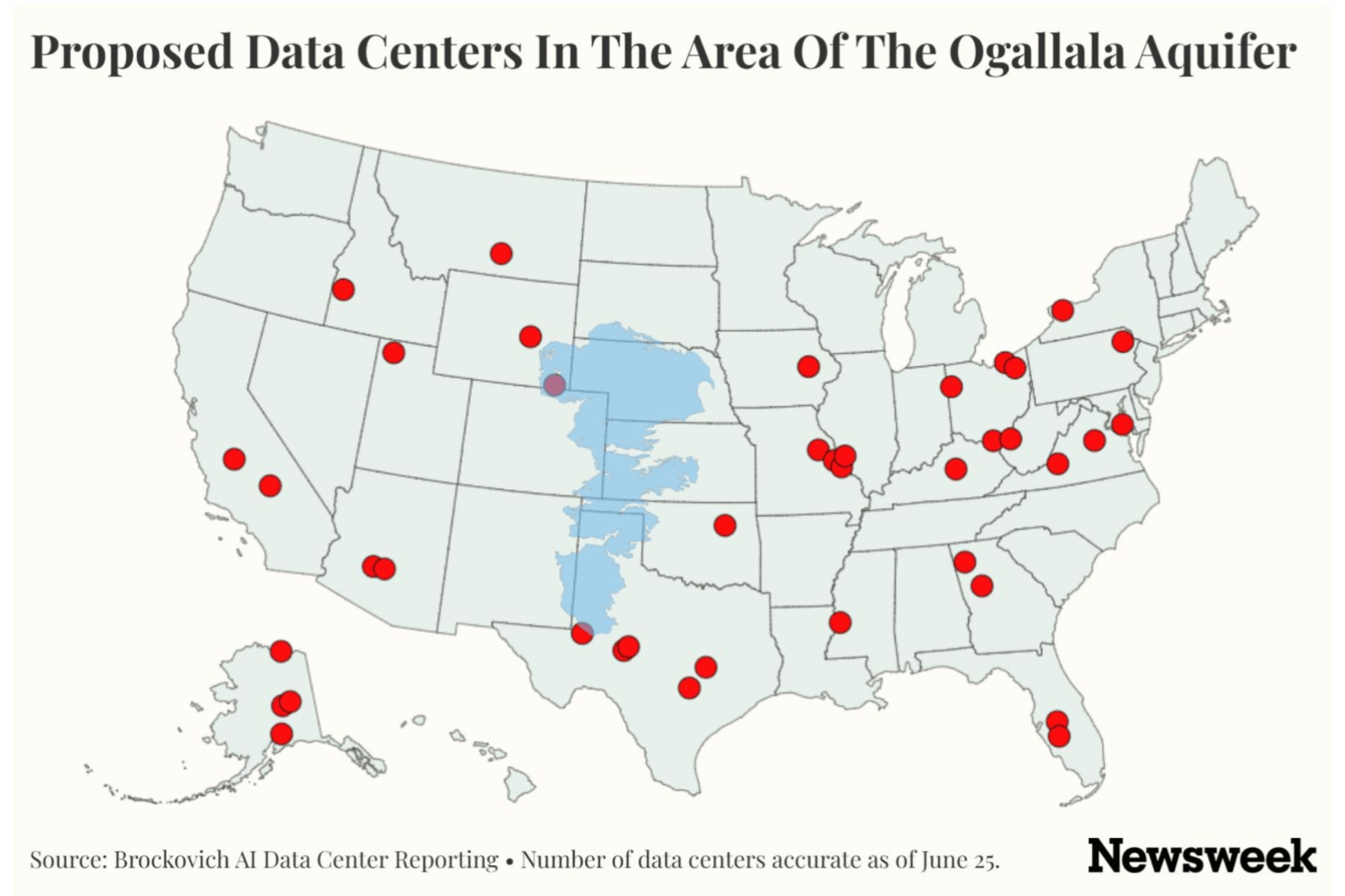
New data from Brockovich AI Data Center Reporting shows several proposed and under-construction AI facilities situated directly above or adjacent to the Ogallala Aquifer. This groundwater system underpins much of America’s agricultural output.
Weighing Economic Benefits Against Water Concerns
Local governments in Texas and Wyoming are grappling with balancing AI investment’s economic advantages against long-term water availability concerns. In Amarillo, Texas, Charlie Hamilton, Fermi Chief Site Development Officer, testified on water conservation before the Texas House Natural Resources Committee on June 24, 2026.
Opposition to AI projects is evident. Over 500 residents protested Beacon’s Dove Creek project in Tom Green County, Texas, leading to a rejection of a proposed 12-month moratorium on data center development in Precinct 4. County commissioners have called for tighter state-level regulations on high-volume water use by data centers.
Concerns Over Ogallala Aquifer Development
The concentration of AI data center development in Ogallala regions has sparked scrutiny from researchers, farmers, and local officials. Not all AI facilities will draw directly from the aquifer; some are exploring lower-water cooling technologies.
AI campuses like Texas Critical Data Centers and Microsoft’s Cheyenne Expansion have captured attention due to their proximity to the aquifer. Prometheus’ proposed Casper campus in Wyoming and Beacon’s projects in Texas are also under examination.
Ogallala Aquifer’s Importance
Stretching beneath eight states, including South Dakota and Texas, the Ogallala Aquifer is crucial for U.S. agriculture. It supports about 30% of U.S. groundwater irrigation and aids one-fifth of American agricultural production. Decades of withdrawals have significantly reduced water levels, leading to unsustainable depletion.
Sudeep Pasricha from Colorado State University highlights that some subregions have sustained water losses, with depletion rates reaching over 100,000 acre-feet per year.
Researchers warn that the aquifer is being mined, not replenished, with recharge rates far below irrigation demands. Recovery could take centuries in some areas.
Why Developers Target the Great Plains
The Great Plains, despite growing water use scrutiny, offers attractive locations for hyperscale AI infrastructure. Developers benefit from affordable land, transmission access, power generation, tax incentives, and fewer constraints compared to coastal markets.
Modern AI facilities generate significant heat, requiring complex cooling systems. Cooling reliance varies from municipal supplies and groundwater wells to recycled systems and low-water methods.
Variability in Water Use
Water use varies with facility size, computing density, and cooling technology. While some campuses have modest water demands, others can resemble small towns in usage.
U.S. data centers used about 17 billion gallons of water in 2023 for cooling. The total, including indirect usage from electricity generation, is estimated at 163.7 billion gallons per year. Predictions suggest growth as AI infrastructure expands.
Engineering Choices: Cooling Technologies
The debate centers around cooling systems. Evaporative cooling may lose up to 85% of water to evaporation. Water-saving alternatives like air cooling, dry cooling, and closed-loop systems can minimize water use but may require more energy.
For projects in Texas and Wyoming, cooling technology decisions are essential, as they impact water consumption. Related Digital’s Cheyenne campus adopts air-cooled infrastructure, minimizing water use. Others have yet to disclose detailed cooling plans.
Indirect Water Footprints
Even low direct-water-use facilities can have considerable indirect footprints due to electricity generation from water-intensive cooling systems. Evaluating impact involves on-site and supporting infrastructure reviews.
The Rise in AI Water Demand
AI workloads are increasing technology infrastructure demand. Shaolei Ren’s study from UC Riverside indicates 20 to 50 AI queries can use about 500 milliliters of water, driven by cooling and electricity processes.
Despite seemingly low individual consumption, cumulative demand becomes substantial over billions of interactions.
Pasricha warned that cumulative development could produce material effects.
Community Concerns and Questions
Water availability is evolving into a local political issue. Communities across Texas and Wyoming increasingly seek information on sourcing, technologies, and sustainability.
In San Angelo, debates around Beacon’s Dove Creek campus demonstrate the tension between economic development and resource demands.
Future Consequences
Long-term impacts hinge on present decisions by developers, governments, and utilities. Potential consequences include:
- Permanent loss of irrigation capacity in certain regions
- Shifts in crop production and food pricing
- Long-term aquifer depletion without realistic replacement options
Immediate effects might include declining well levels, increasing water costs, and local supply pressure. Economic impracticality for irrigation may reshape agriculture and rural economies.
‘Placing data centers in these regions could be risky,’ Pasricha stated.
The Core Debate
The debate extends beyond water usage; it involves technologies, site locations, and community balance between economic growth and resource security.
With multiple AI projects proposed near the Ogallala Aquifer, a crucial U.S. groundwater reserve, the urgency for decision-making grows. The impact on U.S. agriculture from AI expansion must be evaluated through engineering, water management, and policy lenses.
Contact Newsweek editors on the story: John Fitzpatrick and James Debens.
Leave a Reply