Imagine a teacher who recalls each student’s responses from six months ago, identifies knowledge gaps, and ensures mastery by making students revisit topics. Now, consider this teacher is an AI tutor. Picture students spending just two hours a day in focused study, learning twice as fast as those in a typical classroom. This allows more time for extracurricular activities.
This vision is being pursued by Alpha School, a network of 46 private schools in the United States, which views AI-supported learning as a new frontier in K-12 education. Supporters of AI in classrooms believe they can solve key challenges in childhood education: offering personalized tutoring on a large scale and adapting learning speed for individual mastery of subjects.
However, differing educational perspectives, concerns about standards and screen time, inconclusive research, and a large market for tech providers create a contentious debate. Surveys indicate declining educational outcomes and growing public dissatisfaction with K-12 education.
Carl Hendrick, chief learning scientist at Alpha School, highlights that AI tutoring can track students’ progress over months, replacing inconsistent testing and learning patterns often found in classrooms of 20 to 30 students. “We gather hundreds of data points,” Hendrick told Newsweek. “The system compiles data over weeks and months to understand student performance.”
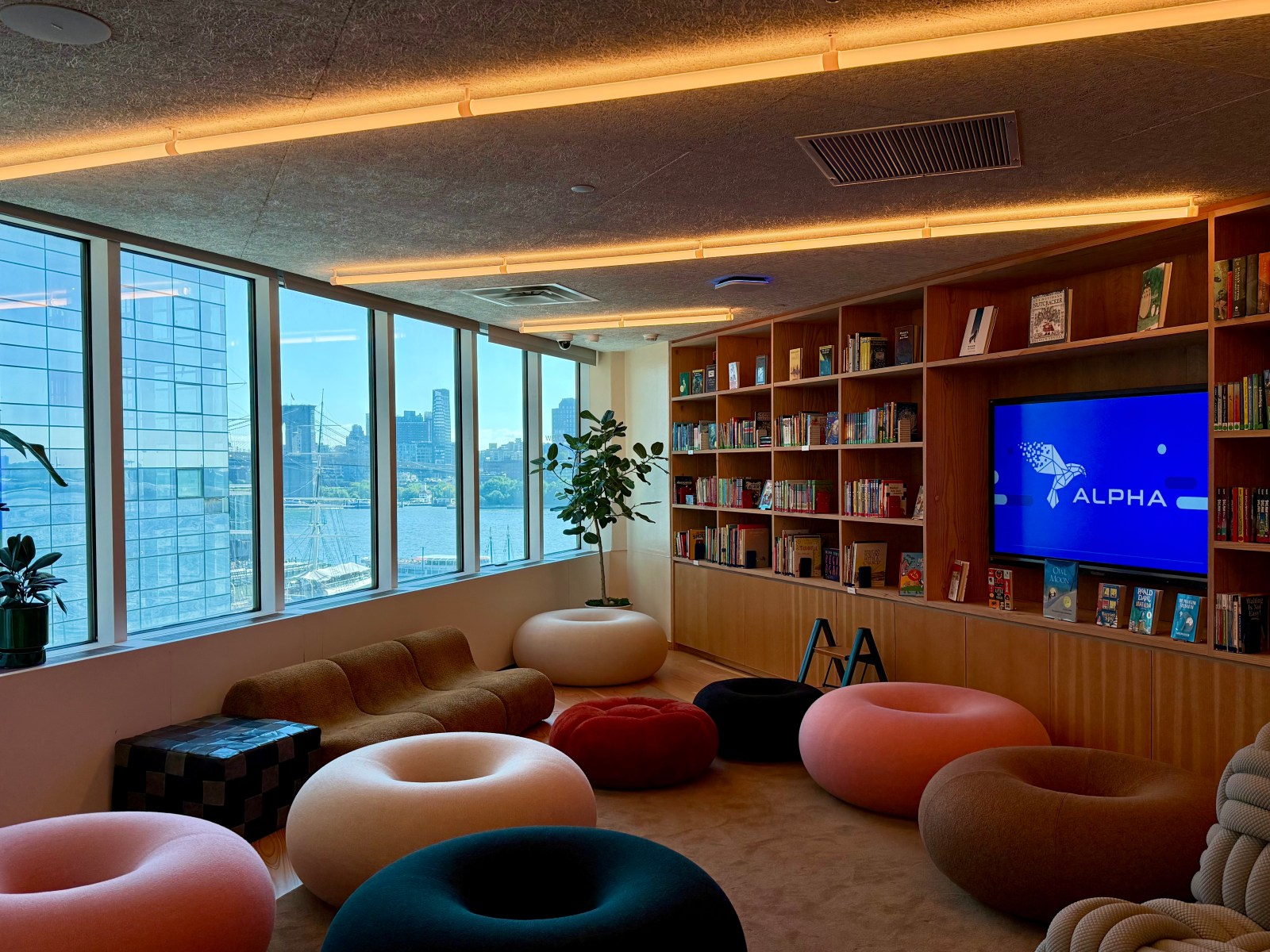
Alpha emphasizes their model does not rely entirely on screen time. Screen use aligns with the national average, and students are encouraged by “guides” rather than traditional teachers. Chauncey Nartey, a reading guide at Alpha School in New York, mentioned a misconception about constant computer use during a Newsweek visit on September 30.
Growing Dissatisfaction with K-12 Education
Increasing one-on-one teacher-student time is a longstanding goal in education. The challenge has been cost. Hendrick believes AI offers a pathway to this goal with personalized tutoring, study plans, and testing.
The debate over technology in education adds complexity, coinciding with concerns about the state of education. An OECD survey last year showed that performance in math, science, and reading declined among 760,000 students in 91 countries. The drop in reading scores was substantial.
A Gallup poll in September reported the lowest satisfaction levels with K-12 education since the poll’s inception 27 years ago, prompting openness to experimental alternatives.
Generative AI is driving a new wave of edtech development, building on past trends like online courses and video learning platforms during the COVID pandemic.
Alexandre Glaser of EduCapital, a venture capital firm specializing in edtech, informed Newsweek of a significant shift in the sector. “AI will enable personalization at scale, affecting all educational levels,” he said.
The edtech market size is considerable. Exact figures are difficult to obtain, but Glaser estimates global education accounts for 4-6% of GDP or $6 trillion to $8 trillion. Edtech comprises roughly 8-10% of this, possibly reaching $800 billion. He projects the AI share of edtech will grow to $90 billion or more by 2030.
Joe Liemandt, Alpha School principal and billionaire tech investor, along with co-founder MacKenzie Price, aims to expand Alpha’s model through AI system TimeBack, used in Arizona’s Unbound Academy and pilot programs in Texas public schools. “Artificial intelligence enhances human intelligence,” Price told Newsweek at Alpha’s New York location.
Studies Show Mixed Results on AI Learning
Research indicates mixed outcomes for AI in learning. A study of 27,000 Chinese high school students found reduced homework time and improved results, yet declines in test scores among those over-relying on AI. This suggests optimal technology use is necessary.
Libby Hills, CEO of EdTechnical, notes the AI debate is “polarized,” with conflicting data on whether AI aids or hinders learning. Concerns about digital devices and AI in classrooms persist.
Kristen Mansharamani of Torit Montessori School in Boston points out concentration challenges among current students. For Mansharamani, AI’s promise of personalized tutoring is not exclusive to AI itself. “Education individualization doesn’t require AI,” she said. “We can help teachers personalize while maintaining proven learning methods.”
Alpha School claims top-tier academic performance, yet the data is self-reported and lacks independent verification, possibly reflecting selection bias due to high fees up to $75,000. “The numbers appear impressive but are self-reported,” Hills said. “There may be potential in Alpha’s approach, but evidence is still catching up with the claims.”
Contact Newsweek editor on this story: Mike Hirst.
Leave a Reply