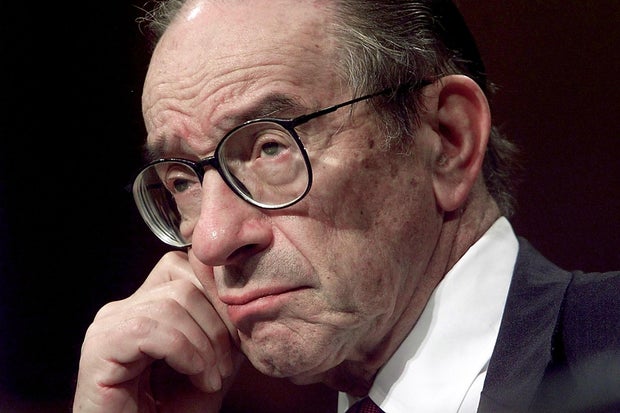
Alan Greenspan, the renowned economist who led the Federal Reserve under four U.S. presidents, passed away at the age of 100, his wife Andrea Mitchell confirmed. Greenspan’s passing was attributed to complications of Parkinson’s Disease, as reported by Mitchell, who is also the chief Washington and foreign affairs correspondent for NBC News.
Greenspan’s Tenure and Economic Impact
Greenspan was one of the longest-serving Federal Reserve chairs in U.S. history. His leadership coincided with the Great Moderation, a period from the mid-1980s until 2007 marked by low inflation, rising stock markets, and strong economic growth. Nevertheless, his tenure was marked by several financial upheavals, including the 1987 stock market crash and the early 2000s dot-com bubble burst.
In 1996, Greenspan introduced the term “irrational exuberance” to describe investor over-optimism leading to stock bubbles, particularly with internet companies. His legacy is controversially linked to the 2008 global financial crisis and the Great Recession, despite his retirement from the Federal Reserve in early 2006. Critics often cite his previous “loose money” policies as a factor in the subprime housing crisis.
“The main post-crisis criticism of Mr. Greenspan was that he was a naive believer in market efficiency, failing to pop bubbles in the late 1990s or mid-2000s and failing to regulate the financial sector properly,” noted The Economist in a 2017 essay.
Greenspan defended the policy decisions made prior to the Great Recession, arguing in a Fortune Magazine interview in 2007 that he was a victim of “revisionist history.” He claimed to have warned about risks in the housing market, including subprime mortgage issues.
Early Life and Career
Born in New York City on March 6, 1926, Greenspan’s parents, Herbert and Rose, divorced when he was five. His remarkable mathematical abilities appeared early, and he could solve complex sums mentally. Greenspan pursued music at Juilliard before turning to economics at New York University, where he completed both bachelor’s, master’s, and doctoral degrees.
Greenspan became an admirer of novelist Ayn Rand and participated in her “objectivist salon.” His career began at the National Industrial Conference Board, analyzing demand for key metals. He later established Townsend-Greenspan & Co., an economic consulting firm. His government roles included chair of the President’s Council of Economic Advisers under Gerald Ford and member of Reagan’s Economic Policy Advisory Board.
Appointed by President Reagan in 1987, Greenspan continued as Fed chair under Presidents George H.W. Bush, Bill Clinton, and George W. Bush. He retired from the Federal Reserve Board in 2006.
Personal Life and Reflections
Greenspan married journalist Andrea Mitchell in 1997. In conversations with Fortune Magazine, he shared that no president directly requested interest cuts while acknowledging occasional political hints.
His reflections on human behavior in economics reveal a shift from his early belief that it wasn’t worth assessing. Greenspan later acknowledged the importance of accounting for human actions in economic forecasting, noting, “You can count that human beings will become euphoric on occasion, and in deep distress and fear.”
As a public figure, Greenspan was known for his enigmatic economic commentary, prompting policymakers, economists, and investors to decipher his statements. He advocated for greater transparency within the Federal Reserve, shifting from less communicative practices of the past.
Leave a Reply