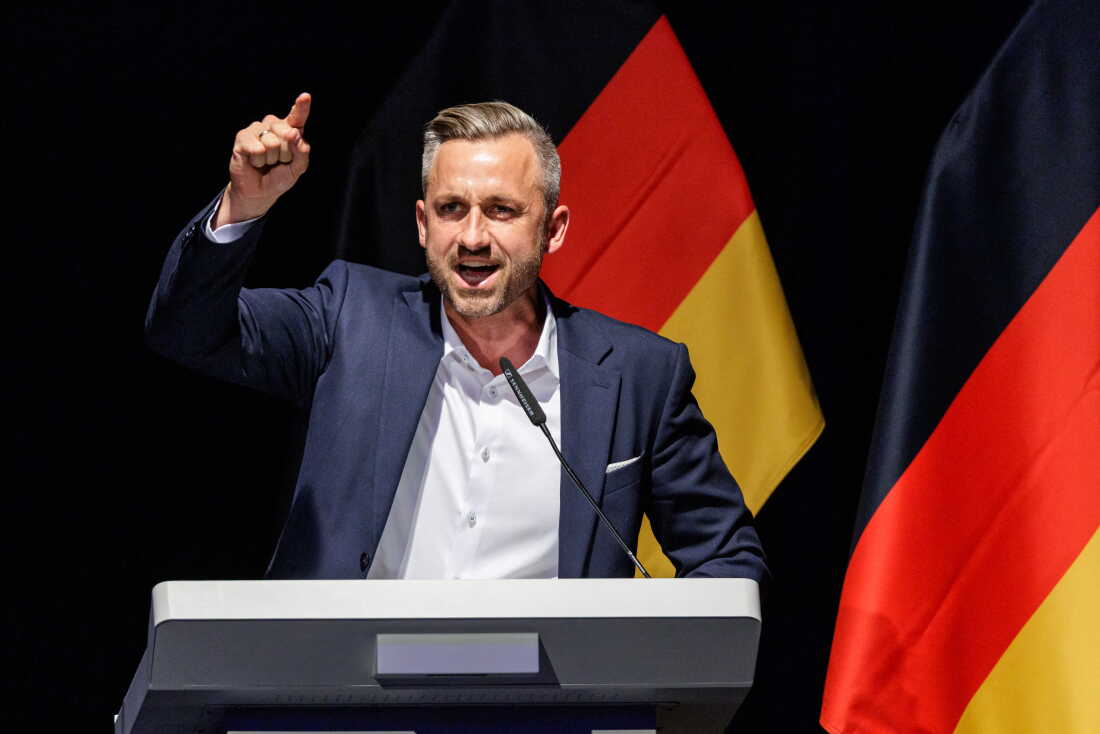
Ulrich Siegmund, candidate for the far-right Alternative for Germany (AfD), is making significant strides in Saxony-Anhalt. At the Generation Germany youth group’s federal congress in Magdeburg, Siegmund, who is a key player for AfD, delivers engaging speeches.
Siegmund doesn’t rely much on influencers or journalists during his campaign. He is a prominent figure on TikTok, engaging directly with followers and potential voters. As the state election approaches, AfD is leading in polls. This positions them as the potential first far-right party to lead a German state government since World War II.
Siegmund has gathered a substantial following on TikTok, almost half the number of voters in Saxony-Anhalt. He answers questions personally, often from his back porch. In each video, Siegmund maintains a polished appearance, with his attire and charming smile standing out among his party peers.
Siegmund’s stance on immigration is firm. He criticizes the flight of German doctors to other countries and the replacement by foreign doctors, emphasizing the AfD’s view that foreign health workers may not meet German standards.
Despite his public persona, Siegmund’s campaign speeches are concise, focusing more on pep talks rather than detailed policies. Hannes Kreschel, a former AfD supporter and law student, discusses the disparities between Siegmund’s campaign image and the AfD’s actual policies. Kreschel engages with voters at rallies, pointing out economic policies that favor the financially secure.
In Halle, where Kreschel resides, opinions differ. Alexander Winsek, an aviation engineer, considers voting for AfD for the first time, appreciating Siegmund’s ideas on controlling immigration. Although Winsek doesn’t fully align with AfD’s foreign policies, he finds Siegmund refreshingly optimistic compared to other AfD members.
At Martin Luther University Halle-Wittenberg, Marcel Lewandowsky researches democracy’s resilience. He notes AfD’s appeal among voters seeking ‘real’ democracy. This appeal contrasts with other parties seen as reluctant to share power with AfD’s claimed silent majority.
The AfD’s influence extends beyond eastern Germany, showcasing substantial support at the federal level. A victory in Saxony-Anhalt would be groundbreaking, especially for a party classified as right-wing extremist by domestic intelligence.
Kreschel, who posts videos of AfD events, highlights the party’s selective representation of ordinary Germans, often excluding voices of dissent.
Leave a Reply