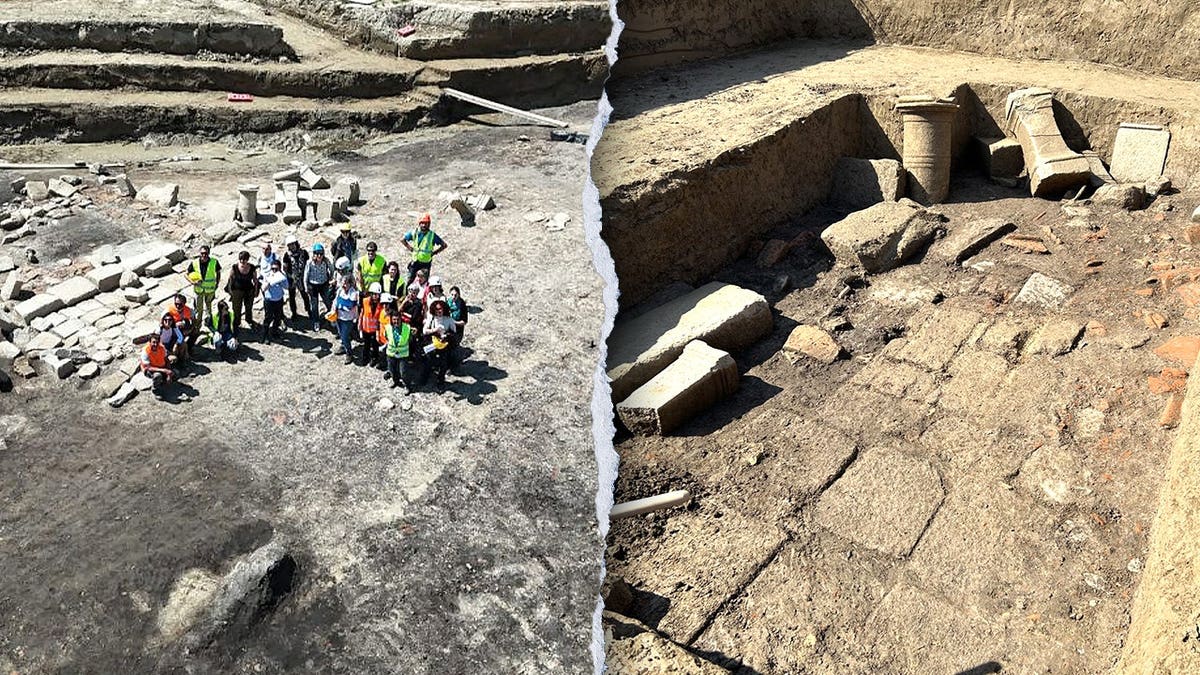
Construction crews working on a highway in Italy have uncovered the remains of an ancient sanctuary, leading to an archaeological investigation. The discovery was announced by the Italian Superintendency of Archaeology, Fine Arts and Landscape on May 19.
The site was found in Ponso, a town about 45 miles southwest of Venice. The construction work was being carried out by Veneto Strade S.p.A. on a new road from Borgo Veneto to Carceri when the remains were discovered. These date back to the fifth century B.C.
The workers were conducting ordnance clearance operations when they stumbled upon the first artifacts. Archaeologists in northern Italy are now investigating these remains, which include large rectangular foundation structures believed to be temples.
Archaeologists uncovered structures with inscriptions in Latin and Venetic scripts.
Some structures include a row of columns, indicative of temple designs. Though several inscriptions were found in Latin, many more were written in Venetic, a language used by the Veneti people before Roman rule.
Officials indicated that many stone inscriptions appear to have been reused in a paving structure, whose function is uncertain, while others remain in place. Evidence under study suggests that the pavement was built during the 1st century A.D.
Photos from the site reveal Venetic inscriptions, column fragments, and stone blocks that were likely part of a temple complex. Some inscriptions have a votive character, suggesting they were used for religious purposes.
Archaeologists believe the Adige River may have flooded the area in ancient times. The sanctuary may offer new insights into religious practices in northeastern Italy.
Officials suggest the site shows continuity of use and transformation over time, not abandonment.
Researchers are actively examining the site, adding this discovery to a series of significant archaeological finds across Italy. Last year, an Iron Age necropolis was found in Trento, dating back nearly 3,000 years. Earlier, an ancient Roman city was uncovered near the Appian Way, a UNESCO World Heritage site.
Leave a Reply