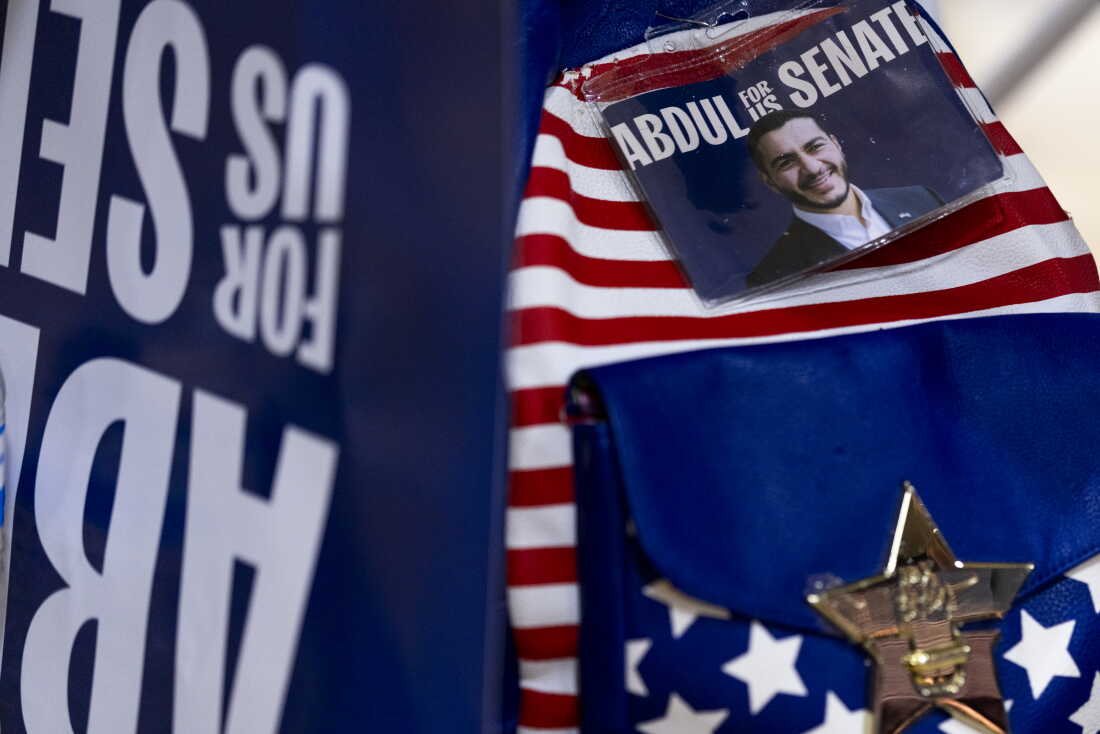
Democratic candidate Abdul El-Sayed received support during a town hall in Waterford, Michigan, after winning his primary. However, this victory led to a spike in anti-Muslim rhetoric, similar to the reaction after New York Mayor Zohran Mamdani’s win the previous year.
Sen. Tommy Tuberville from Alabama criticized El-Sayed, labeling him a ‘radical Islamist’ and implying he intends to harm America. Tuberville’s comments align with the growing trend of anti-Muslim and anti-Arab messaging within right-wing politics.
‘We’re far beyond the 2016 presidential campaign where the use of explicit racism in political rhetoric was shocking,’ said Nazita Lajevardi, a political science professor at the University of Michigan. ‘This rhetoric is now commonplace.’
Campaign ads across the nation have focused on terms like ‘Radical Islam’ and ‘Sharia law,’ suggesting an Islamic takeover. Muslims represent over 1% of the U.S. population. The Center for the Study of Organized Hate highlighted how anti-Muslim hate increased significantly following El-Sayed’s primary win.
Raqib Naik from CSOH stated that bigotry and hate online have reached unprecedented levels. An analysis by CSOH found 46 GOP officials made over 1,100 anti-Muslim posts between February 2025 and March 2026. Social media amplifies these fear-mongering messages, turning them into revenue and influence.
The narrative has shifted from labeling Muslims as a security threat to a ‘civilizational threat.’ Naik pointed to an August post by Rep. Nancy Mace, describing Muslim public officials as ‘trojan horses.’
These narratives tie into the ‘great replacement’ conspiracy, which suggests white populations are being replaced intentionally. This theory has connections to deadly attacks in various U.S. cities.
Rep. Andy Ogles’s comment about Muslims being unfit for American society was defended by Speaker Mike Johnson, reframing it as an issue with ‘political Islam.’
Comparing current rhetoric to post-9/11 attitudes, Maya Berry from the Arab American Institute noted a shift towards using anti-Muslim sentiment for political gain, highlighting a contrast with President George W. Bush’s condemnation of scapegoating Muslims post-9/11.
Lajevardi warns this rhetoric might backfire in diverse areas like Michigan. Despite potential backlash, anti-Muslim messaging remains a mobilizing tool for some Republican voters, targeting fear of change over economic issues like inflation.
Leave a Reply