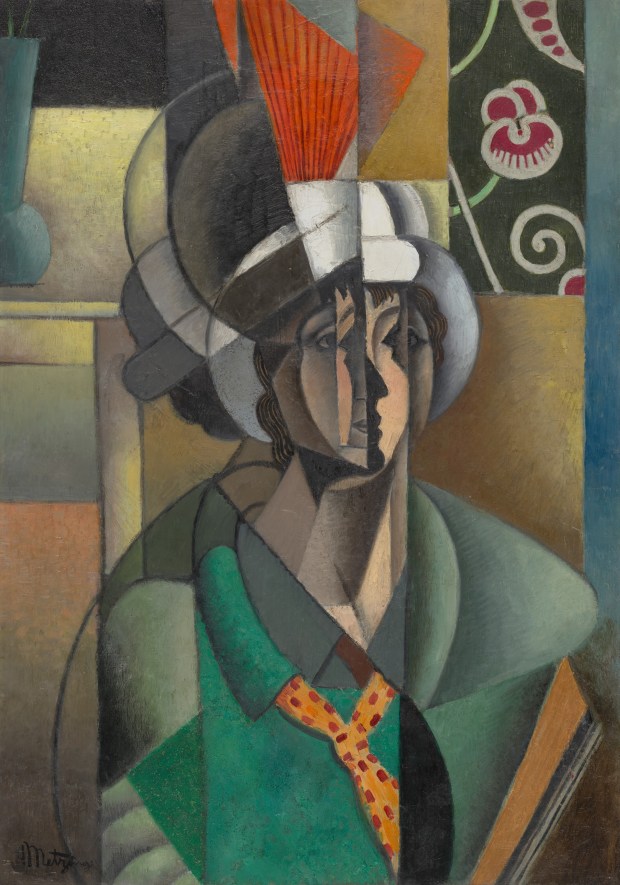
For three decades, Jewish art collectors’ descendants have sought to retrieve artworks stolen by Nazis during World War II. Recently, the Art Institute of Chicago decided to return a 1913 painting, “Woman with a Fan” by Jean Metzinger, to the original owner’s heirs.
Historical Context of the Painting
The Art Institute’s provenance research revealed the painting belonged to the Lewenstein family, a Jewish family from Amsterdam. In Nazi-occupied 1940 Amsterdam, the painting was sold under duress. Jacques Schuhmacher, the museum’s executive director of provenance research, confirmed the sale’s circumstances.
This research was a joint effort with Mondex Corp., a Canadian company focused on recovering stolen artworks. Mondex represented the heirs in this case. Their records indicate Emanuel Lewenstein, a collector supported by his family’s sewing machine business, initially owned the painting. His collection included works by Dutch contemporary artists and old masters like Rembrandt.
Provenance Challenges
Recovering the artwork’s ownership history, known as provenance research, can be arduous. Information is often dispersed globally, and prior transactions rarely left a thorough paper trail. Schuhmacher highlighted these research challenges, citing the museum’s collection of around 300,000 objects, many with provenance gaps.
The museum acquired “Woman with a Fan” in 1959. Metzinger, a pioneer of Cubism, painted the colorful piece depicting a woman using basic shapes in distinct planes. Despite its display history, the museum’s investigation revealed uncertain wartime gaps in its provenance.
Efforts to Fill Provenance Gaps
Efforts to solve these uncertainties gained momentum in the 1990s, following an international push led by the U.S. State Department. Museums began revisiting collections, leading the Art Institute to question the painting’s provenance.
The museum listed the painting online, seeking public assistance to resolve these gaps. Mondex responded with information about the Lewenstein family history, clarifying previous ambiguities. A critical clue was handwritten on the painting’s back, identifying Paul Citroen
. Citroen, Lewenstein’s cousin, influenced Emanuel’s collection and brought art pieces to the Netherlands post-1919, enabling Emanuel to purchase several.
Conclusion and Contrast with a Similar Case
Ultimately, these discoveries connected the painting to the Lewenstein family. The painting’s appearance in a 1940 forced sale catalog confirmed its unwarranted sale under Nazi rule.
In contrast, another disputed artwork, a 1916 drawing “Russian War Prisoner” by Egon Schiele, faced different circumstances. The Art Institute acquired it in 1966, but recent legal challenges questioned the drawing’s provenance. Unlike the Metzinger painting, no evidence suggests the drawing was looted or sold under duress. The Art Institute claims the artwork remained within the family until a post-war sale.
Schuhmacher noted the rarity of dedicated provenance research departments like at the Art Institute. Plans are underway to return “Woman with a Fan” to its rightful heirs.
Leave a Reply