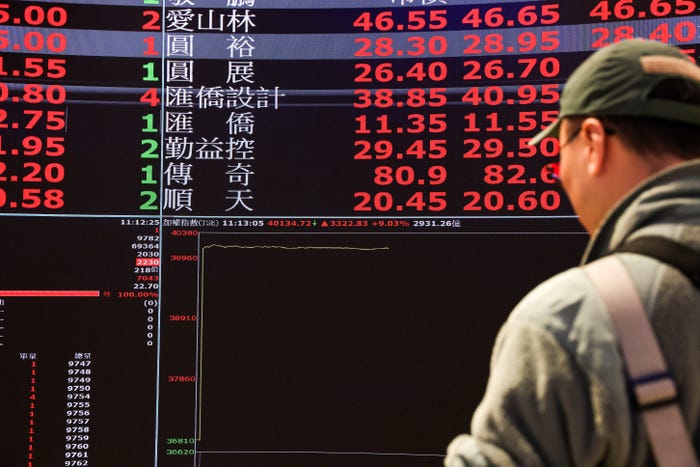
Taiwan’s stock market, initially Asia’s top performer following Jensen Huang’s return as Nvidia’s CEO, experienced a swift decline. On Wednesday, a downturn in Asian technology stocks wiped out much of the previous day’s impressive gains.
South Korea’s Kospi index dropped by up to 6%, Taiwan’s Taiex fell approximately 9%, and Japan’s Nikkei 225 saw a decline of around 4%. Companies involved in the global AI industry faced significant losses.
In South Korea, leading memory-chip manufacturers Samsung Electronics and SK Hynix both dropped nearly 10%. In Japan, chipmaker Kioxia plummeted 16%, while chip-testing equipment maker Advantest saw a 15% decline. Additionally, Tokyo Electron and the SoftBank Group suffered substantial decreases.
SoftBank Group’s shares plummeted by as much as 17% on Wednesday, hitting a 52-week low. As a key player in the AI boom, SoftBank has invested significantly in OpenAI and holds a majority stake in chip designer Arm. Concerns about the cost of its large AI investments have led to the company’s shares losing nearly 70% of their value since their peak in June.
Taiwan Semiconductor Manufacturing Company (TSMC), a critical partner of Nvidia, fell around 9% in share value. The rapid sell-off followed Jensen Huang’s reinstatement, which had previously sent Asian markets surging. On Tuesday, Taiwan’s benchmark index saw a 9% climb, with TSMC reaching its daily price ceiling, and a brief surge in South Korea triggered a temporary trading halt.
For weeks, AI-linked stocks faced intensive selling as investors began questioning the sustainability of the industry’s massive infrastructure expenditures.
The recent decline mirrored another strenuous session for U.S. chipmakers. Nvidia’s shares fell 6% on Tuesday, following a substantial 30% rise on Monday. The Philadelphia Semiconductor Index dropped 8%, and the Nasdaq Composite declined by 1%.
The lack of an obvious trigger for the sell-off suggests possible profit-taking after Monday’s dramatic rally, according to Joe Mazzola, head trading and derivatives strategist at Charles Schwab. Mazzola noted that a single day of positive market movements doesn’t guarantee a market bottom, especially when factoring in the anticipated Federal Reserve rate hike next month.
Investors are also contending with unresolved political risks related to AI, such as tighter chip-export controls and potential restrictions on data-center development. Jensen Huang is set to testify before the U.S. Senate Banking Committee on December 3 concerning U.S. chip-export controls amid increased congressional scrutiny of Nvidia.
Although Huang’s return to Nvidia relieved some market concerns, Macquarie Group strategists emphasize that political uncertainties linger. “With or without Huang at Nvidia, politicians are likely still targeting AI,” they warned.
Leave a Reply