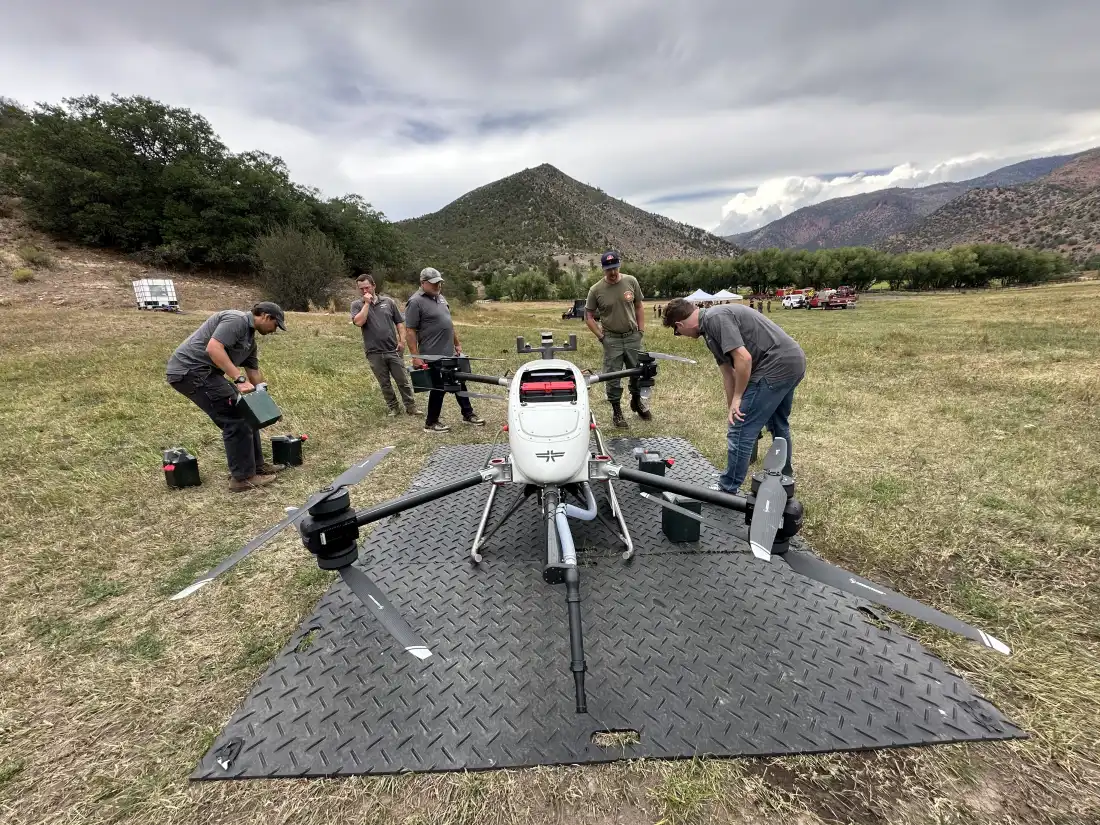
In Aspen, Colorado, fire crews are being trained to operate new, innovative drones. Manufactured by Seneca, these drones are equipped to carry and deploy fire-suppressing foam, potentially transforming firefighting methods in the region.
On a rare overcast day, red-and-white fire trucks were visible on a grassy area in the mountains of western Colorado. The sound of buzzing was constant as uniformed Aspen Fire Protection District staff focused on an iPad. A volunteer firefighter piloted a large drone, resembling a giant insect. This machine, black and white with four propeller arms, spans approximately 10 by 12 feet, comparable to a small U-Haul trailer. Although drones have long been used to monitor wildfires, this new model, employing AI, aims to actively fight fires.
Seneca’s drones, designed in California, operate in groups. Each unit can carry between 500 and 1,000 gallons of fire foam. Aspen firefighters noted the ease of operation. Andy Fisher, deputy chief of Aspen Fire, commented humorously that even a child could operate the drone.
Once Aspen Fire officially launches this drone program, they will lead by being the world’s first fire department to independently use these drones. Previously, in California, drones had been deployed under Seneca’s supervision for controlled burns.
The drones have shown capability in reaching difficult fire zones, such as remote areas hit by lightning, ahead of personnel. Aspen’s valuable real estate is encircled by forested land, akin to a tinderbox with limited escape routes. Fisher believes a prompt response, targeting smoldering fires before winds escalate them, is ideal.
Seneca’s founder, Stuart Landesberg, explained that the drones can navigate challenging terrains up to ten miles, doubling their range when unladen. Using AI and an advanced sensor suite, they gauge distance and wind conditions to accurately deploy water or retardant.
While not designed to replace air tankers, drones offer an economical alternative for carrying equipment, monitoring, and managing residual hotspots. Landesberg highlighted a significant reduction in aerial firefighting costs.
Aspen Fire plans to invest approximately $2.5 million over five years, with backing from private donors. Many fire departments nationwide are watching Aspen to see if this technology meets expectations.
Joe Stutler, an experienced firefighter, supports the integration of technology in firefighting. He anticipates that the drones will provide night-time assistance, where conventional aircraft is oftentimes grounded, thus enhancing safety.
Nevertheless, Stutler remains cautious. Although tested in controlled environments, the drones have yet to be proven against real wildfires. He values firsthand verification of their claims. Despite the advancement, ground crews remain essential, as large aerial water or retardant drops rarely extinguish fires outright.
The FAA granted Aspen Fire a waiver in October, allowing training completion and subsequent drone flights up to 200 feet in Pitkin County. They cannot use drones over populous areas, requiring constant visual supervision from vantage points. Aspen Fire aims to expand its capabilities, potentially aiding statewide firefighting efforts.
Leave a Reply