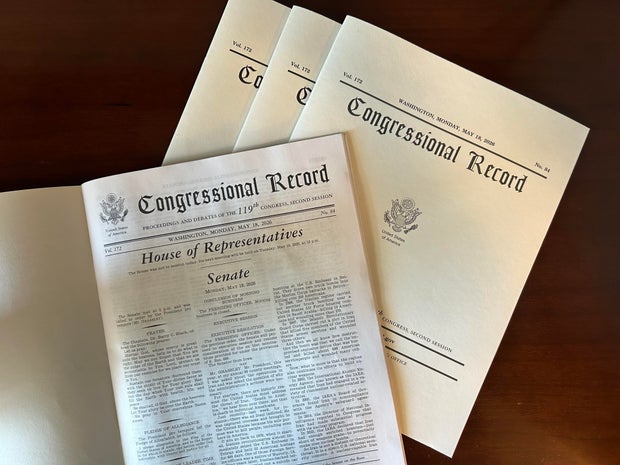
Each night that Congress is active, workers at a red-brick building near the Capitol produce the Congressional Record, laying down the first draft of history for Congress. This building, lit by industrial-strength lights and filled with minivan-sized printers, is the Government Publishing Office (GPO). Established in 1873, the Record remains the most thorough daily account of Congress’s proceedings, detailing both noteworthy events and mundane activities with precision and consistency.
The Evolution of Congressional Documentation
Before 1873, information on congressional activities was sparse, with newspaper reporters providing only fragmented accounts. Associate Senate historian Daniel Holt notes a significant demand for detailed congressional proceedings. The first Congressional Record emerged in response, offering a formal, unbiased account of legislative activities. Lyndon B. Johnson, then Senate Majority Leader in 1956, highlighted its importance as a document impacting laws and judicial precedents.
The Record is printed on formal stationery, its size reflecting Congress’s activity. On an active day, the pages can reach 233, while recess days may only yield 22. It provides a ‘substantially verbatim’ account across four sections, including a daily digest, committee meetings, and extensions of remarks where members insert unspoken speeches or tributes.
Compilation Process and Historical Changes
Controversy over unspoken words in the Record led to changes. When a posthumous speech by Rep. Hale Boggs appeared after his plane crash, it raised questions about accuracy. Subsequent rule changes required formatting that indicated added speeches, with further reforms limiting content edits to clarity only, not substance. Despite technological advances like cameras in the House and Senate, the Record maintains its role as a comprehensive account of congressional activities.
Creating the Congressional Record
The process begins with gavel-to-gavel logging of Congressional sessions, transcribed by floor reporters with stenotype machines. These short shorthand shifts are then expanded by editors into formal documents. Transcripts include vote records and committee reports, which are all collated at the North Capitol Street headquarters of the GPO. Conveyed digitally and on paper, manual paper copies hold the authority in cases of discrepancies.
Inside the Government Publishing Office
The GPO employs about 70 people to produce the final Record. Its storied building houses offices where content from Congress is meticulously accounted for and edited daily. In the proof room, workers engage in a rigorous process of comparing and marking up transcripts for printing accuracy, with the operation running continuously five or six days a week. Three different machines then print the Record: one produces covers, another prints the pages, and the third assembles the final product.
The Shift to Digital
From 50,000 daily copies in 1970, production has dropped to around 1,500 prints, mostly sent to libraries and institutions. Digital platforms like govinfo.gov are now central to GPO activities, reflecting modern document management. GPO Director Hugh Halpern mentioned efforts to modernize systems and prepare for potential changes Congress might seek in the future, acknowledging the ongoing need to adapt to current technological standards. While AI advancements are being monitored, human expertise remains invaluable to the editing process.
Looking Ahead
The GPO’s evolution, continually adapting since its inception in the 1860s, is an ongoing journey. Its commitment to providing an accurate account of Congressional proceedings while incorporating technological advances ensures it continues moving in the right direction, fully prepared to meet Congress’s future needs.
Leave a Reply