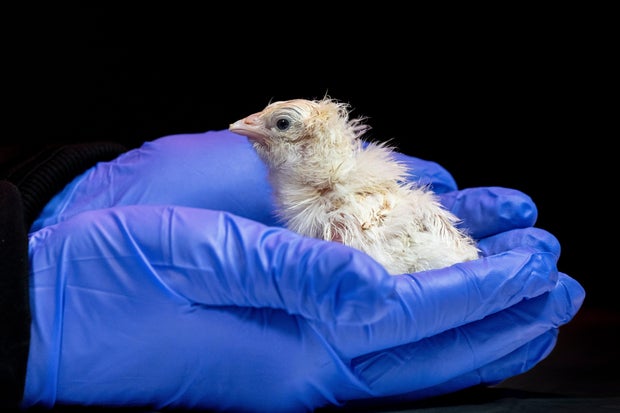
A biotechnology company, Colossal Biosciences, has announced a significant step in its effort to bring extinct creatures back to life. They have successfully hatched live chicks in an artificial environment, a news met with varied reactions from scientists and critics of their de-extinction mission.
The company revealed that 26 baby chickens, ranging from a few days to several months old, were born from a 3D-printed lattice structure that acts like an eggshell. Previously, Colossal engineered living animals to resemble extinct species, such as long-haired mice resembling the woolly mammoth and wolf pups patterned after dire wolves.
Ben Lamm, CEO of Colossal Biosciences, believes this artificial egg technology could one day be utilized to genetically adjust living birds to resemble New Zealand’s extinct 12-foot giant moa. Moa eggs are 80 times larger than a chicken’s, posing challenges for modern birds to lay naturally.
We wanted to build something that nature has done a pretty good job of developing and make it better and scalable and even more efficient, said Lamm.
Images and videos from the company show scientists carefully working with the chicks. Independent scientists express mixed feelings about the achievement. While they find the technology impressive, they argue it lacks key components required to be considered a complete artificial egg. They also doubt the feasibility of reviving fully extinct species.
Vincent Lynch, an evolutionary biologist at the University at Buffalo, commented, They might be able to use this technology to help them make a genetically modified bird, but that’s just a genetically modified bird. It’s not a moa.
The process involved pouring fertilized eggs into the artificial system, incubating them, and adding calcium needed for chick development. The designed structure allows adequate oxygenation, similar to a natural egg, but lacks temporary organs found in real eggs that nourish the chick and remove waste.
Historically, researchers have created transparent shells using primitive technology, allowing the study of chicken development. This new development sheds additional insights useful for understanding reproductive biology in other mammals, including humans.
Nicola Hemmings, a researcher in bird reproductive biology at the University of Sheffield, stated Producing a chick from an artificial vessel is not necessarily new
, though not involved with Colossal’s team.
Colossal plans further steps towards bringing back the moa but requires extensive DNA comparison and larger eggshell adaptations first. Lamm mentioned, We didn’t want to wait till we were ready to birth a giant moa. We actually wanted to start working on the engineering challenges for surrogacy and birth now.
Even achieving a similar bird doesn’t address issues concerning its survival in today’s altered landscapes, as bioethicist Arthur Caplan from New York University’s Grossman School of Medicine noted. Some scientists feel efforts should focus on endangered species preservation instead of reviving those lost.
Colossal emphasized the platform’s significance in aiding bird conservation, remarking that it offers potential for rescuing fragile embryos, assisting birds that struggle to breed in captivity, and possibly bringing back species from preserved cells and DNA.
My personal interests lie more in preserving what we’ve got than trying to bring back what is already gone
, stated Hemmings.
Colossal gained attention in 2021 with plans to resurrect creatures like the woolly mammoth and later the dodo bird. By 2024, they claimed progress in reviving the extinct Tasmanian tiger. In a previous interview, CBS News correspondent Jonathan Vigliotti remarked about the seemingly science-fiction nature of their projects. Yeah, I mean, it is
, Lamm replied, until it’s not.
Leave a Reply