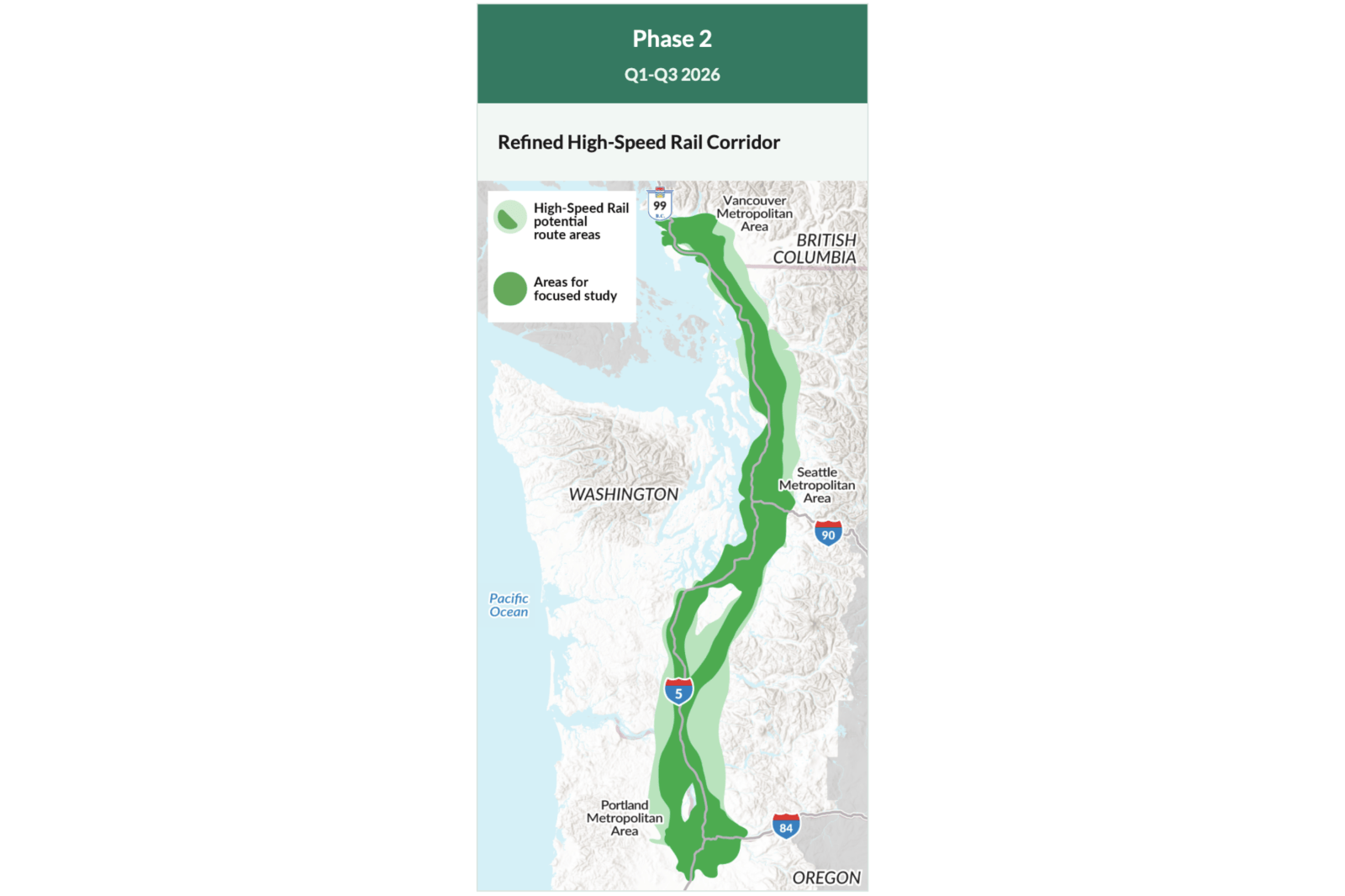
A long-term plan aims to establish a high-speed railway connecting three major metropolitan areas in the Pacific Northwest, spanning across the U.S. and Canada. The proposed Cascadia High-Speed Rail system is designed to link Portland, Oregon, Seattle, Washington, and Vancouver, British Columbia.
The Washington State Department of Transportation (WSDOT) has released a conceptual map indicating the railway’s path from the Portland metropolitan area through Washington to Vancouver. Although in its early stages, community feedback is actively sought via an online survey open until November 13.
Understanding the Cascadia High-Speed Rail Plan
The high-speed railway plans to enhance connectivity between the growing cities in the Pacific Northwest. The network’s goal is to create a high-speed link between Portland, Seattle, and Vancouver, B.C., crossing the U.S.-Canada border.
The project is a collaboration between WSDOT, the Oregon Department of Transportation, Oregon Metro, and British Columbia’s Ministry of Transportation and Transit. This proposal is part of the broader Cascadia High-Speed Rail and I-5 Program, which includes improvements to Interstate 5. Authorities are examining how roads, rail, airports, and transit can integrate into a regional system.
In December 2024, the Federal Railroad Administration allocated $49.7 million to WSDOT to draft a Service Development Plan, with an additional $5.5 million coming from the Washington State Legislature. This phase is projected to extend until 2028.
Potential Train Stops
While Portland, Seattle, and Vancouver are identified as central metropolitan areas in the plan, specific stations remain undecided. WSDOT’s Service Development Plan will explore possible routes and evaluate service options, including train stops and frequency of service. It will also consider governance and funding strategies. Finalizing preferred routes or station locations is not expected before 2028.
Consequently, any areas shown on the conceptual map as potential stops should not be considered confirmed locations.
Need for the Proposal
Primary motivations for the high-speed rail are the projected population and industry growth in the Pacific Northwest. According to WSDOT, the Cascadia megaregion is expected to gain 3.4 million people by 2050, with growth occurring in sectors such as technology, aerospace, health care, and logistics.
Current transportation links are predicted to encounter increased demand. WSDOT estimates that by 2050, 80% of I-5 in Washington will face medium to high congestion as opposed to 59% today. Similarly, in Portland, the interstate congestion is projected to intensify, affecting 78% by 2045 compared to 33% in 2019.
No single mode of transportation is projected to meet future needs on its own. This underscores the necessity for highways, rail, public transit, and aviation to function cohesively in the region’s transportation network.
Learning from California’s High-Speed Rail Challenges
Despite the project’s promising outlook, the complexity and cost of implementing U.S. high-speed rail proposals are exemplified by California’s experience. Construction of California’s high-speed rail through the Central Valley has been ongoing for years, with initial operations planned between Merced and Bakersfield by 2033.
California’s efforts have included managing substantial costs, with expenditures reaching $8.10 billion on Central Valley construction packages by mid-2026. Their strategy has involved streamlining designs and infrastructure to control costs while progressing towards operational segments.
Cascadia’s high-speed rail construction is still in the distant future. The current focus for WSDOT involves determining the project’s economic and technical feasibility and gathering public input on the region’s future transportation needs.
Leave a Reply