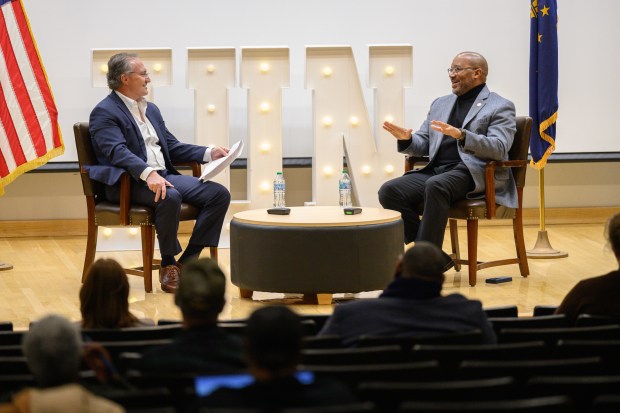
Chancellor Arrick Jackson of Indiana University Northwest credits his tenure in the U.S. Army with shaping his path in higher education. Reflecting on his military service, Jackson noted how military discipline and strategy equipped him to manage multiple challenges simultaneously. This persistence and innovative thinking have been integral to his current role.
Jackson served for six years in the U.S. Army, being interviewed as part of a Veterans Week event by Patrick Russell, founder of the Making History Project. This nonprofit organization records veterans’ stories through video oral history interviews, preserving them at the U.S. Library of Congress. Russell has conducted over 100 interviews since the project’s 2015 inception.
During the interview, Jackson recounted his childhood in Saginaw, Michigan, and his enlistment in the Army in 1987. He served as an airborne officer in field artillery and a noncommissioned officer in military intelligence, achieving the rank of sergeant. His early life was marked by tragedy, with both parents dying before he turned nine, prompting a determination to succeed independently.
Jackson’s initial career interest was in criminal justice, but after graduating high school at 16, he decided to pursue military service, inspired by family members who had served. He shared with humor the moment he enlisted, recalling his mother’s unusual reaction when he announced his decision. Her response led to his eventual journey into higher education.
Military training involved early challenges, including jumping from aircraft. Jackson described this experience as uniquely tranquil but later asked to leave the dangerous unit, a request met with the assertion that quitting was not an option for airborne soldiers.
In his second military enlistment, Jackson joined military intelligence, with assignments in Germany and Korea. While in Korea, he volunteered at an orphanage and spent significant time studying, sparking his interest in returning to academia to pursue a doctorate and a teaching career.
Russell’s interview extended to Jackson’s views on education’s impact on democracy. Jackson underscored the importance of education for sustaining democracy, citing his mother’s lessons on civic responsibility and societal engagement.
Russell concluded by thanking Jackson, acknowledging Jackson’s contribution to the fields of education and public service, and noting the successful realization of his aspirations for personal and professional significance.
Leave a Reply