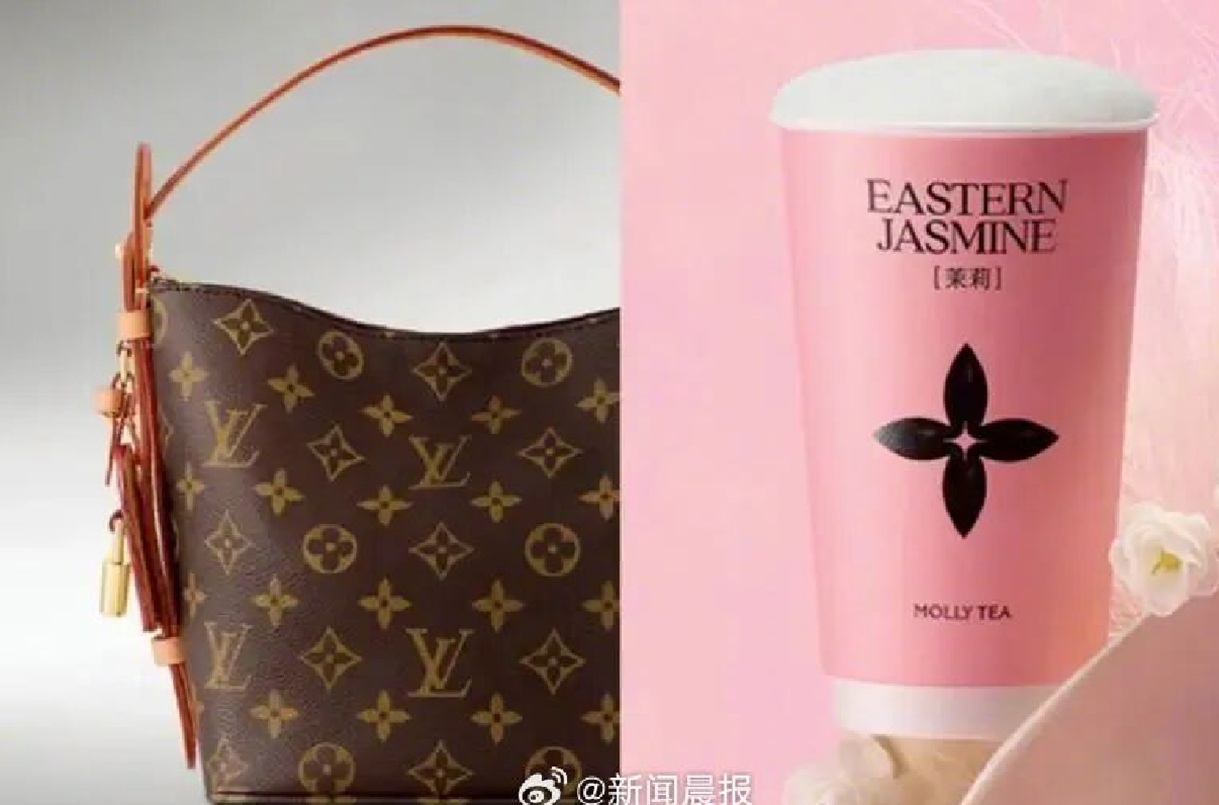
A recent court decision in China favoring Louis Vuitton in a trademark dispute has stirred a strong reaction among Chinese internet users. The ruling is criticized for letting the French luxury brand claim rights over designs rooted in traditional Chinese culture.
Legal Dispute: Luxury Brand vs. Local Business
On June 29, the Intermediate People’s Court in Jiangsu province determined that Molly Tea, a local tea chain, infringed on seven of Louis Vuitton’s registered trademarks. This includes their renowned Monogram Canvas with stylized floral patterns. The court concluded that Molly Tea’s four-leaf floral design closely resembled Louis Vuitton’s monogram motifs. Consequently, the court ordered Molly Tea to pay 10 million renminbi (approximately $1.4 million) in damages and an additional 300,000 RMB for legal costs. This ruling, reported by the Nanfang Metropolis Daily, has not yet taken effect, and Molly Tea’s intention to appeal is still unknown.
Molly Tea, based in Shenzhen, has gained popularity among younger people by blending traditional tea flavors with modern minimalistic branding, appealing to social media users.
Online Reaction: Defending Cultural Heritage
On the social media platform Weibo, the hashtag “LV cannot sue for trademark infringement over its use of Chinese patterns” has been seen more than 33 million times. Users have shared images comparing Louis Vuitton’s floral designs to ancient Chinese motifs that predate the brand by over a millennium.
“Under no circumstances should international brands such as LV be allowed to steal Chinese culture and then turn around and accuse others,” expressed one Weibo user.
“While waving the banner of intellectual-property protection, they are acting with impunity and harvesting profits from Chinese companies,” commented another user.
Some critics also blamed the court’s handling of cultural origins in its decision. One commenter questioned if the judges lacked a sense of national sovereignty.
Trademark Law vs. Cultural Imagery
The criticism focuses on trademark law interpretation rather than Louis Vuitton’s legal ownership of trademarks. Designs used historically are typically regarded as common, lacking eligibility for trademark protection. However, with sufficient promotion, companies can secure exclusive rights if the public associates a design with a specific brand.
This case echoes a prior ruling where a Nanjing restaurant had to pay damages and legal fees for its vintage decor allegedly infringing Louis Vuitton trademarks.
Lingering Controversy and Mockery
The controversy also rekindled online mockery, with some netizens jestingly labeling Louis Vuitton bags as “toilet bags” due to their resemblance to traditional motifs seen on various decorative items, including those historically found in public restrooms.
For further discussions, contact Newsweek editors John Feng and Sam Wilson.
Leave a Reply