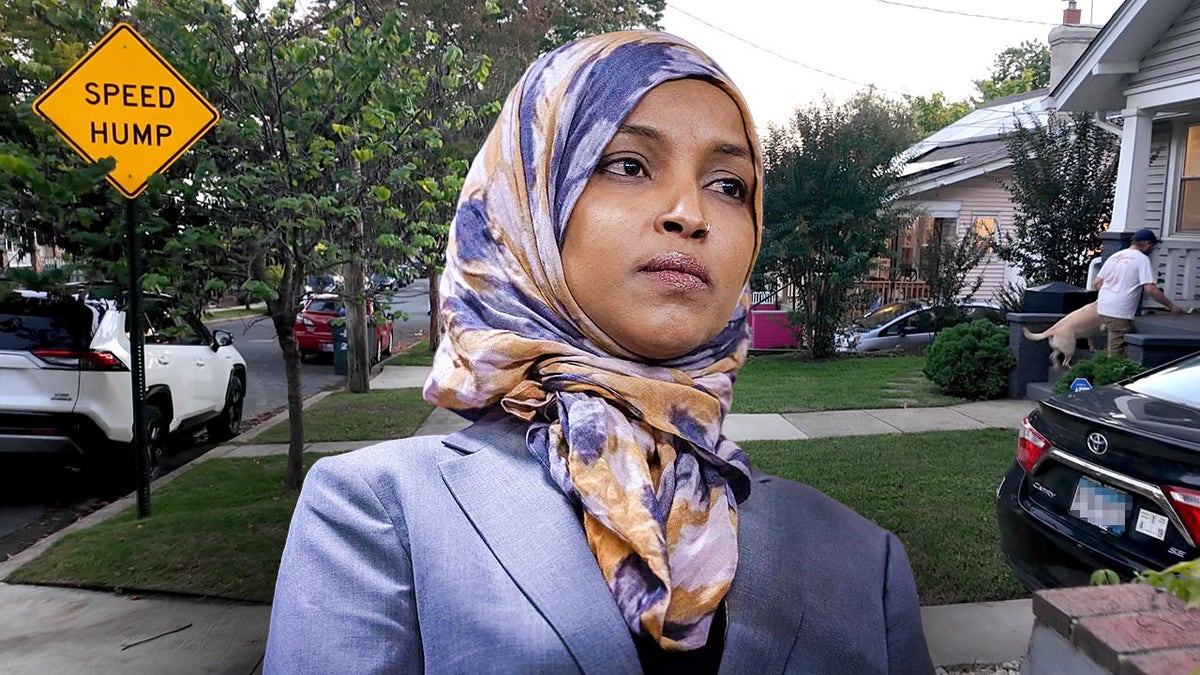
Republicans are anticipating a change in the political landscape, urging voters to reject Democrats in upcoming elections. However, President Trump focuses intensely on Rep. Ilhan Omar (D-Minn.), who is expected to secure re-election in her consistently Democratic district. Despite winning with nearly 75% of the vote last term, Trump questions Omar’s legal status in the United States and her eligibility to serve in Congress.
Trump alleges Omar used a false identity during her congressional swearing-in. The Department of Justice is currently investigating her for potential immigration fraud. Recent raids at her Washington, DC residence resulted in the confiscation of 17 items, including phone and camera equipment, along with a Somali phrase book for her children.
The President claims that Omar’s real name is different from what she publicly uses, citing federal documents naming her as “Ilhan Nur Said Elmi, a/k/a Ilhan Abdullahi Omar.” This leads Trump to call for her resignation from Congress.
When questioned by a Fox Digital reporter about her identity, Omar affirmed her name as “Ilhan Abdullahi Omar.” Despite the discrepancies, official House records consistently list her as “Ilhan Omar” since 2018, prior to her entry into Congress.
President Trump urges Congress to expel Omar. However, according to the Constitution, only Congress can determine its membership. Rep. Morgan Griffith (R-Va.) acknowledges this, suggesting such actions should only occur under exceptional circumstances.
In practice, expelling a Member requires a two-thirds House vote, a challenging feat, especially without a criminal conviction. The Constitution’s Speech or Debate Clause also shields legislative documents from federal seizure, complicating any executive branch’s removal attempt. Historically, the House has expelled only six Members, the most recent being George Santos (R-N.Y.) in 2023.
In unique situations, such as the case of Rep. Adam Clayton Powell (D-NY) in 1968, the House delayed seating Members under investigation, as seen again in 1985 with Rep. Frank McCloskey. Powell v. McCormack underscores that as long as basic qualifications are met, exclusion is difficult.
The House may opt to seat a questioned Member first and consider expulsion later, though circumstances warranting this are uncommon. Trump’s focus on Omar’s name raises questions, but substantial congressional action seems improbable. Chad Pergram, serving as Chief Congressional Correspondent, offers insight into these congressional dynamics.
Leave a Reply