Introduction
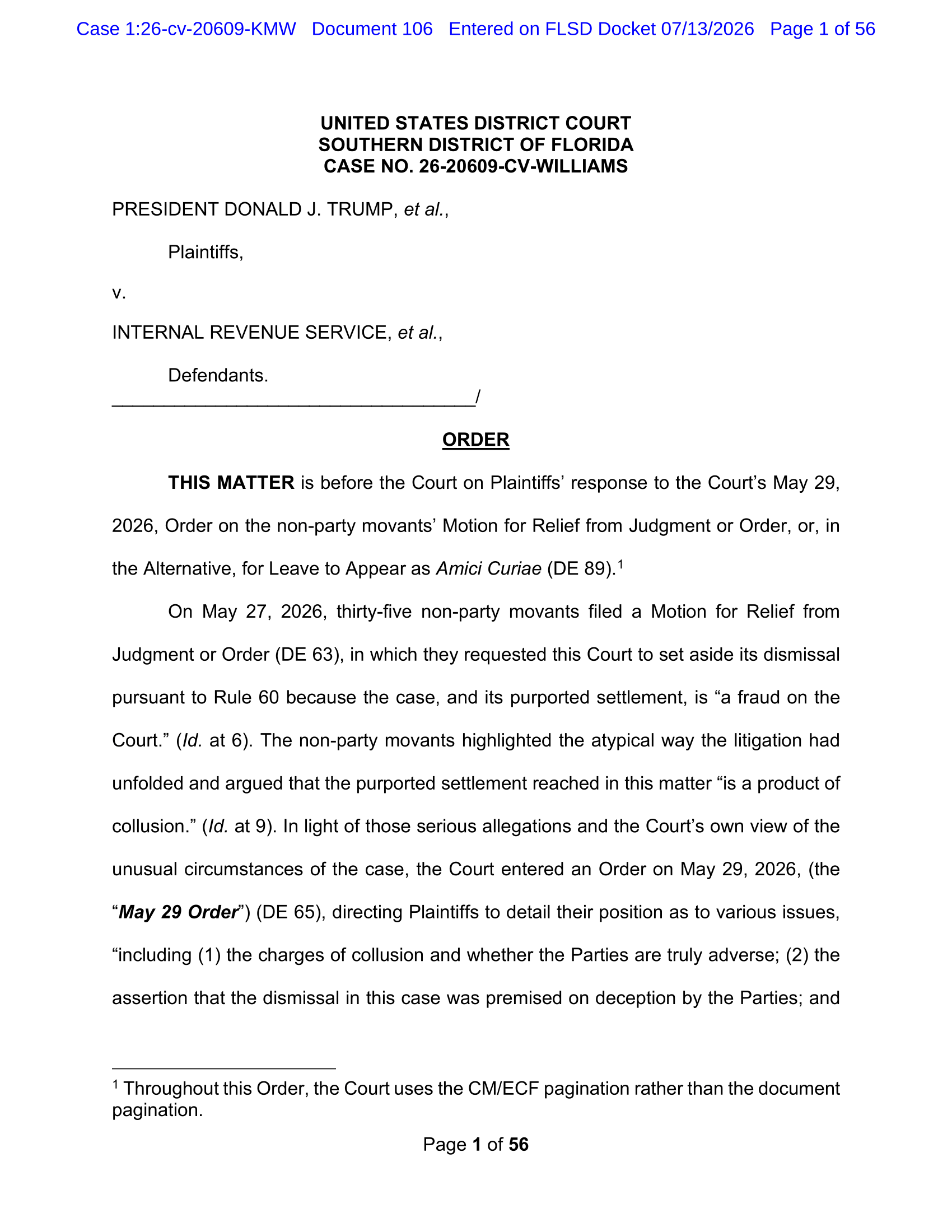
The United States District Court for the Southern District of Florida recently addressed complex jurisdictional issues in a case involving President Donald J. Trump. This case examined whether a lawsuit against the Internal Revenue Service (IRS) and the Department of the Treasury, both part of the executive branch led by President Trump, constituted a legitimate legal dispute.
Background
On January 29, 2026, President Trump, alongside family members and business entities, filed a lawsuit against the IRS and Treasury Department. They sought damages for alleged unauthorized disclosures of tax returns, seeking over $10 billion. The case developed under unusual circumstances, with many external legal experts questioning the adversarial nature of the parties involved.
The court previously appointed amici curiae to assist in examining jurisdictional questions, given concerns about the lack of adverseness between parties controlled by President Trump.
Control Over Defendants
President Trump, as head of the executive branch, has significant influence over both Defendants—the IRS and the Treasury Department. The court scrutinized Defendants’ silence and lack of active defense in the case, aligning with President Trump’s authority due to his executive power and existing governmental structures.
The Settlement Agreement
The ‘settlement agreement’ reached by the parties stipulated a substantial monetary settlement and cessation of future audits related to President Trump. This agreement raised serious questions of legality and procedure, with the court noting a striking lack of public judicial review or adversarial advocacy.
The Acting Attorney General’s unilateral decisions to void certain aspects of the agreement, without Plaintiff or Defendant consultation, demonstrated a lack of genuine legal opposition. Such actions suggest the absence of an adversarial scenario—the cornerstone of judicial jurisdiction under Article III of the U.S. Constitution.
Judicial Findings
The court concluded that the case lacked a true controversy as defined by the Constitution. With Plaintiffs controlling Defendants due to President Trump’s role as Chief Executive, the Court identified the lawsuit as an improper attempt to manipulate the judicial system. The absence of jurisdictional challenges by Defendants further emphasized the absence of true adverseness.
Consequences and Sanctions
Sanctions were imposed on the Plaintiff’s legal representative under Rule 11 of the Federal Rules of Civil Procedure, as the litigation was pursued for improper purposes. The claim was deemed an abuse of the judicial process, conceived to create legitimacy for an agreement without legal basis.
Furthermore, the court exercised its inherent authority to address the misuse of judicial proceedings. Non-monetary sanctions included the prohibition of referring to the settlement agreement as evidence in any legal setting. Recommendations to relevant bar associations were also part of the corrective measures.
Conclusion
Ultimately, the District Court’s findings highlight critical jurisdictional boundaries and the need for legal adverseness in federal lawsuits. It reinforces the judiciary’s role in maintaining an impartial and legitimate legal system, free from manipulation by entities within its purview.
Leave a Reply