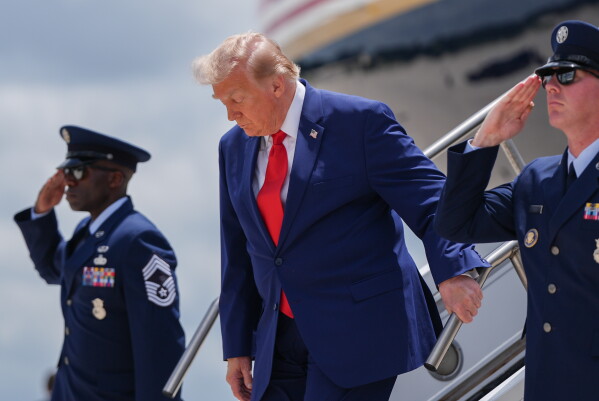
President Donald Trump highlighted the “Abraham Accords” during his Middle East visit on Monday. The Accords are agreements made in 2020, increasing the number of Arab states with diplomatic ties to Israel. The name Abraham carries religious and cultural weight, referencing a biblical patriarch honored in Christianity, Islam, and Judaism. Abraham, or Ibrahim in Islam, is seen as a common figure among these faiths. However, differing claims to his legacy can lead to division.
Bruce Feiler, author of “Abraham: A Journey to the Heart of Three Faiths,” remarked that everyone tries to claim Abraham. He noted this has been the case for millennia, with groups asserting their perspectives. Feiler emphasized the importance of shared stories and legacies.
The Abraham Accords Framework
The Abraham Accords represent diplomatic agreements initiated by the U.S. between Israel and several Arab nations, including the United Arab Emirates, Bahrain, Sudan, and Morocco, during Trump’s tenure. A comprehensive agreement on Gaza could potentially open doors for dialogues with other primarily Muslim countries.
From Scripture to Current Times
In the Book of Genesis in the Hebrew Bible, Abraham is introduced as an elderly, childless man promised by God to father a great nation. His journey leads him to present-day Israel and Palestinian regions. Abraham first has Ishmael with Hagar, then Isaac with his wife Sarah. After their separation, Ishmael and Isaac reunite to bury their father. The story of Abraham’s willingness to sacrifice Isaac is retold every Rosh Hashana. Christians view Abraham as a symbol of faith. While Jewish and Islamic traditions depict Abraham smashing his father’s idols to worship a sole God, Muslims emphasize Ismail (Ishmael) in the binding story, seeing him as a prophet and Muhammad’s ancestor.
The Dome of the Rock in Jerusalem is believed by Muslims to be where Abraham offered Ismail. This location underscores Abraham’s dual role as both a unifying and dividing figure among the monotheistic faiths.
Abraham’s Legacy in Diplomacy
Despite differences, the shared reverence for Abraham by Christianity, Judaism, and Islam facilitated the Abraham Accords, brokered by the predominantly Christian U.S. between Jewish and primarily Muslim countries. After the 9/11 attacks, President George W. Bush recognized Islam’s roots in Abraham, promoting peace.
The “Abrahamic faiths” term is used to foster dialogue among these religions. The United Arab Emirates boasts an Abrahamic Family House, which houses a church, mosque, and synagogue. In the U.S., many engaged in interfaith dialogues find “Abrahamic” more inclusive than the “Judeo-Christian” descriptor of the previous century. While “Abrahamic” doesn’t cover all belief systems, it extends an invitation for broader inclusion.
Such dialogues occur amid rising antisemitism and anti-Muslim sentiments. Amidst these tensions, Trump’s speech at the Israeli Knesset highlighted the Jewish association with Abraham, using “Avraham Accords” in Hebrew. He also lauded Arab and Muslim leaders from participating nations, countering his previous stance during his initial 2015 campaign, where he called for a halt to Muslim entry into the U.S.
Feiler notes that understanding Trump’s approach to the long-standing narrative of Abraham provides insight into his diplomatic strategies. The story of Abraham, his sons, and their mothers encompasses themes of tension and relationship dynamics that remain relevant today.
The Associated Press religion coverage benefits from support through collaboration with The Conversation US, funded by Lilly Endowment Inc. AP maintains independent content responsibility.
Leave a Reply