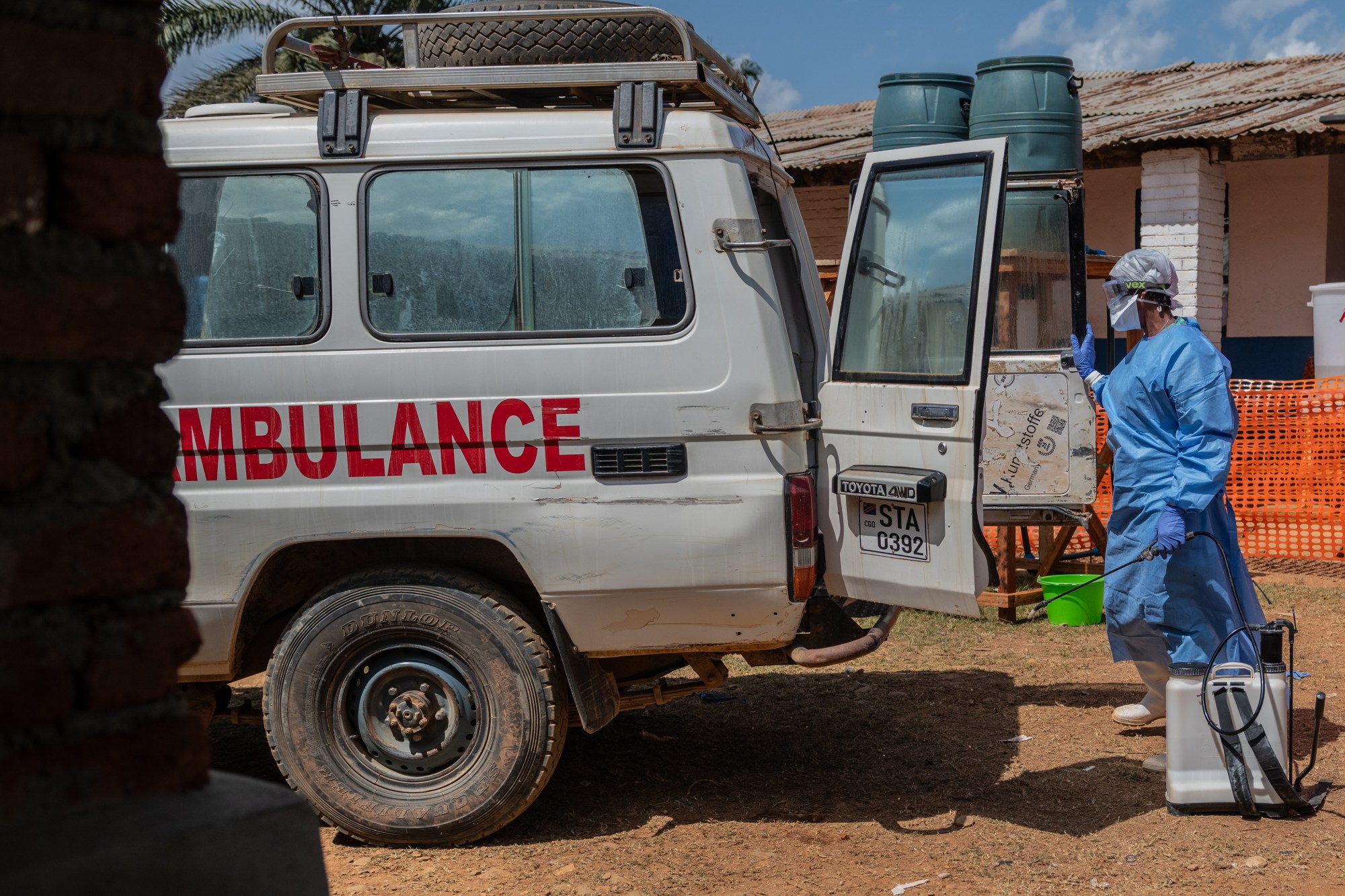
A health worker disinfects an ambulance outside the Mongbwalu treatment center in Congo. This facility recently transported a suspected Ebola patient. The outbreak of Ebola caused by the Bundibugyo virus in the Democratic Republic of the Congo and Uganda has led to 617 confirmed cases and 117 deaths. The U.S. administration is considering establishing a quarantine and treatment facility at a U.S. military base in Kenya for Americans who might have been exposed to Ebola. This proposal faces criticism and legal challenges.
Healthcare experts with Ebola experience express significant concerns regarding this policy, highlighting clinical, ethical, operational, and legal challenges. Outbreaks of Ebola are not unprecedented. The current situation mirrors the West African outbreak from 2014 to 2016, which reported over 28,000 cases and more than 11,000 fatalities, reflecting a 39% fatality rate. Unfortunately, lessons from previous outbreaks are often ignored, leading to ineffective plans lacking essential measures to control the virus’s spread.
In 2014, the U.S. implemented airport screening to prevent the virus’s entry into the country. Prior to this, there were four confirmed cases in the U.S., resulting in one death. The federal government also set up several top-tier medical facilities specifically for treating and managing infected patients and containing the virus. These facilities are still operational and can provide quality care to those infected. More importantly, the U.S. previously led a global effort establishing a strong humanitarian aid infrastructure.
Today, the situation differs. The U.S. public health infrastructure has eroded over the past year and a half. The U.S. Agency for International Development is no longer active in the Congo, and the Centers for Disease Control and Prevention faces budget cuts and oversight limiting its expertise. An outbreak in one area can quickly escalate globally. The optimal strategy to prevent Ebola spread is containment, stopping the virus at its origin.
The CDC has deployed personnel to the Democratic Republic of the Congo, but the response lacks the robustness seen a decade ago. The issue worsens with the U.S. withdrawal from the World Health Organization. Prolonged outbreaks increase the chance of spreading beyond central Africa. Air travel facilitates the virus’s movement from Africa to other continents, including Europe, Asia, the Middle East, and the Americas. Additionally, global events like the FIFA World Cup in North America compound the risk.
Those exposed to Ebola, especially U.S. residents, seek the highest possible care and are inclined to travel to the U.S., where advanced treatment facilities are accessible. Since Ebola symptoms may take up to 21 days to manifest, and fever can temporarily be suppressed with medications like acetaminophen, barring at-risk U.S. citizens from entry is misguided. Prolonged outbreaks in the Congo complicate efforts to control transmission beyond the region. Though the transmission risk remains low at present, requiring contact with bodily fluids, it’s not absent.
The State Department aims to safeguard Americans. As vaccines or treatments for the Bundibugyo virus do not exist, the most effective strategy is to contain the virus at its source. Airport screening and barriers only offer limited benefits and fail to address the root cause, akin to erecting barriers to prevent a fire rather than extinguishing it. Aviation security insights apply to addressing the Ebola threat. Risk-based strategies, like TSA PreCheck, allocate resources based on specific risk profiles rather than a uniform approach.
Similarly, risk-based strategies emphasize source containment to safeguard not only Americans but the global population. Effective risk mitigation, whether from human actions or natural occurrences, requires understanding and addressing the source of risks, employing appropriate resources to minimize impact. For the Ebola outbreak in Congo, containment should be a top priority.
This perspective is shared by Sheldon H. Jacobson, Ph.D., a professor of Computer Science at the University of Illinois Urbana-Champaign, and Janet A. Jokela, MD, MPH, FIDSA, MACP, an infectious disease and public health physician at Carle Illinois College of Medicine. Their expertise highlights the importance of targeted and informed strategies in tackling public health threats.
Leave a Reply