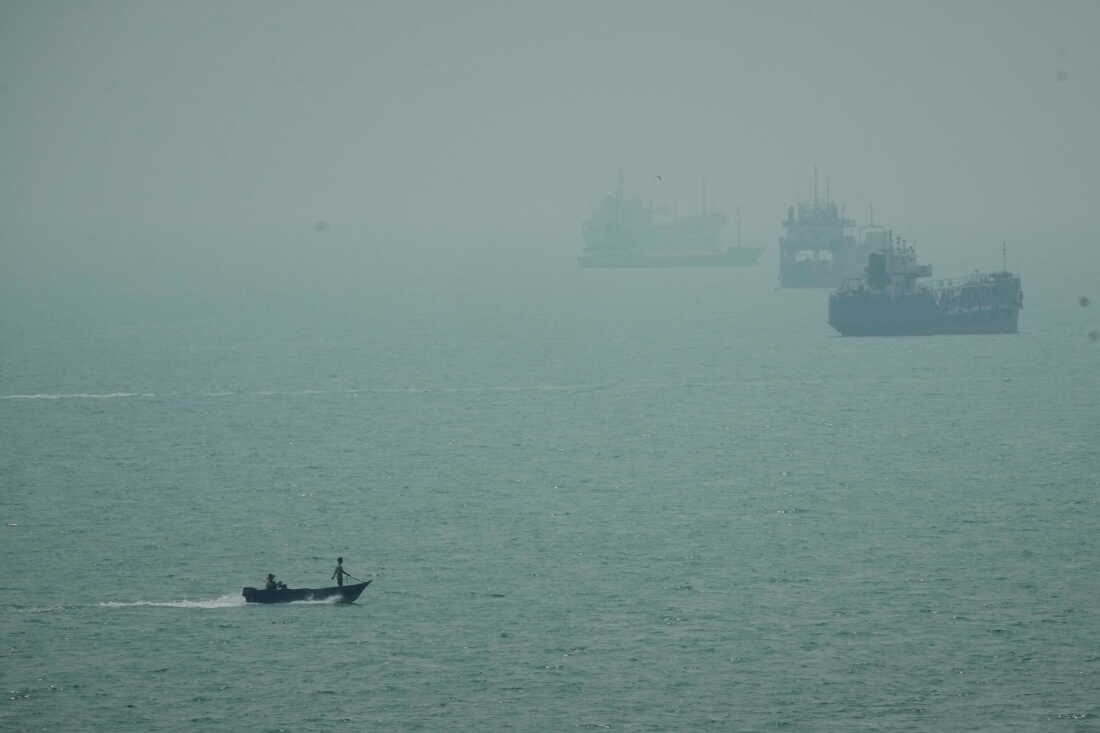
A motorboat navigated past commercial vessels in the Strait of Hormuz, near Bandar Abbas, Iran, on a hazy Monday, September 7, 2026. On Tuesday, the U.S. military announced it destroyed five Iranian oil tankers after recent attacks on its warships. Iran retaliated by targeting American positions in Jordan, marking another round of hostilities in an ongoing war lasting over six months.
Iranian state media reported missile launches against U.S. targets in Jordan. Jordan’s military intercepted 18 ballistic missiles and confirmed no casualties with two missiles landing in uninhabited areas. Jordan, a key U.S. ally, hosts American forces, rendering its military bases frequent targets of Iranian aggression. U.S. Central Command refrained from offering additional information.
The recent strikes signify President Donald Trump’s simultaneous economic and military efforts to conclude the conflict. The Trump administration imposed sanctions on Iran’s aviation sector, affecting several airlines and cargo service providers, aiming to further isolate Tehran economically. Both nations seek control over the Strait of Hormuz, a critical passage for global oil shipments, now affected by the conflict. Energy prices are rising, complicating Trump’s political landscape ahead of the November midterm elections, with Brent crude temporarily reaching $99.46 per barrel.
On Saturday, U.S. forces destroyed three additional Iranian tankers after Iran’s Revolutionary Guards targeted U.S. naval ships with missiles, prompting threats of dismantling Iran’s exposed oil fleet. Iran then announced plans for a new “exclusion zone” near the Strait of Hormuz, targeting passing vessels. Secretary of State Marco Rubio asserted that U.S. forces would respond to Iranian attacks decisively. “For every attempt Iran makes on U.S. naval ships, they will lose tankers,” Rubio stated while in Colombia.
“There is no kinetic solution to the Strait of Hormuz problem,” noted Danny Citrinowicz from Israel’s Institute for National Security Studies on social media, warning of further global economic consequences from continued hostilities.
U.S. Central Command confirmed that strikes on Tuesday followed Iranian missile attempts on a Navy warship. “The U.S. warship evaded Iranian attacks and continued its patrols,” the statement said, adding that no harm came to American personnel. The destroyed Iranian tankers included the Kivik, Charminar, Horizon 1, and the Riesco in the Gulf of Oman, along with the Derya near Kharg Island. Crews were instructed to abandon their ships prior to the attacks.
Iranian state television also covered the U.S. strikes, noting attacks on tankers near Jask and Kharg Island in the Persian Gulf, confirming crew evacuations. A state TV reporter in Jask mentioned a direct strike on an Iranian tanker by Yekbeni’s coast. Additional tanker attacks near Jask waters and Kharg Island were later reported.
Iran’s Revolutionary Guard Navy issued warnings to tanker crews near Kuwait and Bahrain’s ports to vacate their vessels, citing possible retaliatory strikes for U.S. assaults on Iranian tankers. It blamed Kuwait and Bahrain for hosting U.S. forces and aiding these attacks.
A U.S. blockade on Iranian ports has further pressured Iran’s economy by restricting oil exports. Meanwhile, America aids limited vessel transits through the Strait of Hormuz to ensure safe passage. Tehran prefers an alternate route of its choosing for vessels in what was once an international waterway.
Leave a Reply