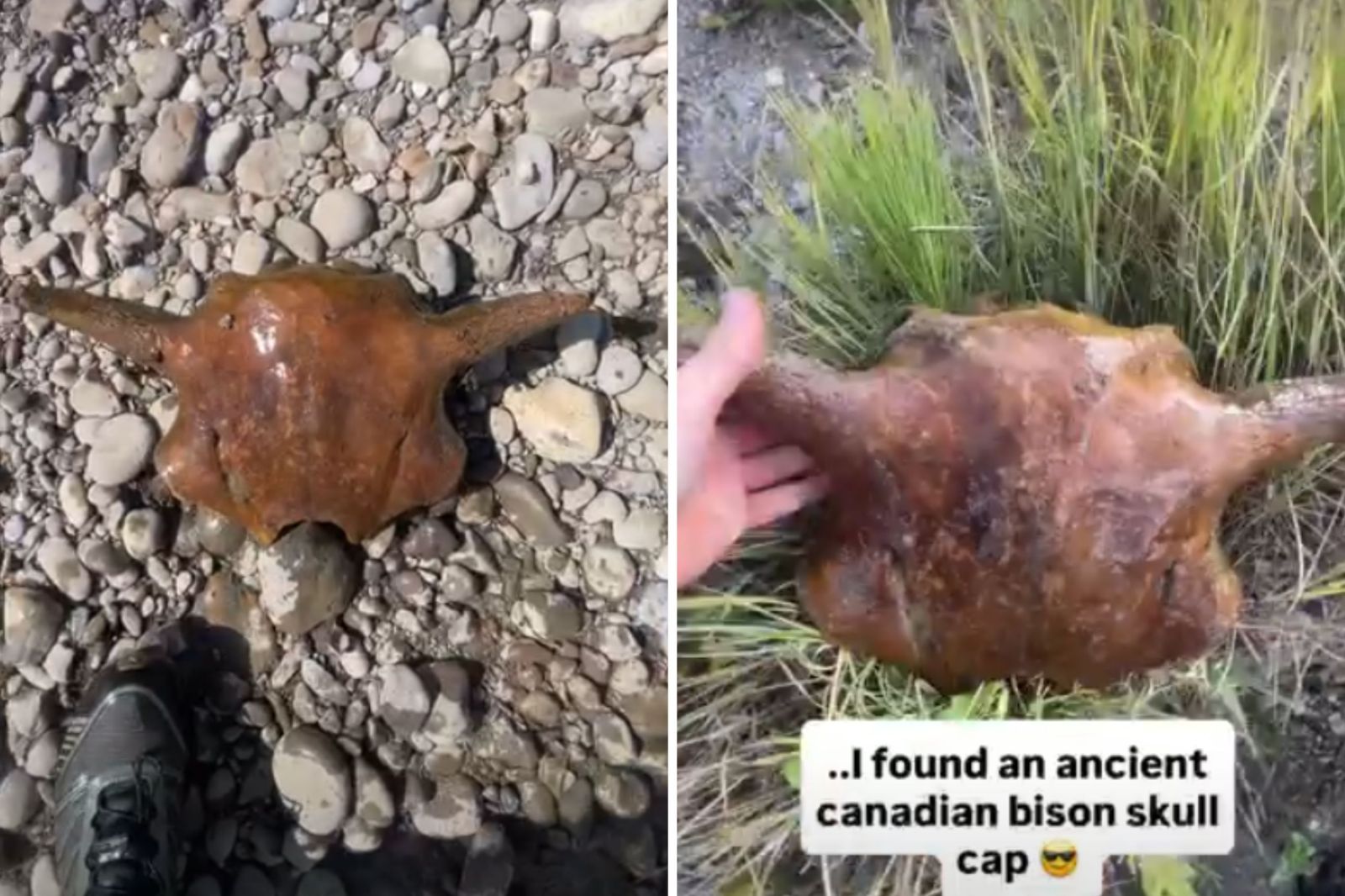
A fisherman in Alberta, Canada, encountered an unexpected object protruding from a creek. Dominic Boon, a resident near Banff, frequently searches for intriguing items while exploring the outdoors and fishing, a habit since childhood. However, this particular find was extraordinary.
Boon captured the moment with his phone and shared the footage on his Instagram, @dominicboon_. Accompanied by two friends, they initially guessed it was a cow skull, but Boon had a feeling it was more significant.
Skull Unveiled by Heavy Rain
Boon’s suspicion was confirmed when the object was identified as a bison skull. The big question remained about how long it had been submerged in the creek. This discovery followed an exceptionally rainy summer, with Alberta’s capital city hitting a record for the wettest summer, as reported by The Canadian Press. The rain likely exposed the skull that had been buried for years.
The skull weighed several kilograms, hinting at its age. Boon speculated that it could be much older than contemporary animal remains.
The 5,000-Year-Old Enigma
Boon consulted museum experts, receiving confirmation from Dr. Chris Jass of the Royal Alberta Museum. Jass identified the find as a bison’s cranium, estimating it at up to 5,000 years old. The estimate was based on its appearance, particularly its shape and eye sockets, which differed from recent remains.
The youngest possible age for the skull might be 150 years. The U.S. National Park Service notes that rapid burial could preserve such remains by protecting them from factors like decomposition and scavenging.
Boon intends to take the skull to a museum for further analysis. Experts plan to measure, weigh, possibly scan, and photograph it to gather more information. Boon remarked on the bizarre nature of the discovery.
History of a Vanishing Species
The discovery relates to a species that nearly went extinct in Alberta. According to CPAWS Northern Alberta, plains bison once thrived across North America, exceeding 30 million in number. However, they nearly disappeared from Canada by the late 1880s due to overexploitation and habitat loss. Wood bison also faced a steep population decline.
Currently, Alberta hosts around 2,800 free-ranging wild wood bison, while plains bison occupy less than 1 percent of their historical range in Canada. This context makes the skull’s discovery even more intriguing, though its precise age is yet to be determined.
Whether the skull is 150 years old or several thousand, Boon noted that the circumstances of its discovery lend it intrigue.
Leave a Reply