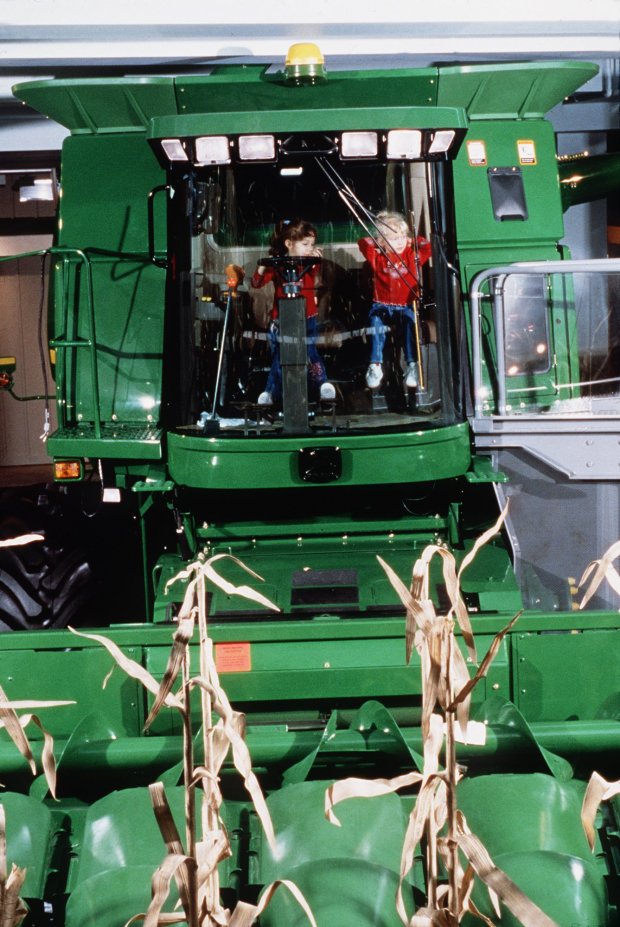
Growing up near Chicago, my siblings and I frequently visited the city’s famous attractions. Our favorite was the Museum of Science and Industry. This museum let us explore its wonders freely. We were fascinated by the 700-ton World War II submarine, the newborn chicks emerging from their shells, and the museum’s first exhibition—a replica coal mine like the one worked by our Irish great-grandfather in Spring Valley.
One exhibit, clambering up a giant John Deere combine and watching corn stalks vanish beneath us, seemed trivial at the time. However, it gained significance years later. Fast forward, and I find myself enjoying the buddy seat in a larger combine. I’m with our neighbor John on his family farm in Muscatine County, near the Mississippi River.
In 2026, John celebrated his 40th year harvesting corn and soybeans. His brother Neil operates another combine nearby. Bryar, John’s son-in-law, soon arrives with a tractor and grain cart, ready to transport corn. His son Tyler then takes the grain to an elevator or bin.
“Regardless of how many times you drive the combine,” John shared, “there’s something special about watching kernels flow into the grain cart after tending to the crops from spring to fall.”
As the combine traverses the field, it performs various processes. The cab offers a stunning view. The header’s snouts gather multiple rows of corn simultaneously. Ears are directed to the feeder box.
Beneath the cab, the threshing and winnowing systems work unseen. Parts like augers, rotors, and sieves separate kernels from the plant efficiently. Through the rear window, you see a massive pile of kernels accumulating. Meanwhile, leftover plant material enriches the soil.
The path of each kernel is intriguing, but so is the technological evolution in harvesting. Beside a skilled operator, you can see these advances firsthand. A GPS on the cab roof ensures accurate steering, removing the need for hands on the wheel. The operator uses a joystick with buttons to control speed and operations.
Digital displays provide real-time data on bushels per acre and corn moisture content. These systems allow fine-tuning of threshing and other components. GPS even synchronizes the tractor with the combine for uninterrupted unloading.
Witnessing a farmer operate a modern combine reveals a remarkable blend of expertise and innovation. This efficiency is vital when a farmer like John has hundreds of acres to harvest in a short span when weather permits. The U.S. Department of Agriculture projected around 16 billion bushels of corn this fall. Iowa, Illinois, and Nebraska lead with over 2 billion each, necessitating many combines.
For those curious about the origin of products like ethanol and tortilla chips, visit the “Farm Tech” exhibit at Chicago’s Griffin Museum of Science and Industry. You can climb into the cab and imagine the journey inside a large green combine, one of thousands produced annually by John Deere Harvester Works in East Moline.
Susan Koch, a retired chancellor of the University of Illinois Springfield, and her husband live in Iowa City, where they farm and raise purebred Angus cattle.
Submit a letter, not exceeding 400 words, to the editor here.
Leave a Reply