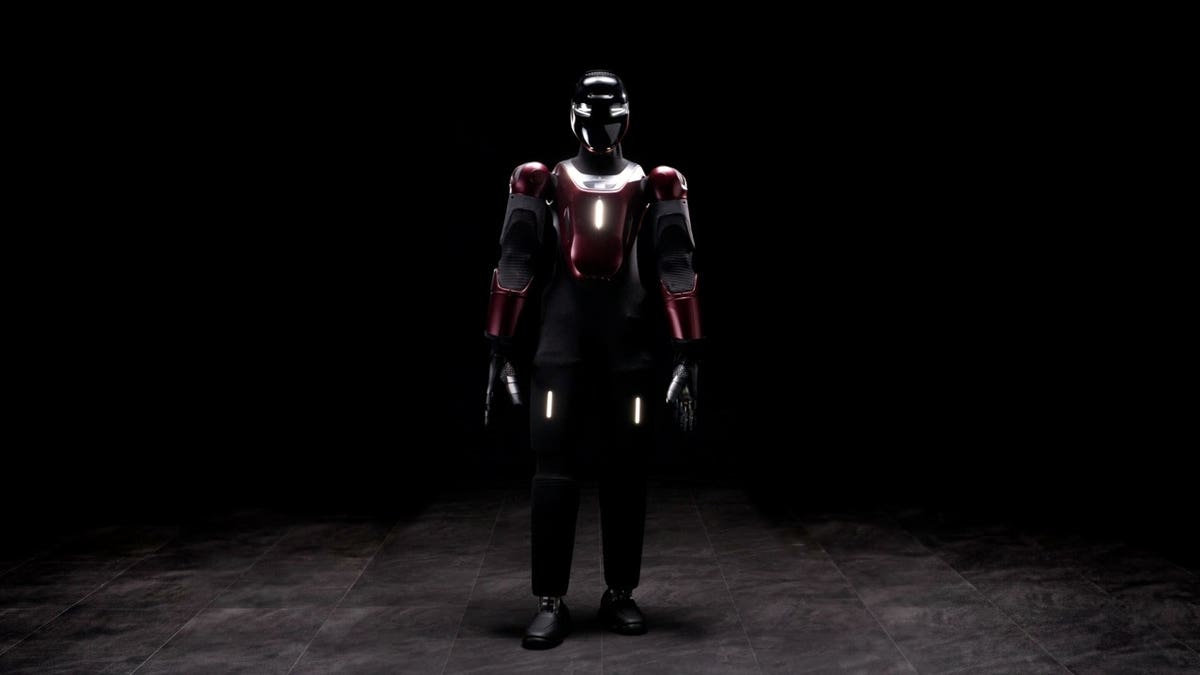
Working beside a metal humanoid robot presents challenges due to the potential for collisions with humans. Generative Bionics, an Italian startup, offers a solution with its Gene.01 robot. This robot features a sensor-filled skin to detect nearby people before physical contact.
The robot’s skin senses touch, temperature, and force, enabling Gene.01 to gather data about its environment and interactions. While the concept is promising, the effectiveness of the system’s quick response in real work scenarios remains a question.
How Gene.01 Senses Workers
Gene.01 incorporates sensors throughout its body, detecting proximity as a key feature. This capability gives the robot an early warning when someone enters its space, akin to feeling heat near a stove and pulling back before touch.
Traditional robots often stay behind barriers to protect workers. Humanoid robots, however, must navigate spaces designed for people. Cameras can help, but they may fail if someone stands too near. Full-body proximity sensing allows the robot to remain aware without relying solely on its vision.
Physical Guidance for Training
Gene.01’s sensors also change how training occurs. Workers can physically teach tasks by guiding the robot’s arms, which records motion and force. For instance, videos may not convey how tightly to hold an object. Direct motion allows the robot to learn proper force application.
This method makes training accessible to workers skilled in tasks but not robot programming.
Physical AI Approach
Generative Bionics employs Physical AI, integrating the robot’s body and movement controls. This method, based on research published in Nature Machine Intelligence, optimizes design through measurable factors affecting both robot and human movement. Gene.01 applies these principles, creating a sensory-equipped industrial robot.
Produced in six months, Gene.01 serves as a platform for various industrial machines. It adapts AI and exterior design to suit tasks and environments, featuring interchangeable end effectors like hands or grippers.
Applications and Partnerships
Generative Bionics sees applications in manufacturing, logistics, and other fields. An open-source digital model allows developers to simulate Gene.01’s movements, promoting innovation in industry-specific tasks.
In shipbuilding, a partnership with Fincantieri aims to use Gene.01 for welding, offering relief in environments with heat and fumes. However, detailed performance results are pending.
Investment and European Expansion
Backed by $81 million in seed funding, Generative Bionics seeks to expand production and create more of its technology in Europe. A partnership with Synapticon focuses on developing actuators to enhance robot motion in compliance with European standards.
Implications for Workers
While it’s unlikely you’ll see Gene.01 at work immediately, its sensor skin signals a shift in robot design, aiming for seamless integration into human environments. Early detection of workers allows for timely robotic responses, enhancing safety.
Gene.01 highlights a future where robots move freely in human workplaces, with awareness built into their design.
Leave a Reply