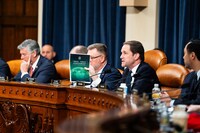
Representative Jim Himes from Connecticut, set to chair the House Intelligence Committee, has announced plans for rigorous oversight of U.S. spy agencies. His focus includes the expanding global covert actions of the Central Intelligence Agency (CIA) under Director John Ratcliffe. This stepped-up scrutiny comes as Democrats prepare to take control in January. Himes aims to ensure proper oversight while emphasizing the importance of adhering to constitutional responsibilities.
In a discussion with The Washington Post, Himes highlighted that the CIA’s expansion of covert action—unacknowledged overseas operations—under Ratcliffe’s direction requires increased attention from the committee. Himes stated, “They are being aggressive on covert action, so we’re going to be aggressive on oversight.” He refrained from revealing classified aspects of these programs, but The Post cited CIA activities in countries like Ecuador, Mexico, and Venezuela during President Donald Trump’s second term.
The priorities for the committee also include examining donations from defense and intelligence contractors to Trump’s construction projects near Washington. Himes plans to investigate firings and security clearance issues by Tulsi Gabbard, former director of national intelligence. He wants to maintain a bipartisan approach, avoiding the divisions seen during Trump’s first impeachment. According to Himes, Democratic-led investigations will likely meet strong opposition from the White House, an indication that Republican resistance to oversight persists.
El Niño’s Impact on Upcoming Winter
Ocean temperatures have reached record levels for 165 consecutive days due to El Niño, affecting global weather patterns through mid-2027. The central equatorial Pacific Ocean has recorded temperatures 3.5 degrees Celsius above average, surpassing the last peak in 2015. Though the U.S. is distant from this unusual ocean warmth, it influences the country’s weather.
El Niño alters the jet stream’s path, leading to shifts in high and low pressure systems. This winter, the southern jet stream may reach unprecedented strength, leading to severe storms across the U.S. (from California to Florida and along the East Coast). Higher chances of extreme precipitation exist in areas like California, the Southwest, Four Corners, the central and northern Plains, Florida, the Southeast, Mid-Atlantic, and Northeast. Maps suggest more snowfall for regions such as the Intermountain West, parts of the Plains, and potentially, the Appalachians and Mid-Atlantic.
Globally, 1.1 billion people are in regions with at least a 10 percent risk of precipitation exceeding top historical levels through February, doubling the usual chance. The Washington Post’s updated El Niño tracker provides insights into changing patterns of drought, floods, and heat worldwide.
United Airlines Limits AI Use
United Airlines has announced measures to stop artificial intelligence agents and assistants from booking flights, citing security and data concerns. In a press release, the company emphasized that engaging third-party AI agents can compromise sensitive information or result in unintended account changes or purchases. United stated these practices may also breach federal regulations, such as luggage content confirmations during check-in.
The airline plans to restrict AI use directly on their digital platforms and through third-party services. This step involves altering booking processes and policy updates to prevent unauthorized AI applications. In contrast, Southwest Airlines has integrated a ChatGPT plug-in to facilitate customer interactions for flight scouting and purchases.
Mississippi’s Historic Senate Race
On Thursday, Nov. 12, Scott Colom became Mississippi’s first Black senator since post-Civil War Reconstruction after defeating incumbent Republican Sen. Cindy Hyde-Smith. The race was closely contested, reflecting changing political dynamics in the state.
Defense Secretary Pete Hegseth faced public criticism for his conduct at Arlington National Cemetery. He was reprimanded for inappropriate behavior near the Tomb of the Unknowns.
The briefing also discusses shifts in housing market trends affecting millennials and explores potential explanations for why some cats may meow for no apparent reason.
Dark Money Influence in Elections
A federal complaint targets United Futures Inc., a dark-money group accused of using illegal straw donor schemes to influence elections. The group, launched in August 2026, allegedly funneled nearly $20 million into Democratic campaigns in states like Alaska, Mississippi, and Kansas.
United Futures, registered as a corporation in Delaware, swiftly rose to become a major donor in the midterms. The Campaign Legal Center’s complaint to the Federal Election Commission claims the group is a shell organization, established to conceal donor identities by passing funds through nonprofits to super PACs. The watchdog highlights the growing problem of undisclosed funding in elections.
United Futures contributed substantial amounts to super PACs supporting Democratic candidates, with accusations of illegal coordination to mask the donors’ identities.
Democratic Gains in North Carolina
North Carolina could experience a Democratic sweep of its state government with the last uncalled race in the state Senate. As of Wednesday, Republican state Sen. Danny Britt held a slim lead over Democrat Catina Hamm. The close margin allows for a potential recount, with Friday being the deadline for vote certification.
If Hamm wins, the Democrats would hold significant legislative power. Governor Josh Stein has faced restrictions with the Republican majorities, established over 15 years. A Democratic victory would lead to shared responsibility in any legislative deadlock. The state has seen substantial Democratic gains in recent elections, indicating a shift in political alignment.
House Freedom Caucus Criticizes GOP Strategy
The House Freedom Caucus held a news conference to critique the Republican Party’s election strategy, suggesting it failed to strongly appeal to conservative voters. The caucus blames electoral setbacks on the GOP’s supposed lack of commitment to policies supporting President Trump’s immigration agenda and fiscal conservatism.
Representative Scott Perry and others insisted that the party should have advanced Trump’s border security policies and voter ID legislation more vigorously. Despite some Republicans identifying other weaknesses like the Iran war and cost of living, the caucus presented a roadmap for immediate legislative actions before the Democratic transition.
They urged Republicans to push significant policy measures in the short time remaining to maximize their influence before losing congressional control.
Leave a Reply