Remote Surgery Breakthrough: Robotic Surgeons
UC San Diego doctors have reached a medical milestone by using humanoid robots to perform remote gallbladder surgery on a pig. Priced at $20,000 each, these robots present a solution to global surgeon shortages and may enhance access to medical care. However, this advancement raises privacy concerns, especially as other AI robots, such as an $8,000 home chore robot, become more common.
Dental Robotics: Revolutionizing Crown Procedures
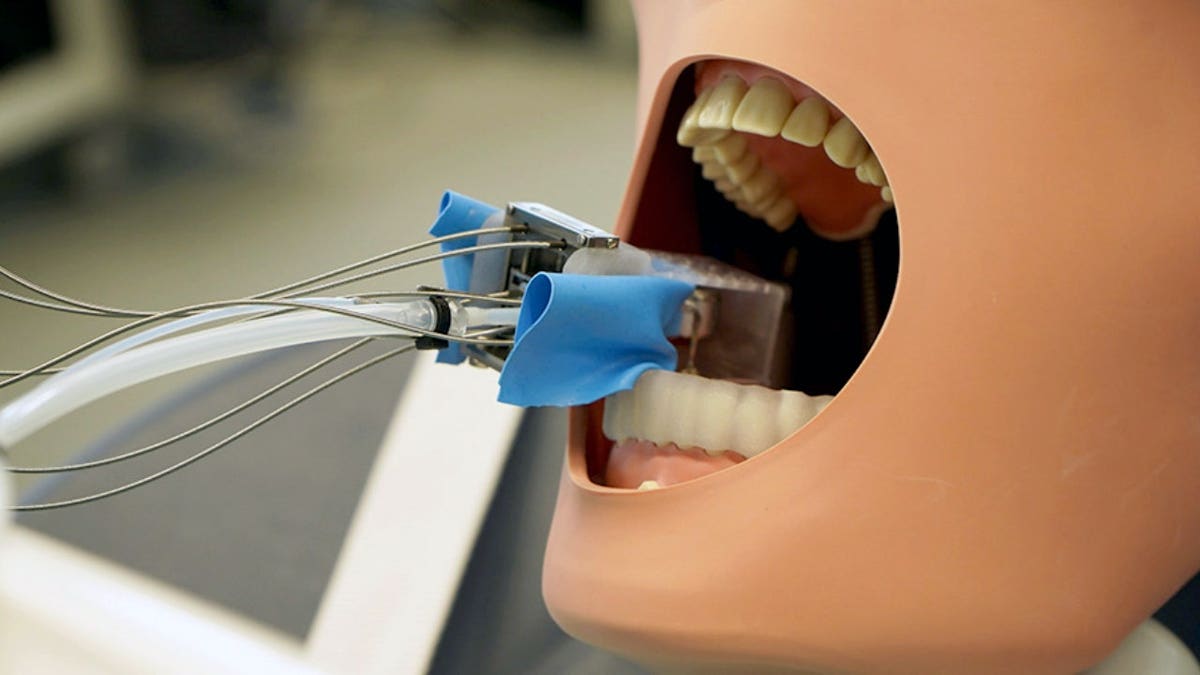
Researchers at the University of Basel are developing the Miniature Intraoral Robot (MIR), a dental robot that could streamline the crown preparation process. This technology aims to reduce the need for multiple dental visits by digitally scanning and preparing teeth for crowns. Currently, crown procedures involve several steps, including cavity filling and temporary crown fitting, demanding multiple appointments.
The MIR robot connects to a custom dental splint based on the patient’s scan. This ensures that the robot moves in sync with the patient’s head movements, making the procedure less uncomfortable. MIR employs a two-stage drilling system, with initial wide drills followed by longer, thinner ones.
Design and Testing of MIR
MIR is compact, roughly the size of a wine cork. Its small size prevents it from obstructing the dentist’s view or feeling bulky inside the mouth. The University of Basel team has tested MIR on synthetic tooth models and ceramic materials similar to tooth enamel.
In testing, MIR demonstrated a positional error of less than 0.2 millimeters. Forces generated during drilling were below five newtons, equivalent to the gravitational force of a half-liter bottle of water. Future improvements include adding sensors and a camera for position tracking during treatment.
Challenges and Future Prospects
Despite promising results, MIR is still in the prototype phase and not ready for dental practices. Researchers plan to ensure its safety by incorporating sensors and cameras for better accuracy. Before it can be trusted for real dental procedures, the robot needs enhanced positional awareness in actual mouth conditions.
MIR was developed by the University of Basel’s Department of Biomedical Engineering, with collaboration from University of Zurich, Camlog Biotechnologies, and University of Bern’s ARTORG Center. Sponsored by Innosuisse, the research is published in IEEE Transactions on Medical Robotics and Bionics.
Potential Impact on Dental Visits
Once developed, MIR could significantly reduce the number of dental appointments required for crowns by allowing more processes to occur digitally. Though still in development, this technology remains promising as part of a shift towards digital dental procedures.
For people familiar with long dental procedures, MIR potentially offers fewer visits and quicker treatment. Researchers continue to refine MIR to work safely in real-world settings, potentially making future crown appointments more efficient.
MIR’s development signifies a step towards integrating robotics in dental care, potentially impacting how crowns are prepared and fitted in the future.
Leave a Reply