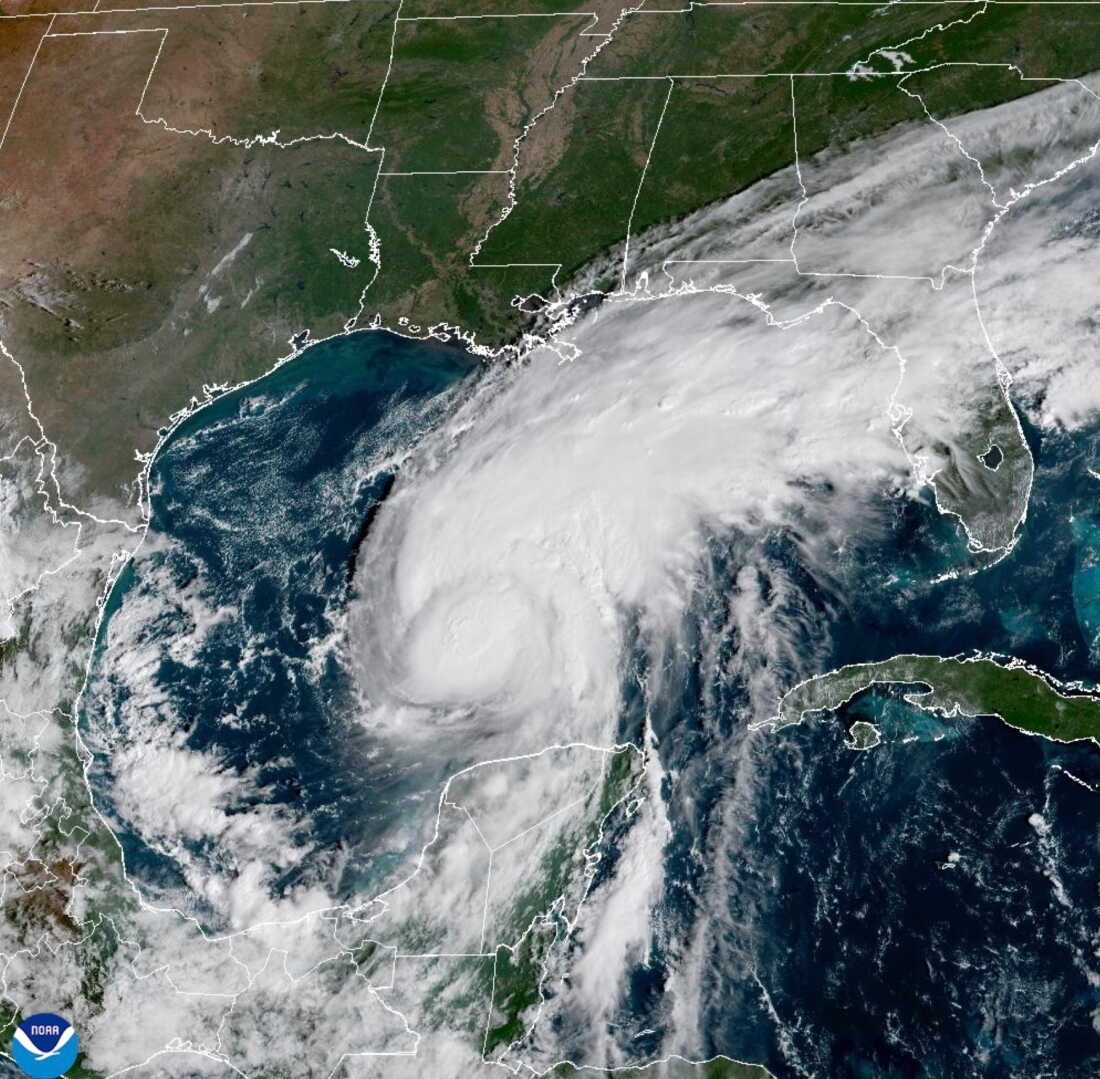
This satellite image from the National Oceanic and Atmospheric Administration captures Hurricane Isaias advancing toward the U.S. Gulf Coast on Thursday, Oct. 8, 2026.
Isaias Escalates to Category 2 Hurricane
Isaias has become a Category 2 hurricane. It is moving quickly toward the U.S. Gulf Coast, causing authorities to issue evacuation orders for tourists. Local residents are preparing by stocking up on gas and groceries. Fishing crews are securing boats as the storm approaches with potentially severe consequences. As the first hurricane of the Atlantic season, it is expected to intensify rapidly, affecting the Florida Panhandle, southern Alabama, and southern Mississippi by Friday night or Saturday morning. Meteorologists warn of potential heavy rain and flooding extending as far north as Tennessee and North Carolina over the weekend.
“We expect Isaias to be a dangerous hurricane when it lands,” stated Michael Brennan, director of the National Hurricane Center in Miami. “Today is the day to prepare and be in a safe location by tomorrow,” he added, highlighting the urgency as conditions deteriorate along the Gulf Coast.
Isaias currently has sustained winds of 105 mph (165 kph). It has surpassed the threshold for a Category 2 storm, with sustained winds needed at 96 mph (154 kph). The storm is traveling northeast at 14 mph (22 kph) and is about 260 miles (415 kilometers) south of the Mississippi River’s mouth. A hurricane warning covers from Ocean Springs, Mississippi, to the Bay-Gulf County line in Florida. A storm surge warning extends from the Mississippi River’s mouth to the Suwannee River.
Coastal Areas Begin Evacuations
Coastal communities are quickly undertaking preparations. Alabama Governor Kay Ivey has ordered non-residents to evacuate Gulf Shores, Orange Beach, and Dauphin Island. Social media videos show heavy traffic as people leave Gulf Shores, with double-red flags indicating closed beaches. Four Florida school districts have canceled classes, and several counties have issued mandatory evacuations in coastal areas.
Governors of Florida and Alabama declared states of emergency across numerous counties, with Governor Ron DeSantis of Florida expecting the mobilization of about 5,000 National Guard troops by Friday. Dauphin Island officials recommend voluntary evacuations, especially in its vulnerable western section. Mayor Jeff Collier mentioned low expectations for damage but stressed the need for readiness, acknowledging the storm’s unpredictability.
Forecasts predict storm surges and high tides reaching 5 to 7 feet (1.5 to 2 meters) in parts of Alabama and Mississippi. Rainfall could amount to 15 inches (38 centimeters) in coastal regions, with tornadoes possible from Friday night into Saturday from Alabama to the Florida Panhandle and southwestern Georgia. Isaias will likely weaken quickly post-landfall. The National Weather Service has warned of potential long-term power outages.
Late-Forming Hurricane in a Quiet Season
Isaias formed later in the season, missing a 121-year-old record for the latest-forming hurricane in the area by one day. The record dates back to 1905, with the first hurricane of that year forming on Oct. 8. This year’s Atlantic hurricane season has been quiet, attributed to a strong El Niño disrupting storm formations. Conversely, the Pacific has seen above-average activity, with Hurricane Simon intensifying to a Category 4 hurricane and Tropical Storm Rachel heading toward Baja California and Southern California.
Isaias is set to impact regions familiar with hurricanes. Historical examples include Hurricane Camille in 1969, which caused over 250 fatalities in Mississippi, and Hurricane Katrina in 2005, which devastated New Orleans and resulted in nearly 1,400 deaths. Most recently, Hurricane Michael in 2018 severely damaged infrastructure near Panama City, Florida.
Effect on Oil Production and Tourism
Oil and gas producers preemptively shut down a large portion of offshore production in the Gulf, which represents nearly 15% of annual U.S. crude output. As of Thursday, about 63% of oil production in the area has temporarily stopped, equivalent to 1.3 million barrels a day. This comes as 121 of the Gulf’s 371 manned oil platforms evacuated teams. While production cuts affect the market amid high oil prices, previous hurricanes have caused more significant disruptions. Concerns remain over the storm striking near refineries.
As Isaias approaches, it may disrupt the college football game between Georgia and Alabama, which President Donald Trump plans to attend.
In Alabama’s Loxley community, Nichole Eubanks and her husband brace themselves on their farm with assorted animals, including pigs and donkeys. They intend to mark their animals with contact information in case they escape. The uncertainty of storm paths and intensity remains a concern.
In Bayou La Batre, Alabama, fishing crews like Tony Rice and Lance Connor install protective measures on their boats to prevent damage. They aim to relocate their vessel to minimize collision risks. In Pensacola, Florida, officials announced the closure of the airport to commercial flights starting Friday morning. Mayor D.C. Reeves emphasized checking on older adult neighbors and others requiring assistance, reinforcing the focus on preparation.
Leave a Reply