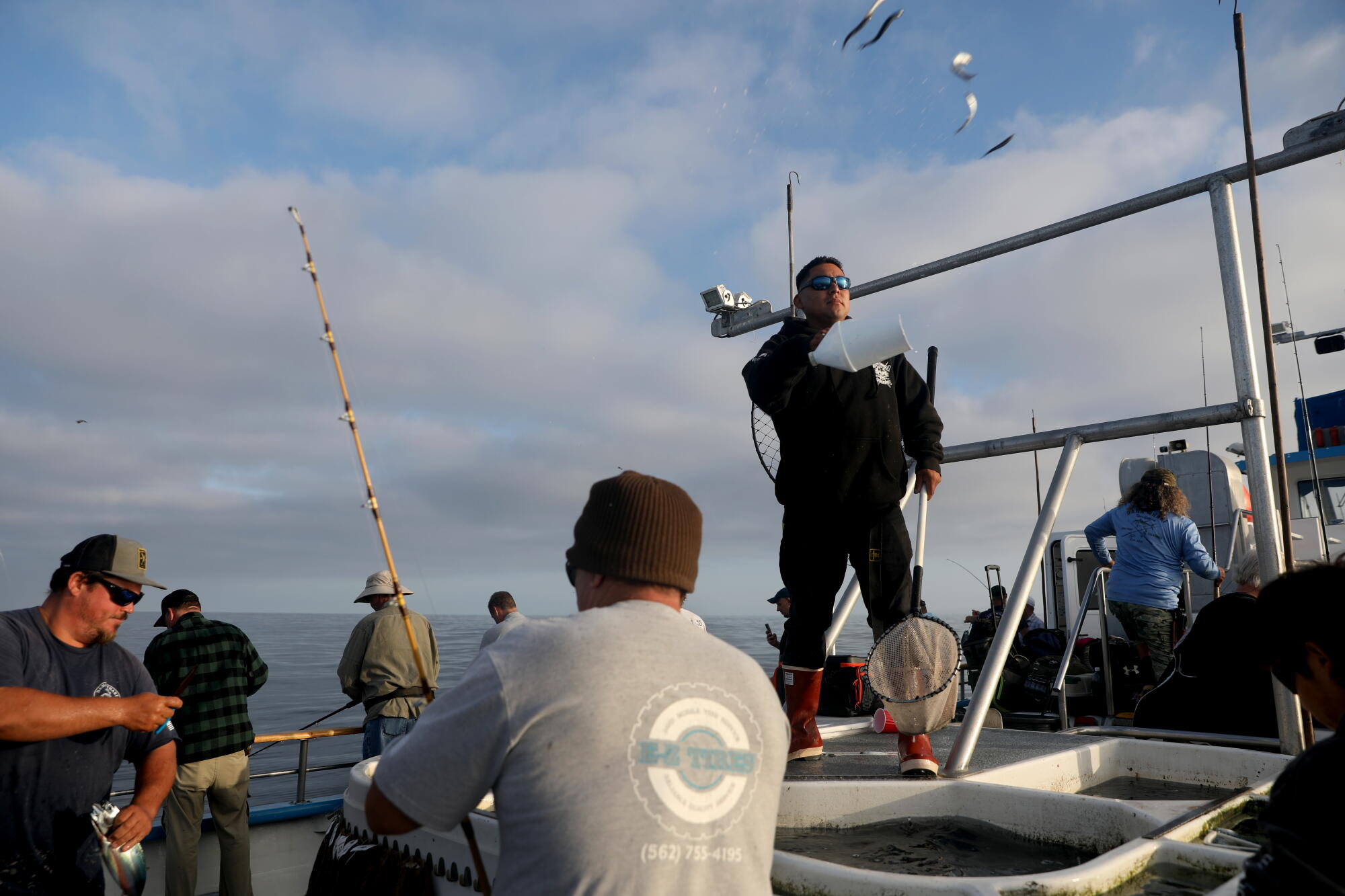
Captain Brandon Erdo navigated the 95-foot Dana Pride into promising waters off the Orange County coast. On this Wednesday morning, the boat nearly reached full capacity with 37 of the 40 available spots occupied by anglers eager to experience the reported fishing opportunities brought by the super El Niño.
With interest piqued by social media reports, the anglers were hopeful. “Get a little bait going here, Eric,” Erdo instructed over the loudspeaker. A deckhand responded, hurling anchovies into the water, creating a shower of tiny scales around the boat. Veteran angler Chuck Freeman soon celebrated his first catch—an approximately 2-foot-long bullet tuna, his first in 47 years of fishing in the Pacific.
“First fish!” Freeman exclaimed, reeling in his catch with excitement.
Recent studies attribute this surge in rare fish appearances to super El Niño conditions. These conditions have warmed the waters off California, attracting species like the bullet tuna that are more common in other oceans. Beachgoers and amateur anglers from Orange County to Malibu now report sightings of unusual sea creatures such as whales, hammerhead sharks, and wahoos.
“We’re seeing fish that should be in Cabo San Lucas right now,” stated Owyn Snodgrass, a biologist with the National Oceanic and Atmospheric Administration. “The entire ecosystem has shifted.”
For recreational fishing businesses, this shift is a boon. Data shows a surge in tuna catch, with some species caught in U.S. waters for the first time in two years. Marlin fishing also hit a historic high, with more marlins caught this year than any year since 1990.
“This is the future’s ‘Good old days,’” said Mike Conroy, president of the Sportfishing Assn. of California.
However, the reality on the water is mixed. While the presence of fish is undeniable, the numbers fall short of expectations. Eric Munoz, a deckhand on the Dana Pride, observed that bullet tuna do not keep well, reducing their appeal as a catch. Captain Erdo shifted to another location, searching for better opportunities.
Using binoculars, Erdo scanned for signs of fish, such as kelp which can indicate smaller fish—and larger fish in pursuit. The sonar continuously scanned the waters, while reports of dolphin pods offered hope.
Last year, Dana Wharf Sportfishing had a meager catch. This year, they’ve captured over 5,800 yellowfin tuna and over 150 mahi-mahi. The previous significant catch was during 2014-2015, when warm waters led to nearly 10,000 catches.
Despite optimistic reports, the lack of a catch spike associated with El Niño is noteworthy. NOAA’s Andrew Leising suggested differences in marine heat waves contribute to this variance. Eric Munoz still hopes as he reflects on the day aboard Dana Pride.
Environmental factors could explain the reduced catch rates, said fisheries scientist Lyall Bellquist. An analysis indicates a 25% reduction in angler trips compared to 2015, along with significant oceanographic differences. Although the potential was hyped, Captain Erdo remarked, “It was hyped up so much,” acknowledging the disparity between perceived and actual experiences.
By early afternoon, Erdo guided Dana Pride to a promising patch near floating kelp. This led to a brief flurry of yellowfin tuna catches, visible in the clear water. Eventually, the fish ceased biting, likely satiated by the presence of tuna crabs in the warm waters.
By day’s end, Dana Pride’s haul comprised 120 bullet tuna, 17 yellowfin tuna, three skipjack tuna, and one mahi-mahi. Anglers like Freeman managed to land a yellowfin, while others took home bullet tuna but missed out on yellowfin.
“Not an epic day by any means,” Erdo commented, encouraging anglers to follow the fish counts. “I don’t think this fish is going anywhere.”
Leave a Reply