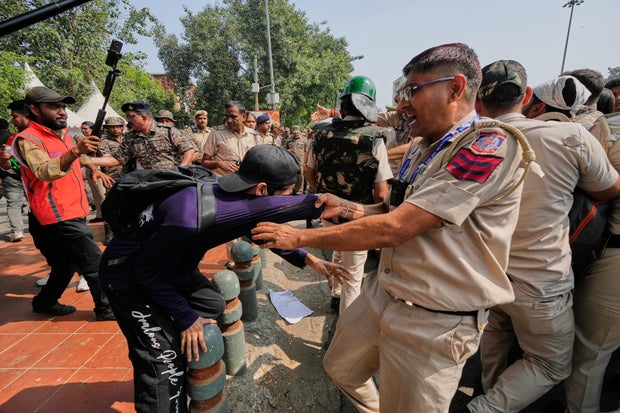
Indian authorities intensified security measures in New Delhi and detained numerous protesters on Saturday. The youth movement known as the “Cockroach” sought to escalate its campaign against a controversial voter list revision. This issue has incited public anger toward Prime Minister Narendra Modi’s Hindu nationalist government and election officials.
Police disrupted the demonstration before it began, intercepting participants en route to Jantar Mantar, the planned protest location in the capital. Many demonstrators were chased off, while others were detained and transported to temporary centers. Leaders of the “Cockroach” movement and student activists were detained before they could reach the site, effectively neutralizing the protest.
Police detain protesters during a demonstration demanding the resignation of Chief Election Commissioner Gyanesh Kumar.
The crackdown extended beyond the protest venue. Authorities stopped vehicles at checkpoints around the city to identify demonstrators. Jantar Mantar was heavily barricaded, with anti-riot vehicles and tear gas equipment stationed nearby. Restrictions on mobile internet and city access further hindered protest efforts. Police cited a late application for protest permission as the reason for denial.
Sambit Patra, a spokesperson for Modi’s party, dismissed the demonstrators as disruptive elements, claiming their efforts were unsuccessful.
The extensive security measures highlighted the government’s intent to suppress a growing protest movement that has galvanized young people and received opposition backing.
Pre-Planned Leadership Detention
Abhijeet Dipke, Saurav Das, and Ashutosh Ranka, leaders of the “Cockroach” movement, were detained upon arriving in Delhi from Mumbai. Videos even showed police boarding their flight to arrest them. The movement accused Delhi Police of deliberately targeting its leaders to undermine the protest.
At the protest site, authorities banned gatherings of five or more people, employing rare security tactics for New Delhi. Journalists faced restrictions too, with some being briefly detained.
Despite barriers, some protesters managed to break through police lines, shouting slogans against Modi and election authorities before being detained. College student Tanya Negi questioned the suppression of peaceful protests and challenged Modi’s stance toward young Indians.
Criticism of Government’s Actions
The large-scale police response raised discussions about public dissent’s place in India. Critics argue Modi’s approach to protests has often involved arrests and restrictions.
Opposition figures criticized the security measures. John Brittas, an opposition lawmaker, questioned whether democracy exists in the country, pointing out the city’s lockdown.
Protests centered around the Election Commission’s voter list changes, which opponents claim disenfranchised millions. They demand Chief Election Commissioner Gyanesh Kumar’s resignation and an end to the revision. The Commission denies accusations of voter manipulation, stating the process ensures accuracy by removing duplicate records.
The “Cockroach” movement, which began online in May, seeks to leverage voter list disputes to expand its influence. Previously, its activities prompted the resignation of Modi’s education minister over exam paper leaks.
Modi faces ongoing challenges from the protests as he continues his third term. While national elections are set for 2029, upcoming state elections in Uttar Pradesh and Gujarat will gauge his party’s current standing.
Leave a Reply