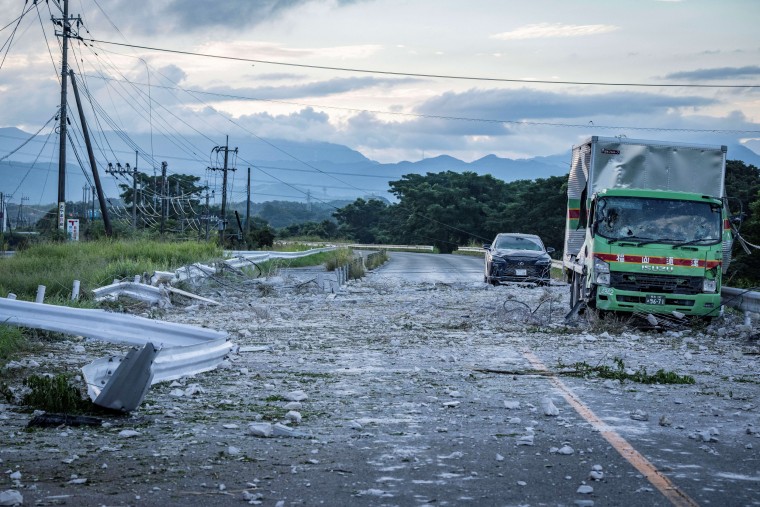
On July 29, 2026, a major earthquake in southwestern Japan claimed at least 13 lives. Prime Minister Sanae Takaichi announced the fatalities as rescue teams worked tirelessly to find survivors amidst the wreckage of a shopping mall and a paper mill.
“There are still individuals waiting to be rescued, making this a critical and urgent effort. We are employing all available local resources to save as many individuals as possible,” said Prime Minister Takaichi in Tokyo.
The magnitude-7.1 earthquake hit Kumamoto prefecture on the southern main island of Kyushu on Tuesday afternoon. It originated at a shallow depth of 6 miles, leading to tsunami alerts and the evacuation of coastal areas. The epicenter was found about 12 miles south of Kumamoto city, which houses approximately 700,000 residents.
Although tsunami warnings were promptly lifted, the damage was widespread. Historic sites like Kumamoto Castle, still under repair from another disaster in 2016, were impacted, alongside widespread road damage. Thousands of households lost power, and authorities cautioned residents about heat stroke risks due to temperatures rising into the 90s.
Eyewitness reports included damaged vehicles along debris-filled roads after an explosion at Aeon mall in Kashima, Japan. Two women in their 20s lost their lives at the scene, and eight were rescued from the debris. Officials from the mall are investigating if a gas leak triggered the explosion, as four people remain missing.
At Nippon Paper Industries in Yatsushiro city, seven individuals were reported missing due to a chimney collapse. Reuters reported a local official confirming this. Thousands of soldiers have joined rescue operations, with hospitals providing care to dozens of injured individuals. Injuries included passengers on Japan’s high-speed trains, which ceased all operations on Kyushu following the quake.
The quake derailed a freight train at Yatsushiro station, turning carriages and collapsing shrine pillars, as shown on Japanese public broadcaster NHK. By Wednesday, bullet trains and airport activities were on hold, and Kyushu Electric Power reported 35,000 homes still lacking electricity.
Japan meteorological agency cautioned that similarly intense earthquakes could follow. “In the coming week, especially the next few days, residents should be alert for earthquakes reaching seismic intensity 7,” it noted via NHK.
Regional nuclear reactors sustained no reported damage. Japan’s nuclear authority informed the International Atomic Energy Agency that Sendai’s nuclear power plant was unharmed, marking an ongoing situation tracking by the U.N. agency. Disasters of this nature put Japan’s nuclear facilities under scrutiny, recalling the 2011 earthquake and tsunami that devastated Fukushima Daiichi’s reactors.
Japan’s position on the “Ring of Fire” makes it one of the most earthquake-vulnerable nations globally. The country experiences about 20% of massive global earthquakes, notably those measuring 6.0 or higher.
Leave a Reply