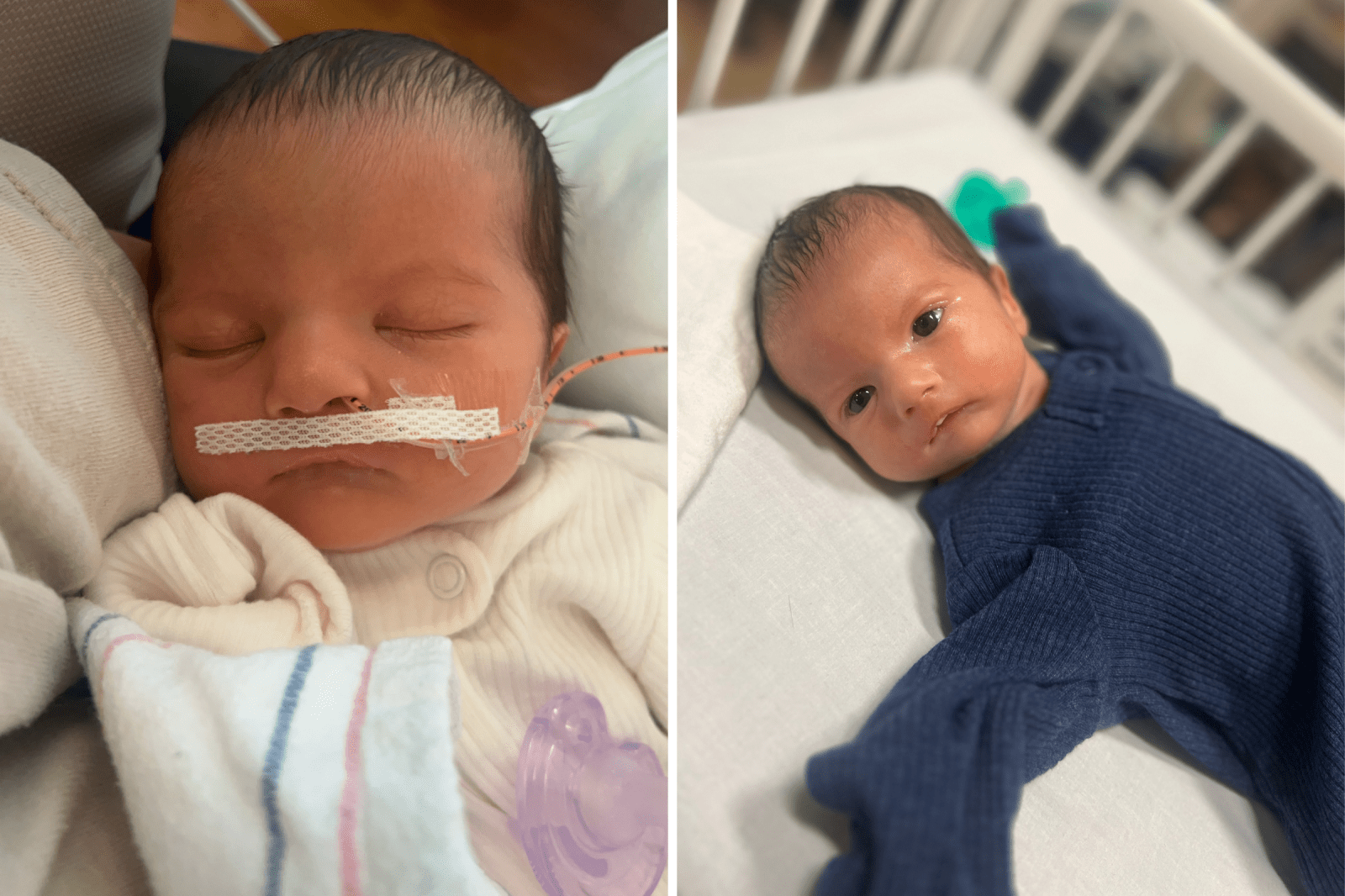
An Indiana mother, Jeannie Hochstetler, has openly discussed her son’s rare condition, which gives him a permanent expressionless face. Her journey began after a straightforward pregnancy, leading to the birth of her first child on January 29, 2025. Initially, there were no significant concerns, although her stomach appeared smaller might indicate a smaller baby.
Upon Riley’s birth, it was apparent something was amiss. “He did not cry when he was born, and they immediately gave him oxygen,” Hochstetler said. A doctor observed Riley closely without providing answers. He was then transferred to a nearby NICU for evaluation. Tests revealed small, webbed hands and a missing right pectoral muscle. His condition stumped doctors who had difficulty diagnosing him, leaving Riley on CPAP and an NG tube for feeding.
After weeks in the NICU, a doctor suspected Riley had Poland-Moebius Syndrome, an uncommon congenital disease causing facial paralysis and undeveloped chest muscles. This required transferring Riley to a more advanced NICU, despite Hochstetler’s emotional struggle of being apart from her newborn. At three weeks, Riley’s condition was confirmed.
According to the National Institutes of Health, Moebius Syndrome affects one in 50,000 births, leading to underdeveloped facial nerves. This results in expression difficulties, swallowing issues, impaired speech, hearing troubles, and motor delays. Often tied to Moebius Syndrome, Poland Syndrome involves missing or insufficient chest muscles.
Learning about Riley’s diagnosis introduced uncertainty for Hochstetler, who had never encountered these conditions before. “Knowing he couldn’t smile was heartbreaking,” she expressed. Despite advice to observe how Riley adapts, it became clear he wouldn’t form facial expressions, face feeding challenges, and experience milestone delays.
Riley’s missing seventh cranial nerve hinders facial movement and restricts his eye motion. He uses a G-tube for nourishment, though Hochstetler hopes for oral feeding once his swallow strength improves. At 13 months, Riley underwent strabismus surgery to address crossed eyes and also corrected eyelashes affecting his vision.
Despite mild hearing loss in his left ear detected through hearing tests, Riley’s laughter brings joy to Hochstetler. He communicates emotions differently, and she’s become proficient at interpreting his body language. “His condition is non-progressive, offering hope for improvement with therapy. He is adaptable and intelligent, revealing new ways to achieve tasks,” she shared.
To raise awareness, Hochstetler documents insights on social media (@jeanniebontrager on TikTok). Riley’s journey exemplifies resilience and strength, with love manifesting in diverse forms. Hochstetler reflected, “He is my greatest blessing, enduring much yet remaining joyful.”
For further inquiries, reach out to Newsweek editors Charlotte Nisbet and Tony Phillips. If you face health-related concerns, contact [email protected] for expert opinions, which could be shared on Newsweek.
Leave a Reply