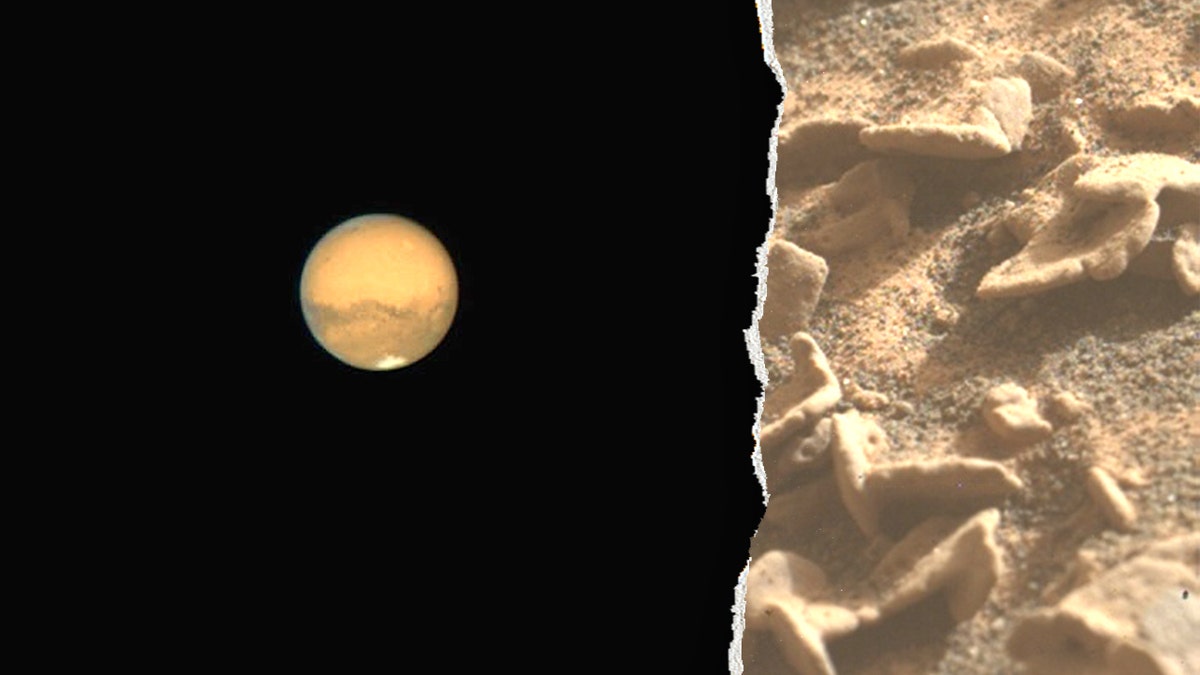
NASA scientists are delving into peculiar formations on Mars that resemble potato chips. These formations have piqued curiosity as researchers seek to understand both their origins and composition.
The discovery was shared in NASA’s ‘Curiosity’ blog on November 11. Curiosity, a rover launched by NASA, has been traversing the Martian terrain since 2012. During a recent drilling campaign at a site known as ‘Nazca,’ it investigated these unusual shapes.
The Nazca drill site is positioned in a region of Mars where distinctive disk-like features have been noted in the bedrock. According to NASA’s blog, this area is marked by bedrock containing unique crystal forms, described as disk-shaped or resembling potato chips.
This is an area characterized by bedrock containing disk-shaped (or, in a liberal interpretation, potato-chip shaped) crystal forms.
Images portray the Martian bedrock with irregular, curled formations resembling potato chips embedded within.
NASA aims to further characterize these chip-shaped features. The Curiosity rover gathered samples from the Nazca drill hole. These samples were sent to the Sample Analysis at Mars (SAM) instrument, an onboard lab designed to define the chemical composition of Martian materials.
Curiosity plans to employ its laser-equipped ChemCam instrument to analyze another crystal-shaped formation, nicknamed ‘Colca,’ in order to learn about its chemical properties.
Additionally, the Mars Hand Lens Imager (MAHLI), a camera on Curiosity’s robotic arm, will photograph these formations at night using both white-light and ultraviolet LED lamps.
ChemCam LIBS observations were planned for each sol including a cluster of crystal forms, a resistant layer in the side of the Nazca block and a dark float rock.
Once data collection concludes, the rover will resume its southward journey across Mars.
Fox News Digital reached out to NASA for more details on the formations and their previous sightings.
These formations are part of a broader initiative to explore Mars, enriching our understanding of the planet and the broader solar system. Scientists rely on a suite of instruments aboard Curiosity to acquire data about these and other Martian formations.
In related news, last month astronomers identified a potential dwarf planet beyond Pluto using the Vera C. Rubin Observatory in Chile. Named 2026 ED138, this body is estimated to be between 370 and 930 miles in diameter, making it one of the largest identified in the distant solar system.
Leave a Reply