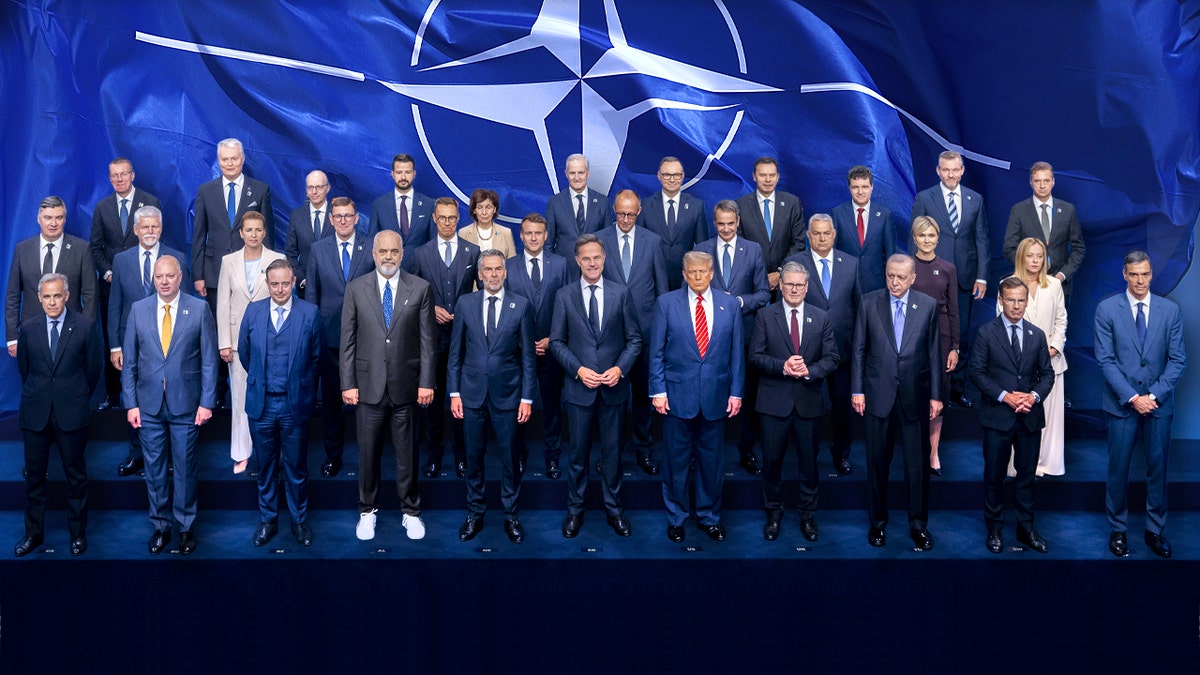
NATO has undergone significant changes by traditional metrics. The alliance, prompted by President Donald Trump’s pressure and the conflict in Ukraine, now sees members increasing defense spending to levels unseen since the Cold War. Leaders agreed to aim for 5% of GDP by 2035.
Trump repeatedly criticized NATO allies for relying excessively on U.S. military protection while underinvesting in their defense. His threats to reconsider U.S. commitments to those failing to meet spending targets intensified focus on defense investment.
Jim Townsend, a former deputy assistant secretary of defense for Europe and NATO policy, told Fox News Digital, “Two things woke everyone up: Putin’s 2022 invasion and Trump, who either scared or shamed allies into action.”
NATO leaders meet in The Hague on June 25, 2025, committing to increase defense spending to 5% of GDP by 2035 at Trump’s request.
Countries closest to Russia acted swiftly. Poland’s defense spending now leads NATO. Estonia, Latvia, and Lithuania have substantially increased military budgets since 2022. Germany initiated a major rearmament effort with a 100 billion euro fund to rebuild the Bundeswehr.
Data shows a historic shift. European allies and Canada raised defense spending by 20% in 2025 compared to the prior year, per NATO’s report. European members and Canada have added hundreds of billions since 2014.
Europe is acquiring tanks, air defenses, fighter jets, and artillery systems. However, the spending surge revealed its limits.
Townsend noted that investment doesn’t immediately translate to increased capability. Ukraine demonstrated how rapidly a major war can exhaust ammunition stockpiles, taxing production lines and peacetime defense industries.
U.S. Army M1 Abrams tanks participate in Poland’s Armed Forces Day parade on August 15, 2025, commemorating Poland’s victory over the Soviet Red Army.
A robust defense budget shows commitment but doesn’t measure readiness or sustainability in wartime. NATO faces a gap between increased spending and actual capability.
The prior 2% spending benchmark offered a simple measure for burden-sharing. While some allies met this, the Ukraine conflict showed it as only the first step. Countries could meet it without adequate deployable forces or timely weapons acquisition.
NATO Secretary-General Mark Rutte, with U.S. President Trump at the World Economic Forum in 2026, emphasized “smarter investment in the right capabilities.”
Rutte also stressed aligning rising defense budgets with expanded production capacity to prepare for competition with Russia. Townsend noted that Europe’s and America’s defense industries suffered after decades of reduced military spending post-Cold War.
Governments now face the reality that factories can’t immediately fulfill NATO’s high demand. While funds and orders are present, producers struggle to meet the requirements.
The Ukraine war revealed how modern warfare strains peacetime production systems. European plans post-2022 have faced long delivery schedules, strained supply chains, and shortages in crucial areas like artillery and air defense.
A McKinsey analysis cautions that structural constraints could hinder the transition from spending to active military capabilities, pointing to fragmented procurement systems and industrial bottlenecks.
Europe relies heavily on U.S. military technology and production, as Townsend noted.
Rebuilding Europe’s capabilities will take years. Air defenses, long-range strike weapons, logistics, intelligence, and ammunition reserves are challenging to restore quickly.
As demand for systems like Patriot missiles and HIMARS launchers increased post-Ukraine, longer production timelines emerged. Some NATO countries are seeking alternatives; Poland turned to South Korea for weapons.
European governments are working to expand domestic production for reduced dependence on U.S. suppliers. Germany has boosted ammunition production, and some industrial firms are shifting toward defense manufacturing.
Rebuilding will take time, Townsend stated. The crucial question is whether NATO can bridge the gap swiftly enough amid challenges.
Leave a Reply