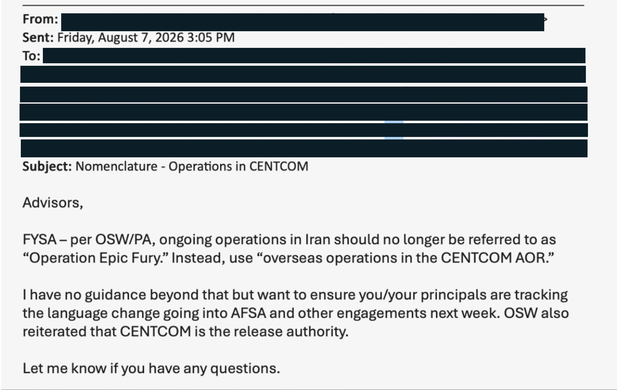
The Pentagon issued guidance in August instructing personnel not to refer to ongoing U.S. operations in Iran as “Operation Epic Fury.” The operation formally ended on May 5, as stated by Secretary of State Marco Rubio. This announcement followed President Trump’s notification to Congress about the termination of hostilities. Although the operation ended, military exchanges with Iran have persisted.
Guidance dissemination occurred across the Defense Department, emphasizing the use of broader terms. Military officials explained that the April ceasefire marked a shift in operations to Freedom of Navigation missions to address threats from the IRGC.
Historically, the U.S. military has provided clear start and end dates for operations, which are essential for tracking involvement abroad. However, only Rubio publicly confirmed the conclusion of Epic Fury, although Defense Secretary Pete Hegseth noted a transition to “Project Freedom.” This new mission focused on maritime protection in the Strait of Hormuz.
Despite the formal end, American forces remain active due to ongoing involvement from the U.S. and Iran. Talks between the two nations collapsed, leading President Trump to inform Congress about resumed military action in July.
“Following the April ceasefire, the administration stated Operation Epic Fury had concluded on May 5.”
Casualties from related missions are categorized under “overseas operations.” This includes four service members originally listed as casualties of Epic Fury. Clarifications were requested by the media regarding these categorizations, and the Pentagon attributed initial listing errors to data disruptions.
The Defense Casualty Analysis System still shows casualties linked to Epic Fury with no end date displayed, which raises further questions about the operation’s formal conclusion.
Leave a Reply