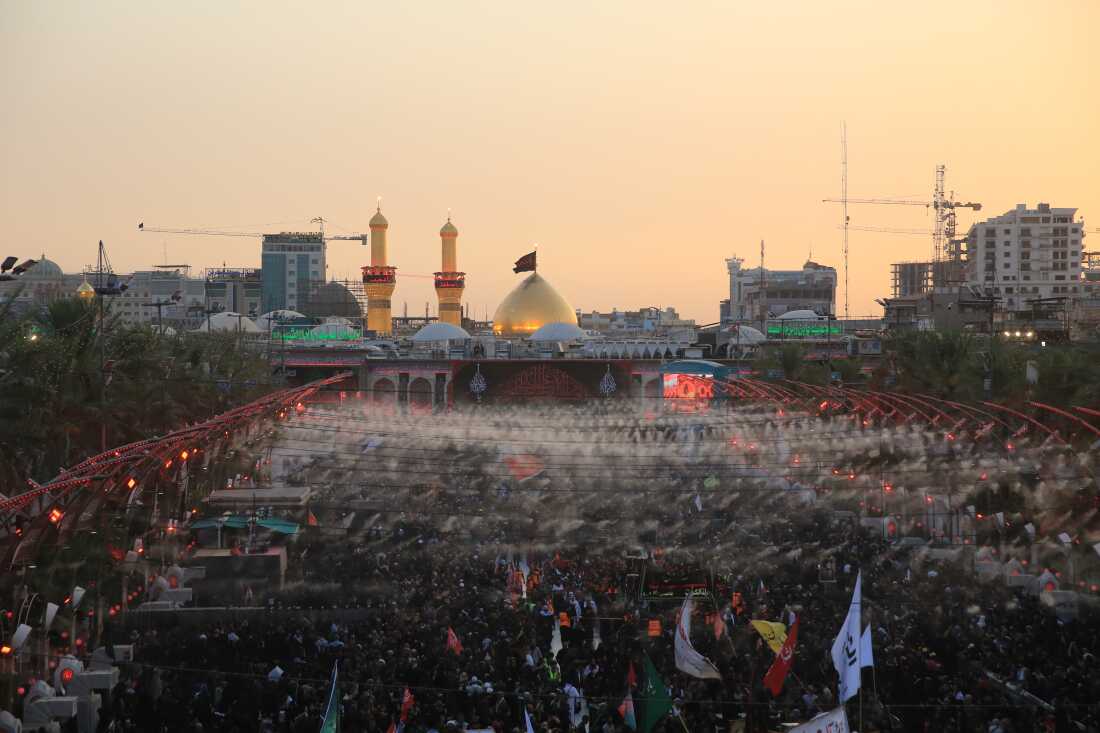
The holy city of Karbala becomes a sea of pilgrims at sunset during the Arbaeen commemoration. The illuminated dome and minarets of Imam Hussein’s shrine form a majestic backdrop for the gathering. Arbaeen marks the story of Imam Hussein’s killing 1,400 years ago, persistently echoed through the centuries. Pilgrims receive cold water in plastic containers, symbolizing the water denied to the Imam and his followers before their deaths.
Some of the attending pilgrims view the recent killing of Iran’s supreme leader, Ayatollah Ali Khamenei, by Israel and the United States as another act of injustice against Shia Muslims. Iran reported that over three million of its citizens participated in the Arbaeen ceremonies held in Karbala. Among the crowd, pilgrims raise their hands in mourning rituals inside the Imam Hussein Shrine.
A man holds a large banner with Ayatollah Khamenei’s portrait, a vivid presence during the Arbaeen. Walkers like Maryam Ghanbari expressed devotion by traveling 200 miles from Iran to Karbala. “More people attended this year to avenge Agha’s blood,” she remarks, using the Persian term of respect for the late leader. This marks Ghanbari’s ninth pilgrimage.
Arbaeen recalls Imam Hussein’s beheading during the Battle of Karbala in 680, which resulted in the profound division between Shia and Sunni factions. Shia followers, gathering around Hussein’s teachings, commemorate his sacrifice annually. Inside the Imam Hussein Shrine, pilgrims engage in prayer amidst the crowds.
The vibrant festival is honored by nearly 200 million Shia worldwide, with Iran as the largest Shia nation. Suppressed under Saddam Hussein, Iraq’s Shia majority rose to prominence post-2003 U.S. invasion. Iran and Iraq, once foes, became allies as Iran gained significant influence over Iraq’s governance and military forces.
In the ongoing U.S. conflict with Iran, Iran-backed militias within Iraqi security forces have launched assaults on U.S. installations in Iraq. Many see this as a war against Shia Islam. Ali Aadi Khairi and his cousin Sajjad Haitham Latif trekked from Kut to Karbala, carrying an image of Imam Hussein. The image also featured Qassem Soleimani and Abdul Mehdi al-Muhandas, both killed six years prior by a U.S. strike.
Iranian authorities reported a U.S. missile strike on an Iranian school killing 120 children, including Khamenei’s grandchild, amplifying the sense of injustice felt by the Shia community. During Arbaeen, religious flags and banners fill the air as pilgrims gather, deeply engaging in spiritual and cultural gestures.
Prior to Arbaeen, pilgrims embark on foot, enduring heat while carrying symbolic flags. Hospitality tents offer sustenance and shelter to travelers. Many Iranians opt for organized tours providing transport and accommodation in Karbala. Inside the shrine, pilgrims reverently strike their foreheads against precious latticework in grief. The shrine’s domes and flags turn red, symbolizing vengeance.
The intense mourning rituals involve sobbing intertwined with chanting, epitomizing sorrow for Imam Hussein’s sacrifice. Pilgrims often associate him and his relatives as part of their extended family. The Arbaeen procession retraces the relatives’ journey back to Karbala to reunite Imam Hussein’s head with his body after 40 days.
In the men’s section, Iranian pilgrims add endearing Persian suffixes as they mourn Hussein. Outside, processions continue in extreme heat, with banners of Khamenei displayed alongside national flags. Historical reenactments in Iraq and Iran ensure the Battle of Karbala remains vivid in the minds of young Shia.
This week, along the walkway between the shrines, cooling mists provide relief to pilgrims. Medics stand ready to care for those affected by heat stroke. Despite appreciating the U.S. role in Saddam’s downfall and the fight against ISIS, many Shia now view the U.S. and its allies as adversaries intent on detrimental outcomes in the region.
Teacher Naser Zadih from Tabriz sees Khamenei’s death as a rallying cause for Shia resistance. He believes this has strengthened their movement against U.S. and Israeli forces. Despite economic hardships from ongoing conflicts, Zadih asserts a cultural adaptation for resistance entrenched in Iranian society.
Iranians on pilgrimage often support their regime. At upscale hotels, wealthier pilgrims are reluctant to engage with U.S. media due to concerns about repercussions. Mohammad Yasin Ahmadi, a 15-year-old from Qom, attends Arbaeen primarily in honor of Khamenei’s memory.
Leave a Reply