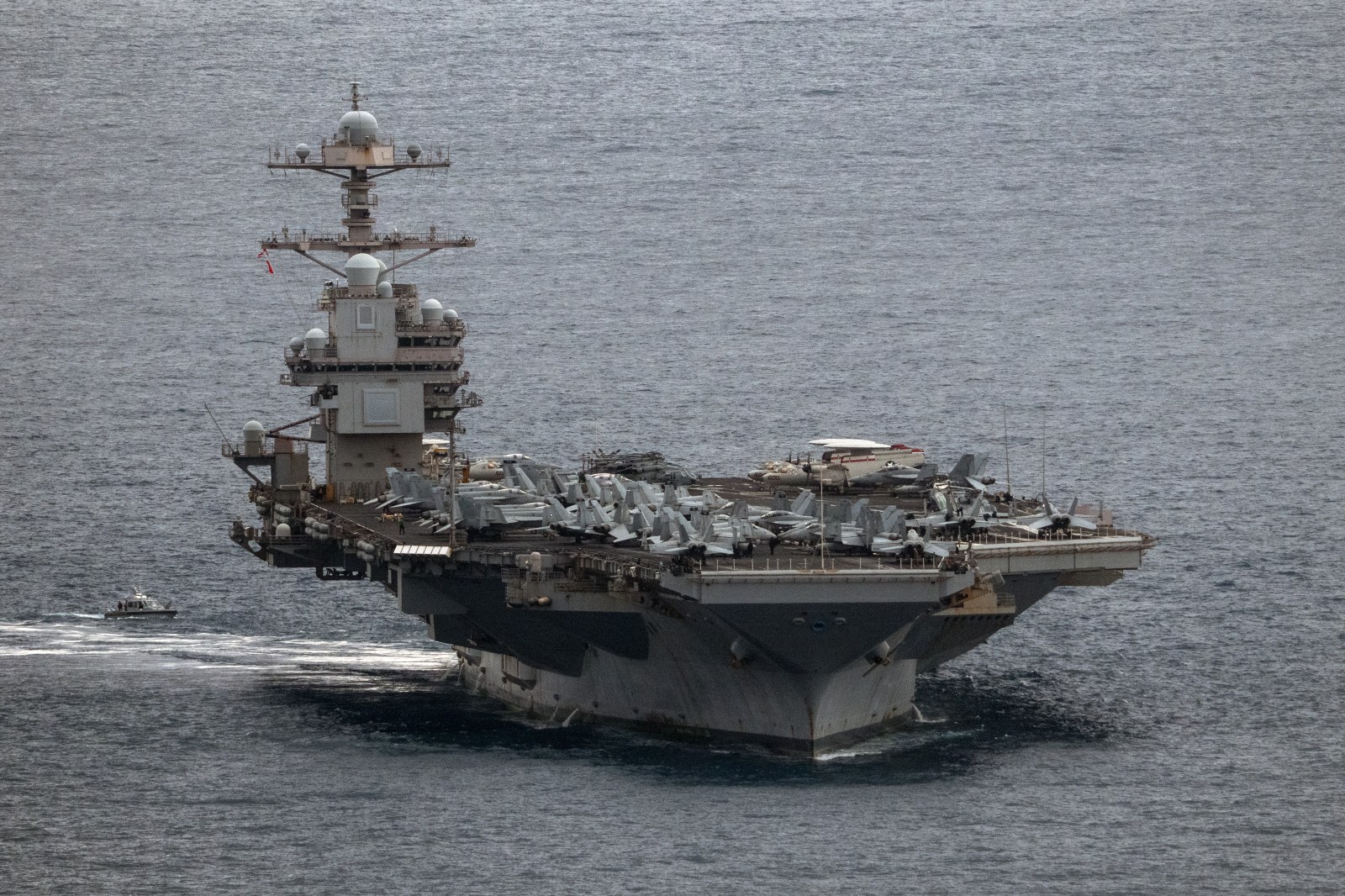
President Donald Trump’s recent directives aimed at altering the U.S. Navy’s newest aircraft carriers have raised alarms among defense analysts, contractors, and former officials. They warn that these changes could escalate costs, delay construction, and undo design decisions that the Navy has spent years implementing.
Trump signed a national security memorandum directing the Pentagon and Navy to devise a plan to replace the Electromagnetic Aircraft Launch System (EMALS) and Advanced Weapons Elevators on the USS Doris Miller, a Ford-class aircraft carrier under construction, with steam catapults and hydraulic systems.
The Ford class represents the Navy’s newest generation of aircraft carriers, meant to replace the aging Nimitz-class fleet over the next several decades. An additional aspect of the debate emerged when the Washington Post reported that Navy officials are assessing the feasibility of relocating the command tower, known as the island, on Ford-class carriers to better align with Trump’s preferred aesthetic. Current and former officials indicated that such a redesign could entail substantial time and financial costs.
Bryan Clark, a former Navy officer and defense analyst at the Hudson Institute, described moving the island as ‘a major redesign’ that would be ‘very disruptive.’
Navy officials told the Washington Post that positioning the island further rearward on Ford-class carriers was an operational decision. This layout aims to provide more aircraft parking near launch zones, enhancing launch efficiency, cutting turbulence during landings, and improving safety. The Navy, during Trump’s first term, had already studied this island relocation. They concluded that it could cost billions and cause significant program delays.
Steam Catapult Debate
Trump has long criticized the EMALS, labeling it as overly complex compared to traditional steam catapults. The new memorandum stresses a preference for ‘proven, reliable, and affordable technologies and ship designs.’
The Navy, however, highlights the benefits of EMALS. According to the service, the electromagnetic system enables higher aircraft launch rates compared to older Nimitz-class carriers and involves fewer personnel. The Associated Press noted that EMALS reduced required sailors for catapult operation on the USS Gerald R. Ford from around a dozen to two. It is easier to maintain and occupies less shipboard space.
Internationally, the discussion extends as China’s latest carrier uses electromagnetic catapults, and France plans similar technology for a future carrier.
Cost and Delay Risks
General Atomics, the EMALS manufacturer, warns against altering the launch systems on the USS Doris Miller. Production for the vessel’s systems is halfway complete, and changing course could lead to ‘significant cost, schedule, and integration risks.’ The company secured a contract worth nearly $1.2 billion in 2023 for the carrier’s launch and recovery systems.
Clark cautioned that altering core carrier systems post-design could create extensive disruptions as modifications would impact multiple ship construction aspects. These concerns arise amid ongoing issues like shipbuilding delays and maintenance backlogs across various Navy programs.
The memorandum notes cost growth, delays, and cancellations linked to design complexity and changes as reasons for pursuing reforms in naval procurement.
Critics Push Back
Several defense analysts question the merit of the proposed changes given the disruptions involved. Todd Harrison, a defense budget analyst at the American Enterprise Institute, called the modifications suggested by Trump ‘highly unusual and disruptive for the Navy.’
Senator Mark Kelly, a former Navy pilot and astronaut, criticized the proposal. He shared on X that despite his aviation and engineering experience, he would not instruct Navy engineers on carrier system designs. In a later interview, Kelly indicated that redesigning under-construction ships would ‘probably’ add billions to costs.
Kelly emphasized, ‘Donald Trump knows nothing about this stuff. Not in any world would I suggest to the Navy to change the design of some system on a ship at this point.’ Critics assert that redesigning vessels could compromise modernization efforts by inflating costs, extending timelines, and reversing years of advanced technology implementation.
Contact Newsweek editor for this story: Anthony Murray.
Leave a Reply