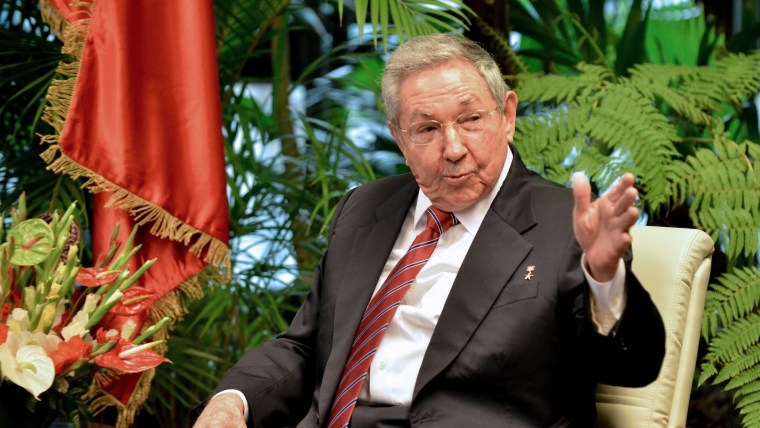
The U.S. Justice Department charged former Cuban President Raúl Castro over the 1996 downing of two civilian aircraft killing four Cuban exiles. Acting U.S. Attorney General Todd Blanche announced the indictment, which includes charges of conspiracy to murder U.S. nationals and aircraft destruction. Five Cuban fighter pilots involved in the incident also face charges.
The charges were disclosed at a news conference held at Miami’s Freedom Tower on Cuban Independence Day, recognized as May 20. This location symbolizes the journey of Cuban Americans escaping the communist regime, likened to ‘Ellis Island of the South.’ Blanche stated, “Raúl Castro and five co-defendants participated in a conspiracy that ended with Cuban military aircraft firing missiles at those civilian planes and killing four Americans.”
The indictment indicates that orders within the Cuban military were controlled by a chain of command led by Raúl and Fidel Castro. Announcing these charges received enthusiastic response from the Miami crowd.
Officials paid tribute to the four men who died when the Cuban Air Force downed the planes on February 24, 1996. The planes were connected to Brothers to the Rescue, a group founded by Cuban American pilot José Basulto. Established in 1991, the organization worked to rescue Cubans fleeing in makeshift rafts but also flew into Cuban airspace at times.
Photos of pilots Carlos Costa, Amando Alejandre Jr., Mario de la Peña, and Pablo Morales were displayed at Florida International University. An international investigation found that Cuba acted directly in international airspace without using standard interception practices. The 1996 incident remains a contentious topic in U.S.-Cuba relations, with Cuban American communities advocating for Castro’s indictment.
Blanche commented that law enforcement has long focused on this case and newly available evidence enabled the indictment. The details of evidence presented to the grand jury remain confidential. Family members of those killed expressed gratitude, optimistic that justice might finally be served.
Cuba is unlikely to extradite Castro, with Blanche acknowledging the complexities but hinting at possible actions. Cuban state authorities strongly condemned the indictment, with President Miguel Díaz-Canel denouncing U.S. actions.
Prominent U.S. politicians and Cuban American representatives have pursued justice, celebrating this development as a significant step forward. In Cuba, Castro still commands influence, despite relinquishing official roles in 2018 and 2021, with celebrations planned for his upcoming 95th birthday.
Indictment Amid U.S. Pressure
This indictment coincides with U.S. pressure on Cuba’s government. President Donald Trump criticized Cuba’s communist regime, particularly after actions taken in Venezuela. Communication disruptions and shortages in Cuba have been exacerbated by strained relations.
Secretary of State Marco Rubio addressed Cubans directly in Spanish, highlighting the hardships faced due to corruption within their government. Cuban state representatives blamed U.S. actions as attempts to undermine their sovereignty, and economic sanctions have intensified Cuba’s resource shortages.
Cubans continue to endure electricity and fuel deficiencies, impacting daily life. Residents are growing impatient, demanding improvements to basic necessities. Havana citizens echo governmental accusations that the U.S. is attempting to force regime change through economic pressure.
This comprehensive coverage included reporting from Miami, New York, Washington, and Havana by contributors Carmen Sesin, Nicole Acevedo, Ryan J. Reilly, Gary Grumbach, and others.
Leave a Reply