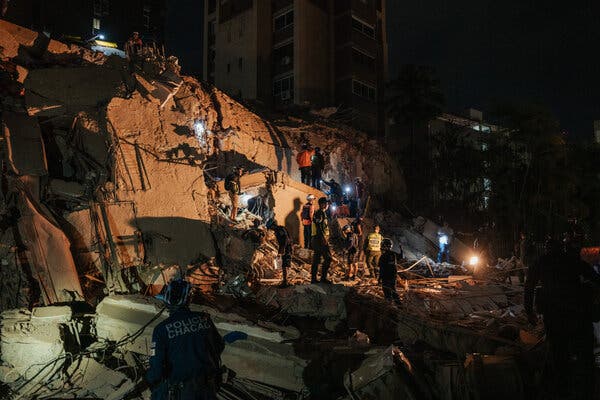
The U.S. Geological Survey has assessed that the recent earthquake in Venezuela might be more devastating than a previous 7.7-magnitude earthquake from 1900.
On Wednesday, Venezuela experienced a magnitude 7.5 earthquake, marking the most powerful seismic activity near the country’s coast since the turn of the 20th century. According to the U.S. Geological Survey’s catalog, the previous notable earthquake in this area was the San Narciso Earthquake on October 29, 1900, with a magnitude calculated based on reported damage and effects due to the lack of modern instrumentation at the time, as explained by Paule Earle, a geophysicist at the U.S. Geological Survey.
This historical event led to significant devastation, causing the death of 21 people and injuries to 50 others, while also destroying churches, public facilities, and residences across Caracas. Reports from The New York Times in November 1900 detailed the collapse of approximately 300 buildings, including notable structures like the university tower and several church spires, leading many affected Venezuelans to seek shelter in tents.
The recent seismic activity was preceded by a magnitude 7.2 earthquake. Experts suggest that these two events are connected, identifying the initial 7.2 quake as a foreshock and the 7.5 one as the main shock. William Barnhart, another geophysicist from the U.S. Geological Survey, explained that earthquakes can alter ground stress levels, potentially triggering subsequent quakes.
Venezuela’s geographical position between the South American and Caribbean tectonic plates makes it vulnerable to frequent seismic activities.
Venezuela experienced a magnitude 7.3 earthquake on August 21, 2018, and a magnitude 7.0 quake on July 9, 1997, highlighting the recurrence of high-magnitude seismic events in the region.
Leave a Reply