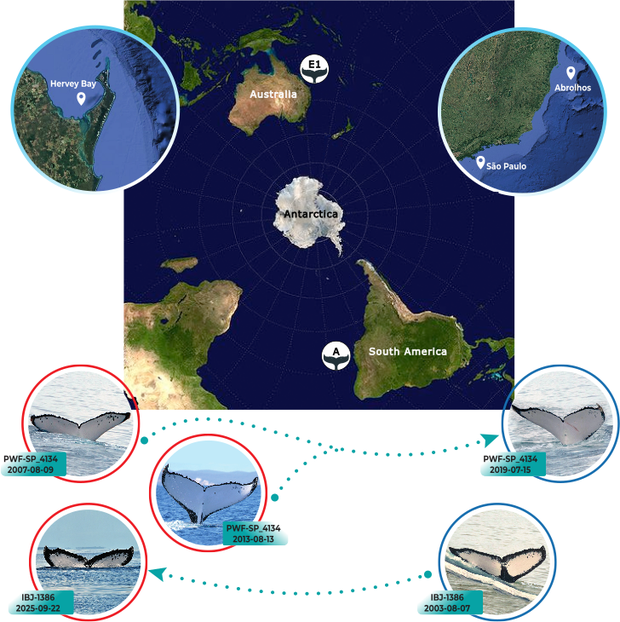
On May 20, 2026, a study published in Royal Society Open Science revealed unprecedented journeys made by humpback whales between eastern Australia and Brazil. Researchers documented the longest distances recorded for these marine giants.
The study involved international scientists identifying whales using tens of thousands of images. These photos revealed two humpback whales traversing oceans on epic journeys. One whale traveled approximately 8,823 miles, moving from Queensland, Australia, in 2007, to Sao Paulo, Brazil, in 2019. Another whale was photographed in Bahia, Brazil, and was seen again 22 years later in Hervey Bay, Australia, covering about 9,383 miles.
These distances mark a critical scientific milestone. The long journeys are rare, but they have significant implications for the whale population. Stephanie Stack, a researcher from Griffith University, emphasized that these movements are vital for preserving genetic diversity among whale groups. She noted that such travels might facilitate the exchange of song styles between whale regions.
The study relies on a massive database collected from 1984 to 2025, comprising almost 20,000 photographs from areas in eastern Australia and Latin America. These photos came from contributions by both scientists and citizen scientists and were processed using an automated image-recognition algorithm to identify individual whales.
Dr. Cristina Castro from the Pacific Whale Foundation highlighted the importance of citizen science, noting that every contributed photo enhances the understanding of whale biology. Through these contributions, researchers unveiled one of the most extreme whale movements ever recorded.
The discoveries give support to the “Southern Ocean Exchange” hypothesis. This theory suggests that humpback whales sometimes travel to Antarctic feeding grounds but return through different routes, ending at new breeding areas. Climate-driven changes, including alterations in sea ice and Antarctic krill distribution, might be influencing such migrations more frequently.
Humpback whales previously faced endangerment due to commercial whaling, which led to their listing as endangered in the U.S. by the 1970s, according to NOAA. The final moratorium on commercial whaling took effect in 1985. Presently, four of the 14 distinct population segments remain endangered, while one segment is considered threatened.
Leave a Reply