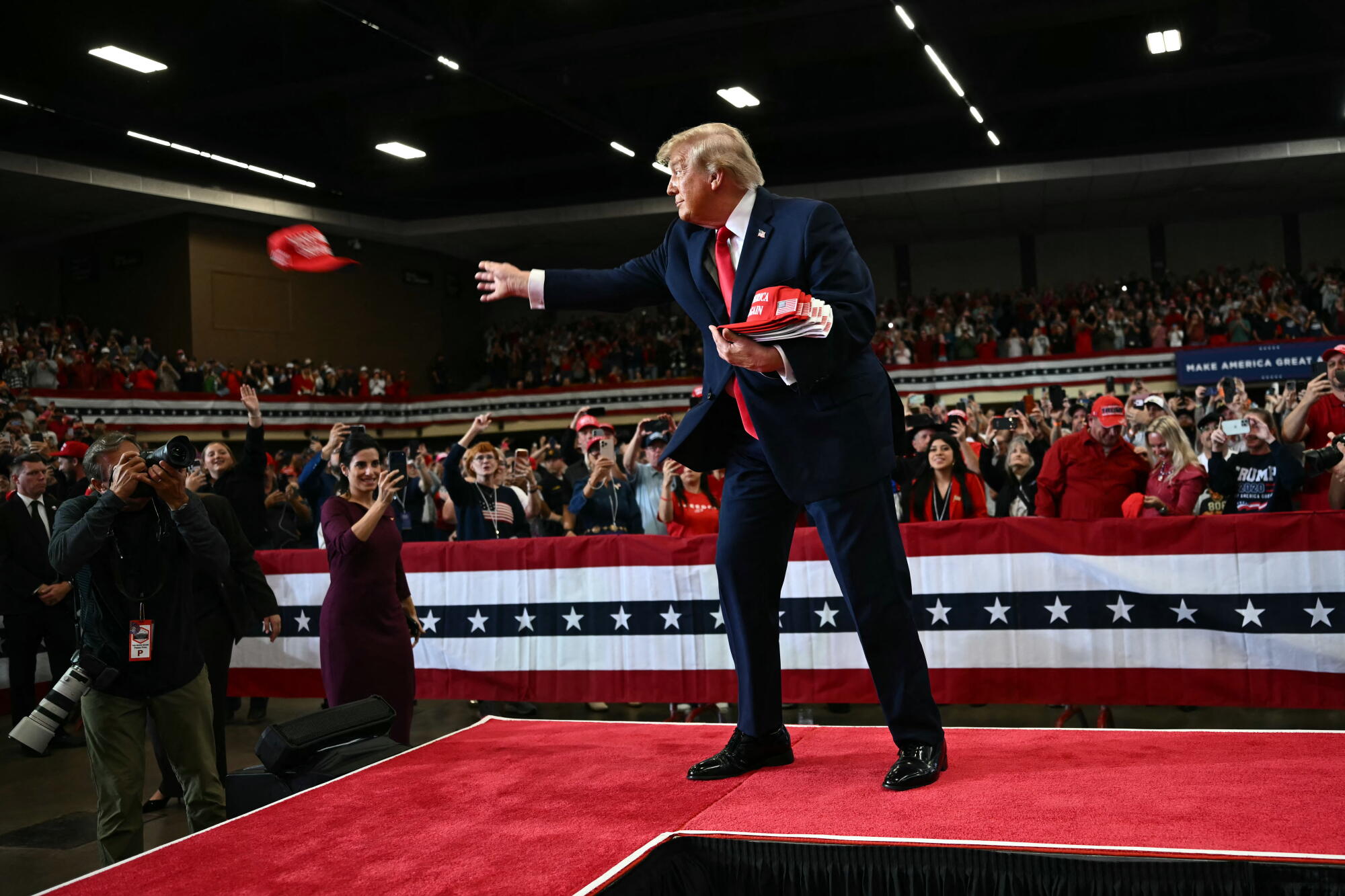
The Republican Party faces internal discussions about its future, influenced by the perceived decline of President Trump’s political power. As election day approaches, Trump’s approval ratings hit a career low, exposing divisions within GOP factions that once strongly supported him. Candidates closely aligned with Trump are now facing significant risks.
Current polling suggests turbulence within Trump’s voter base. A Pew Research Center poll shows his approval among 2024 voters has plummeted to 67%, a drastic drop from 95% early in his term. This decline is particularly notable among younger voters and the Latino community.
Despite Trump’s influence, a New York Times/Siena poll indicates that a third of Republicans hope the next presidential nominee will adopt a different strategy. Marc Short, Trump’s former White House Director for Legislative Affairs, noted the GOP’s struggles with economic issues and corruption narratives, describing the party’s state as “triage mode.”
The party must navigate an infrastructure tailored around Trump since his rise in 2015. Many see him as the defining figure in Republican politics, suggesting that decisions should reflect his enduring influence. Joe Gruters, Chairman of the Republican National Committee, affirmed Trump’s pivotal role in shaping the party’s direction and future candidates.
Within Trump’s close circles, there’s a consensus that his movement is not ending soon. A member of Trump’s team emphasized that while there’s speculation about what follows, Trump remains keenly focused on current tasks. Although questions emerge about Trump’s successor, no clear heir apparent is identified, with Trump refraining from formal endorsements.
A New York Times/Siena poll reveals Republican voters are considering figures like JD Vance and Marco Rubio for future leadership, underscoring Trump’s continuing sway. Observers within the party suggest the challenge lies in balancing the MAGA base with broader voter appeal without alienating mainstream Republicans.
Mike Madrid, a political strategist and co-founder of the Lincoln Project, argues that Trump’s dominance lies more with media influence than traditional ideology. According to him, the GOP lacks ideological coherence, making a split over ideological lines less likely than division influenced by media figures.
Madrid expressed doubts about Trump altering his approach, even with significant Republican losses in the elections. History suggests that presidents sometimes adapt after losing congressional control, often repositioning their policies to regain political momentum.
Examples include President Clinton’s shift after 1994 elections; yet, President Biden refrained from such changes post-2022, a decision that potentially impacted the Democratic strategy in 2024. Trump hinted he might collaborate with Democrats should they gain congressional power, although his core support seems unwavering.
Lynn Vavreck, a political science professor at UCLA, believes the coalition Trump built will persist beyond his tenure. Voters committed to his vision seek to create a distinct future for the party, unlikely to change immediately after electoral setbacks or Trump’s eventual political departure.
Leave a Reply