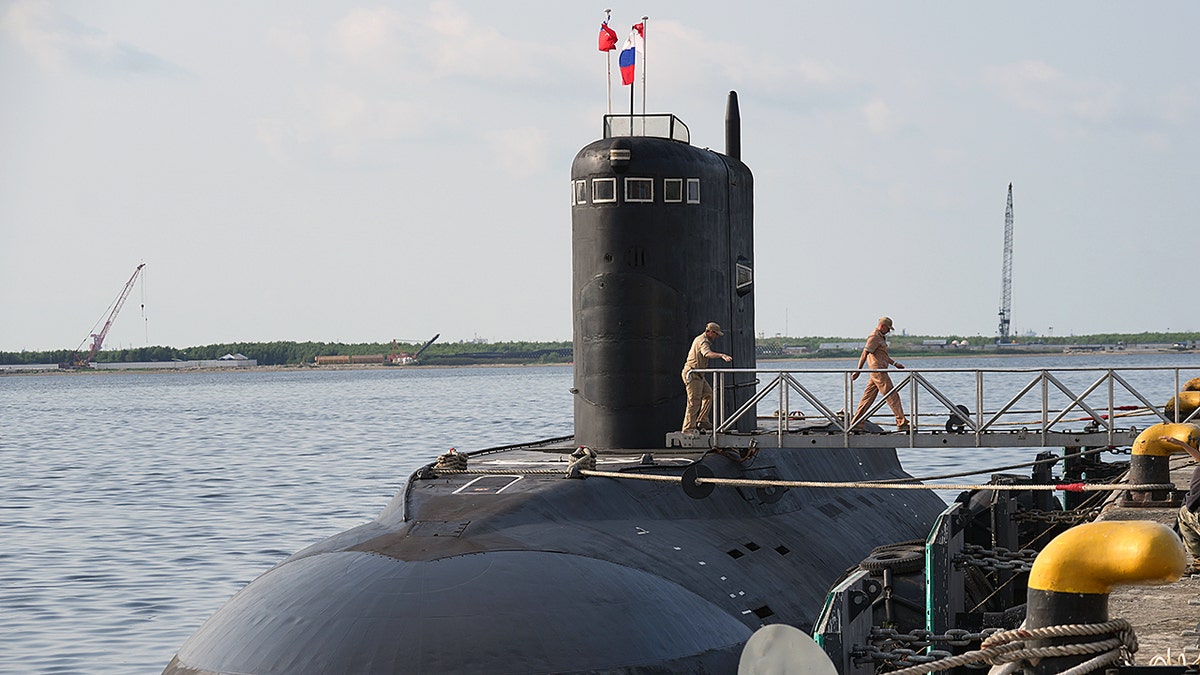
Russia’s new generation of quieter nuclear-powered submarines is putting pressure on NATO’s northern defenses. These submarines, part of President Vladimir Putin’s emerging arsenal of ‘super weapons and super capabilities,’ are causing concerns for NATO as it works to secure Arctic and North Atlantic approaches to North America.
The challenge includes Russia’s heavily militarized Kola Peninsula. Moscow has expanded military infrastructure with new airfields and ports, boosting its position along the Northern Sea Route. This also impacts the Greenland-Iceland-United Kingdom Gap, known as the GIUK Gap.
NATO’s Allied Joint Force Command Brunssum recently noted a ‘serious’ Russian submarine threat in the region.
According to NATO’s Allied Joint Force Command Brunssum, Russia is expanding and modernizing its submarine force. The Kola Peninsula remains a key hub for the Northern Fleet, including new-generation nuclear-powered submarines. These bring long-range strike and sea-denial capabilities to the High North.
Retired Gen. Philip Breedlove explained that these submarines present a significant threat, being challenging to track and capable of operating close enough to launch missiles toward the Atlantic shoreline.
‘We’ve taken measures in the past to monitor Russian activity in those waters. With the potential of quieter submarines, NATO will need to adapt,’ Breedlove said.
Submarines like the Yasen-M-class feature advanced acoustic-quieting and sonar technology, capable of carrying long-range cruise missiles, anti-ship missiles, and hypersonic cruise missiles. Russian officials claim these submarines remain ‘invisible.’
NATO’s efforts to counter this include strengthening its northern posture in response to resumed Russian military activities. In February 2026, the alliance launched Arctic Sentry, a multidomain military initiative led by Joint Force Command Norfolk to improve coordination across the Arctic and High North.
Furthermore, NATO fortified its northern flank in June with Forward Land Forces Finland, a Swedish-led multinational force designed to enhance deterrence and defense, using Finland as the host nation.
Breedlove mentioned that melting ice in the Arctic has created faster trade routes, known as the Northern Passage, significant for European trade with Asia. Russia views this as a chance to control northern waters.
Increased NATO activity has prompted strong reactions from Moscow. Russian Foreign Minister Sergei Lavrov warned that Western military actions threaten Russia’s security and may lead to incidents with serious consequences.
This article was reported by Emma Bussey, a breaking news writer for Fox News Digital, who previously worked for The Telegraph.
Leave a Reply