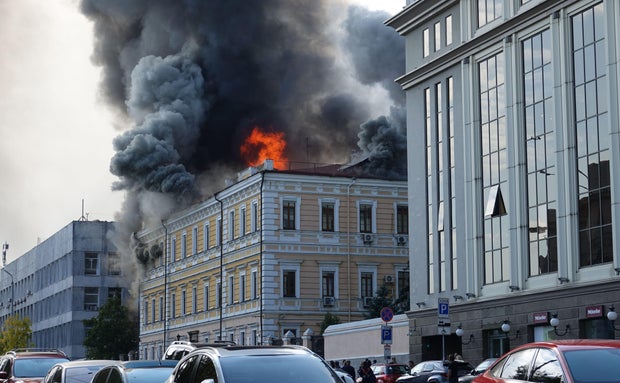
On September 28, 2026, Russian forces continued their intense bombardment of Ukraine, resulting in at least seven casualties and more than 50 injuries. The barrage, which included drone attacks, targeted various structures such as residential buildings, offices, and a significant cultural site, the National Academy of Sciences of Ukraine, in Kyiv.
During a daytime strike in Kyiv, CBS News’ Aidan Stretch had to seek cover when more Russian munitions were incoming shortly after arriving at the science academy site. The Academy was enveloped in fire and smoke following the attack.
Moscow’s continued aggression comes amid a week of diplomatic attempts at the United Nations to advance peace negotiations to end the invasion that began over four years ago.
Kremlin spokesperson Dmitry Peskov remarked on Monday that the prospects for quick progress in peace talks were grim, citing recent Ukrainian attacks. He emphasized that Ukraine would face consequences for its actions in the past months.
At the U.N. General Assembly, Russian Foreign Minister Sergey Lavrov criticized Europe for hindering peace talks, suggesting a discord within the NATO alliance.
Extent of Russian Drone Attacks
Russian drone strikes in Kyiv killed four individuals and injured eight, as confirmed by local officials. A separate attack in the Shevchenkivskyi district of Kyiv claimed another life, damaging cultural landmarks like the National Academy of Sciences of Ukraine. Russian forces also struck a pharmaceutical facility and fuel stations in Kyiv.
In Dnipro, a Russian drone hit an office center during business hours, resulting in three fatalities and at least 12 injuries. In Kharkiv, a strike on a nine-story apartment building injured 43 people, including children. Northern Ukraine’s Chernihiv region experienced more attacks, injuring four, including two teenage girls.
Targets and Intent
The Russian Defense Ministry reported strikes on two data centers in Kyiv and additional targets such as gas stations and distribution hubs in Odesa. The military confirmed attacks on cargo ships in the Black Sea and Chornomorsk, aiming to disrupt Ukraine’s grain exports and potentially causing food shortages for reliant countries. While Russia claims it targets military sites, Ukrainian sources argue that civilian areas are frequently hit.
Ukraine’s Counteroffensive Developments
On the battlefield, Ukraine has made small territorial gains despite little movement in frontline positions due to drones limiting troop operations. A recent Ukrainian offensive, dubbed Operation Vivaldi, has resulted in reclaiming 68 square miles, including using modified Soviet-era vehicles to breach Russian defenses. The operation marked progress in the Donetsk region, challenging the larger Russian army’s control.
Russian authorities have not publicly addressed these claims, though the Defense Ministry acknowledged capturing villages in Donetsk and Sumy regions. Verification of these claims remains challenging.
Ukrainian President Volodymyr Zelenskyy highlighted long-range strikes targeting Russian defense plants and oil facilities, notably in the Tula, Voronezh, and Krasnodar regions. Ukrainian drones have persistently hit Russian infrastructure, impacting its economy and military capabilities. Recent Ukrainian drone activities led to fires in Krasnodar, and Russia’s Defense Ministry reported intercepting 254 drones.
Leave a Reply