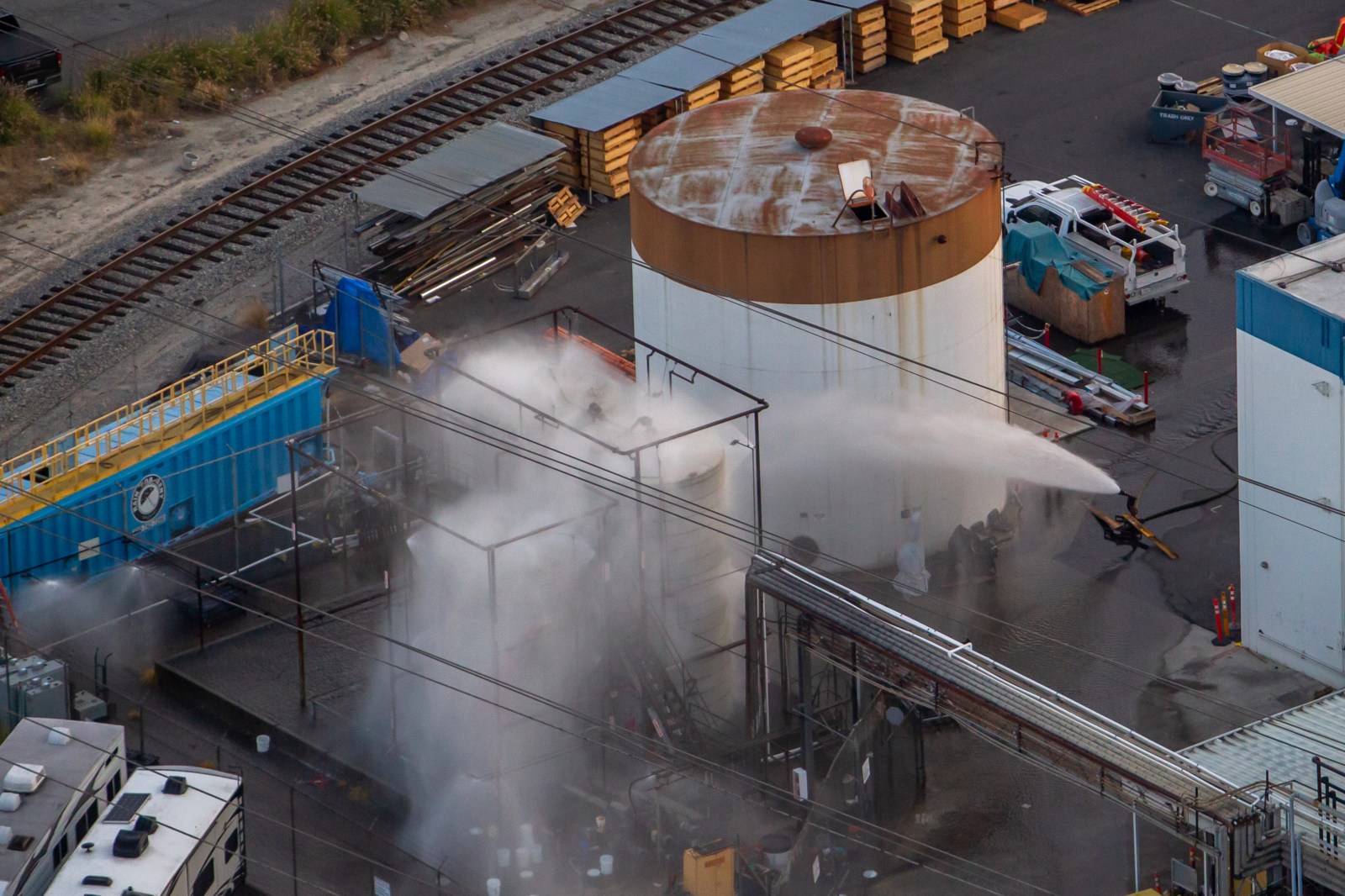
A Southern California chemical tank has reached temperatures of at least 100 degrees Fahrenheit, sparking fears of a catastrophic explosion. Firefighters in Garden Grove are working tirelessly to stabilize the tank, which holds thousands of gallons of methyl methacrylate, a volatile substance used in manufacturing plastics and aerospace materials. On Sunday, the temperature inside the tank soared to the highest level measurable by the thermometer, raising concerns about a potential ‘thermal runaway’ reaction.
Evacuations and Emerging Factors
The tank’s overheating has led to the evacuation of over 40,000 residents in Garden Grove and nearby areas. Officials warn that the situation could either result in an explosion or a significant chemical spill. Despite the persistent threat, two factors may help mitigate this risk.
Structural Relief
A crack discovered in the tank could function as an unintended pressure-release mechanism. The Orange County Fire Authority (OCFA) discovered this crack during a high-risk inspection. OCFA interim fire chief T.J. McGovern stated that this could influence future response strategies. By allowing gases to escape, the crack may prevent internal pressure from reaching dangerous levels. Although rumors circulated about multiple cracks, the OCFA clarified there is only one known crack.
Weather Conditions
The weather is also playing a role in risk reduction. Meteorologist Joe Wegman from the National Weather Service (NWS) indicated that mild temperatures and limited wind are expected for the coming days. Daytime highs will remain in the low 70s, while nighttime lows will be in the 50s. These conditions slow heat accumulation in the tank, allowing responders more time to act. Although light winds help contain any potential vapors, they could still spread chemicals to nearby areas if released.
Firefighters have been continually spraying water on the tank to stabilize its temperature, a strategy more effective without intense heat or environmental fluctuations. The combination of internal venting and stable weather conditions appears to be mitigating the risk of a catastrophic event.
Origins of the Emergency
The crisis began on May 21 when a tank at a GKN Aerospace facility started overheating and releasing vapors. A faulty valve has prevented crews from neutralizing the chemical contents, causing the tank’s temperature to rise. Methyl methacrylate is highly flammable and produces toxic fumes, making both explosion and vapor release hazardous to local communities.
This emergency is one of the most complex hazardous material incidents in recent California history. Authorities have enforced continuous monitoring and coordinated responses from various agencies. The evacuation affected thousands, with residents unable to retrieve essential items before being displaced. Some, like Roseletty Feliciano, returned to find their neighborhoods blocked off.
Federal and State Responses
The White House confirmed engagement with the situation on Monday. The Trump administration, U.S. Environmental Protection Agency (EPA), and Federal Emergency Management Agency (FEMA) are all involved in monitoring and contingency planning. The EPA is conducting air quality assessments across the region. California Governor Gavin Newsom declared a state of emergency and requested federal assistance to support displaced residents and stabilize the situation. Emergency shelters have been mobilized, and monitoring efforts expanded to keep air quality safe outside the evacuation zones.
Ongoing Uncertainty
Despite signs of reduced pressure, the threat is not over. The tank remains unstable, and it is uncertain whether internal reactions have slowed or if another temperature spike might occur. Evacuation orders are ongoing, and continuous operations to monitor pressure levels and prepare for any outcome are in place.
Leave a Reply