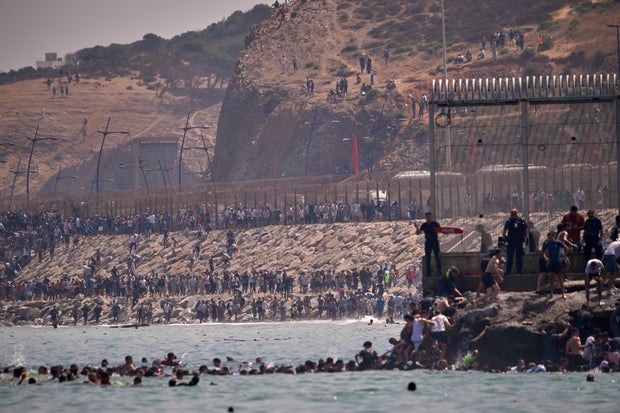
Spain has decided to deploy its military forces to address the escalating migrant situation at its border with Morocco in Ceuta. Thousands of migrants have surged into the small Spanish territory, prompting local authorities in Ceuta to request reinforcement from the central government in Madrid.
Following this request, Spain announced it would send the Armed Forces to assist the Civil Guard in maintaining security in Ceuta. Prime Minister Pedro Sánchez and Interior Minister Fernando Grande-Marlaska plan to visit Ceuta to assess the situation.
Rachid Sbihi, representing Spanish Civil Guard officers in Ceuta, described the conditions as chaotic. Precise numbers are difficult to determine, but there are reportedly thousands of migrants crossing the border, which has collapsed under the pressure.
Achraf Maimouni from the Moroccan Association for Human Rights highlighted the exceptional nature of the crisis. Footage shows large groups, mainly Moroccans, moving through the Tarajal beach area, with families, women, and small children among them.
It remains unclear why there was such a large spike in crossings. However, numbers of migrants attempted to reach Ceuta by swimming earlier in the week, resulting in at least three deaths. Moroccan authorities have yet to comment publicly on these events.
Spain’s Interior Ministry revealed ongoing cooperation with Morocco to manage the situation, noting that Moroccan police are intercepting many attempting to cross illegally. Both governments have committed to work together to return those who entered Ceuta without permission.
Spain rejected declaring a national emergency despite Ceuta’s local authorities having linked the surge to a recent Supreme Court ruling. This decision stated that migrants arriving by sea are entitled to due process before deportation.
Ceuta is a crucial entry point for migrants entering Europe, seeking better economic conditions or escaping violence. Located on the northern coast of Africa, migrants often swim from nearby Moroccan towns to reach Spanish soil.
The situation draws comparisons to a similar crisis in May 2021, involving thousands of migrants. At the time, diplomatic tensions arose after Spain allowed Polisario Front leader Brahim Ghali hospital treatment, causing disputes with Morocco.
Juan Jesús Vivas, head of Ceuta’s regional government, has urged for further military and police presence on grounds of national security. He claims the migrant reception centers are overwhelmed, with many sleeping on the streets after recent entries.
As of mid-July, almost 3,000 migrants have reached Ceuta by land or sea this year. The Interior Ministry assured ongoing coordination across government sectors to manage the situation swiftly.
Ceuta’s unique historical status since 1580 includes a diverse community living behind a border fence. However, many migrants across Africa attempt to cross these lines, pursuing improved lives in Europe.
Leave a Reply