A comprehensive new study has brought into question the long-held belief that all roads lead to Rome. The research, published on September 15 in Nature Communications, examines roughly 190,000 miles of Roman roads stretching across Europe, the Middle East, and North Africa. This vast network was analyzed to assess its structure on a grand scale.
The lead researcher, Tom Brughmans, a classical archaeologist at Aarhus University in Denmark, emphasized that Rome was not the sole central node in the empire’s road network. Instead, various provincial capitals significantly contributed to overland travel. When Emperor Constantine declared Constantinople the imperial capital in the fourth century A.D., it became a crucial hub for travel across the empire. This new capital’s strategic location amid Europe and Asia fortified its importance.
Brughmans noted that the adage “all roads lead to Rome”—originating centuries after the empire’s decline—does not fully capture the ancient network’s complexities. He remarked that Roman Britain’s roads never led directly to Rome, underpinning the proverb’s limited accuracy. According to Brughmans, “It’s fair to say our study complicates the proverb. I prefer to say, ‘All roads lead to Rome and everywhere else.’”
The study does not undermine Rome’s central role as the empire’s nucleus, a point supported by Taco Terpstra, a professor at Northwestern University in Illinois. Terpstra acknowledged that while Constantinople rose to prominence during the empire’s later years, the city was previously a modest fishing town called Byzantium. This perspective sheds light on how Constantinople became an essential hub, drawing significant connectivity once it was established as the capital.
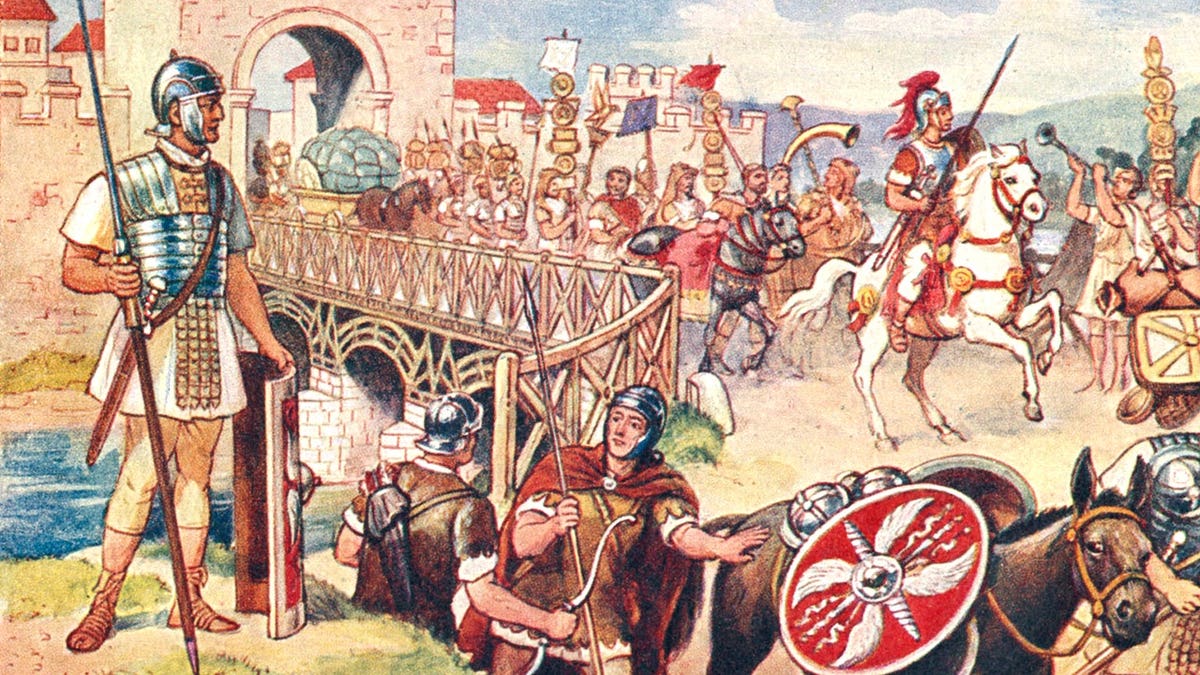
Throughout its history, Rome remained a dominant seat of political, military, and ideological power. The city of Alexandria, though large, had only about half the population of Rome. The study also highlights the Roman roads’ engineering precision, known for their straightness, though they were sometimes less direct due to challenging terrains. The roads initially served a military purpose, facilitating rapid troop movements, and later gained economic importance.
Despite the robust road network, Terpstra pointed out that maritime transport was pivotal for the empire’s broader connectivity. Sea routes offered more economical options for moving goods across the empire’s expanse. Hence, while Roman roads were engineering marvels, they played a secondary role to maritime pathways in maintaining the empire’s connectivity.
Leave a Reply