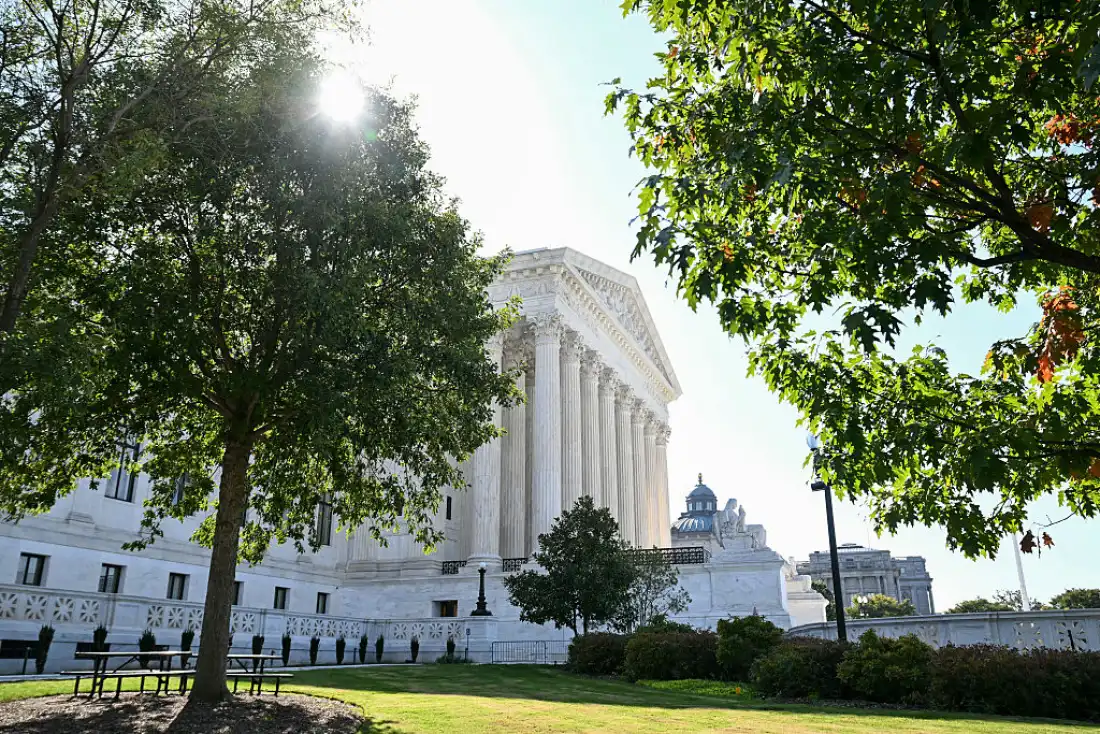
On Tuesday, the Supreme Court is set to hear arguments in a pivotal case involving the Catholic Church and taxpayer-funded school programs in Colorado. The case centers around whether religious schools can refuse admission to the children of gay and trans parents, violating state anti-discrimination laws.
The first line of the Bill of Rights states: “Congress shall make no law respecting an establishment of religion, or prohibiting the free exercise thereof.” Historically, this clause has been interpreted to create a separation between church and state. However, recent years have seen a shift with the Supreme Court’s conservative majority emphasizing the protection of religious exercise over separation.
Michigan State University law professor Frank Ravitch notes the dramatic shift in doctrine. He cites the Supreme Court’s 1983 ruling, which by an 8-to-1 vote, decided Bob Jones University should lose its tax-exempt status for prohibiting interracial dating and marriage.
The current case in Colorado challenges this foundation. Professor Douglas Laycock highlights the unique place race holds in U.S. history, suggesting other groups lack such a defining narrative.
The controversy involves Colorado’s universal pre-K program, designed to offer access to preschool for all 4-year-olds, funded by a $6,300 annual benefit from a tobacco tax, enforced by non-discrimination policies.
Steve Fenberg, former president of the Colorado state Senate, explains the intent was to provide “robust choice” to parents, including religious school options. Colorado state Rep. Emily Sirota adds that initial Catholic Church support included participation from various schools.
However, objections arose when the Denver Archdiocese and two parishes, supported by the Becket Fund for Religious Liberty, contested the anti-discrimination law, claiming it discriminates against religious schools.
Tim Uhl, interim director of mission and ministry at Notre Dame High School, disagrees with the church’s stance, arguing the importance of diverse opinion within education.
Archbishop James R. Golka voiced concerns that enrollment in Catholic schools fell by 20% across the archdiocese due to the program’s requirements, impacting minority and low-income families.
Scott Elmer, superintendent of Catholic schools, notes that LGBTQ enrollment attempts are uncommon. Yet, the Supreme Court’s current composition, including President Trump’s appointees, suggests a move towards bolstering religious rights.
Berkeley Law School dean Erwin Chemerinsky raises questions about the extent to which the government might fund religious schools or charter schools at the taxpayer’s expense. Charter schools traditionally operate independently but remain publicly funded.
Recently, Oklahoma approved a Jewish charter school with substantial state funding. The outcome of the Colorado decision could influence similar future initiatives.
Leave a Reply