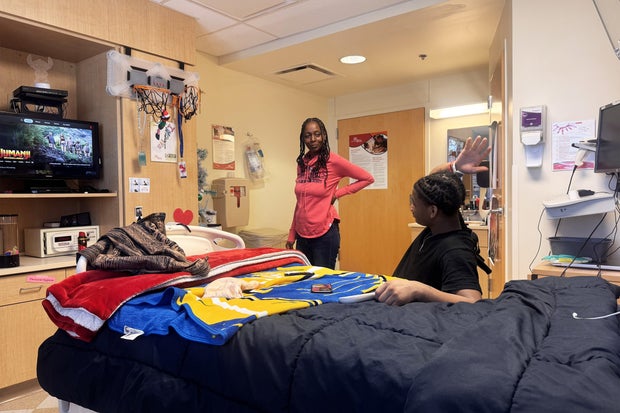
In St. Louis, a teenager’s journey began in room 3005 at Cardinal Glennon Children’s Hospital. For Jaloni, the room initially felt unfamiliar, devoid of personal touches or comfort. The 14-year-old, then suffering from severe gunshot wounds, was overwhelmed by pain. His reliance on powerful pain medication led him to feel as though he was escaping into a dreamlike state.
Jaloni found himself trapped between two worlds. He had been a fearless risk-taker among friends but had become a vulnerable boy in need of reassurance in the hospital. His grandmother’s comforting words could not guarantee a brighter future. Jaloni spent over 475 days hospitalized over three years, not only for medical care but due to the absence of a safe home.
Jaloni is among many children across the nation experiencing what is termed as a ‘social stay’ or hospital boarding. This issue arises when children, often with mental health challenges or disabilities, remain in hospitals beyond medical necessity. In 2017, a Minnesota study found hospital boarding costs for a child with complex conditions reached about $3,932 a day.
The exact details of Jaloni’s extended hospital stay, including costs, remain unclear as the hospital opted not to comment. Nevertheless, SSM Health stated its commitment to assisting those in need, noting the financial burden hospitals bear when discharge options are unavailable.
Missouri’s state records indicate over $64.7 million spent in the past five years on hospital boarding for state custody children. However, Dave Dillon from the Missouri Hospital Association suggests this figure is an underrepresentation due to unlogged and unreimbursed costs by hospitals.
The toll of such circumstances on children is significant. ‘Y’all almost killed him,’ Jaloni’s mother recalled being told by hospital officials.
When first hospitalized in June 2023, Jaloni was recovering from gunshot wounds. He had witnessed numerous loved ones fall victim to violence, including his sister and brother. Despite the odds, Jaloni wanted to live.
Returning home proved challenging for his family. His grandmother, also in a wheelchair, was unable to provide adequate care, nor was his employed mother. Consequently, Jaloni returned to the hospital with worsening bedsores and was accused of neglect, resulting in his wardship in Illinois.
While discussions ensued about his future, Jaloni endured a 250-day hospital stay. Children like Jaloni face barriers finding suitable accommodations due to accessibility needs. In Illinois, 304 youth were hospital boarded beyond necessity in the fiscal year ending June 2025, with similar cases in Missouri.
Despite legislative attempts in Missouri to address hospital boarding, progress has stalled. Jaloni, unaware of legislative struggles, waited on the third floor of the hospital for a solution.
Jaloni’s grandmother, a lifelong safe harbor, sadly passed while he was hospitalized. Eventually, his aunt, Deborah, stepped up as a foster parent. She prepared her new home to accommodate Jaloni, who remained in the hospital until all was ready.
Though hospital staff tried to connect with Jaloni, the confines felt isolating. When the door to his room opened, he saw a different world unfold, one where he accumulated seasons of gifts and festive treats.
By his third hospitalization for a bone infection, Jaloni had embraced the hospital as a temporary kingdom. He ventured through the hospital, formed connections, and even attended a prom. Yet, he longed for external freedom.
Jaloni’s new home with his aunt provided a fresh start. Adjusting to post-hospital life included managing his medications and preparing meals independently. His birthday celebrated at an aquarium marked a new chapter.
As Jaloni cautiously reentered the outside world, he battled anxiety and fear, making brief, carefully planned public appearances. Meanwhile, his aunt navigates her responsibilities while supporting his aspirations and safety.
This report was made possible by a grant from the Association of Health Care Journalists and funded through The Joyce Foundation. KFF Health News provides extensive health issue coverage and operates under KFF, a key health policy and journalism entity.
Leave a Reply