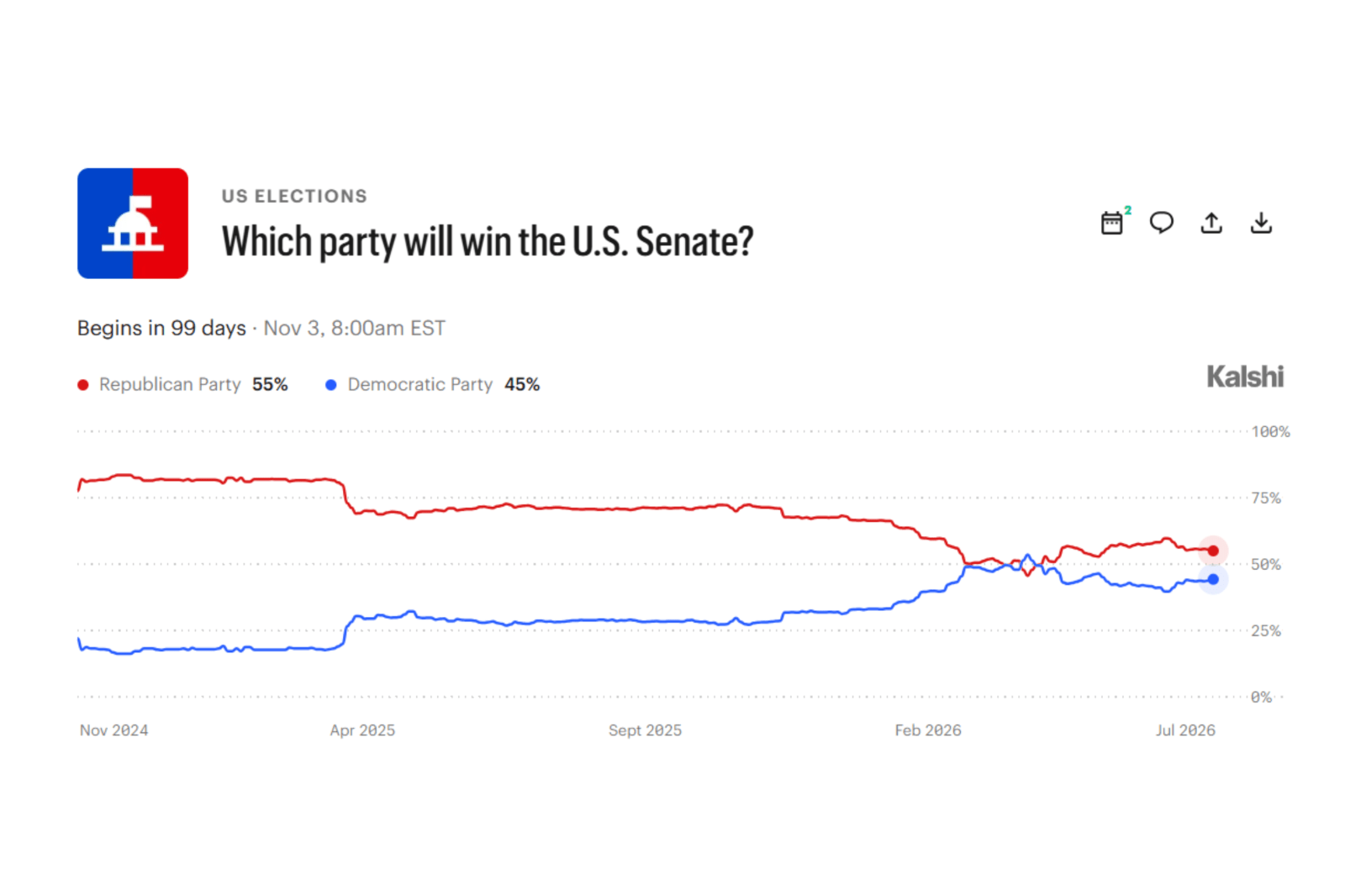
As the 2026 midterm elections approach in 100 days, prediction markets indicate that Democrats have a potential avenue to regain control of the Senate. Currently, Republicans hold a 55-45 Senate majority. For Democrats to achieve outright control, they need a net gain of four seats, considering the Vice President’s role in breaking a 50-50 tie in favor of Republicans.
According to Kalshi’s 2026 Senate election guide, Democrats need to secure 51 seats. The most straightforward path for Democrats involves flipping four Republican-held seats: Alaska, Maine, North Carolina, and Ohio. The Cook Political Report classifies Alaska, Maine, and Ohio as ‘Toss Ups,’ suggesting both parties have viable chances, while North Carolina is categorized as ‘Lean Democrat,’ giving Democrats a slight advantage despite it being a Republican-controlled open seat. Additionally, Michigan, a Democratic-held open seat, is also rated as a ‘Toss Up,’ meaning Democrats could gain multiple Republican seats but still fall short if they lose in Michigan.
Prediction markets echo this delicate balance. Kalshi’s Senate markets show Democrats as favorites in Alaska, Maine, and North Carolina. However, Ohio presents an evenly matched contest. Polymarket reflects similar sentiments, favoring Democrats in Maine and Alaska, while considering the races in North Carolina and Ohio as near even, with Democrats having a 50% chance in each. Overall, Polymarket gives Republicans a 56% probability of retaining Senate control, compared to 44% for Democrats.
It is important to note that prediction markets reflect investor sentiment and trading activity, not direct public opinion polls.
Alaska
In Alaska, Kalshi predicts the Democratic Party has a 55% chance of victory, while Polymarket places Democrat Mary Peltola with a 57% chance in the race. Polling results are mixed but competitive. A New York Times/Siena University poll from June showed Republican Senator Dan Sullivan leading Peltola 47% to 45% among likely voters. Alaska Survey Research had earlier found Peltola leading in some polls, including one from June showing her ahead 49% to 44%.
Maine
In Maine, Kalshi lists Democrats with a 64% chance to win. Polymarket aligns closely, giving Democrats 67%. Polls remain close, with a University of New Hampshire Survey Center poll from July showing Democrat Troy Jackson leading Republican Senator Susan Collins 49% to 46%.
North Carolina
In North Carolina, Democrats see a strong chance. Kalshi gives Democrat Roy Cooper a 90.5% probability of defeating Republican Michael Whatley. Polymarket is more cautious, listing the race as a ‘Toss Up,’ with Democrats at 50%. Surveys have consistently shown Cooper ahead; Public Policy Polling and a New York Times/Siena University poll had Cooper leading by margins of 48% to 44% and 50% to 43%, respectively. Cook rates North Carolina as ‘Lean Democrat,’ the only Republican-held seat not listed as a ‘Toss Up’ among the four battlegrounds, yet the state remains challenging for Democrats in federal races.
Ohio
Ohio stands as the most uncertain of the battlegrounds. Kalshi gives an equal 50% chance for Democrat Sherrod Brown and Republican Senator Jon Husted. Polymarket also lists Ohio as a ‘Toss Up.’ Polls are split; a New York Times/Siena University poll had Husted leading Brown 50% to 47%, but AARP found Brown ahead in other polls. Ohio’s recent rightward shift in presidential elections contrasts with Brown’s strong statewide presence, presenting a complex scenario for Democrats.
The Michigan Complication
Even if Democrats triumph in all four Republican-held battlegrounds, Michigan’s ‘Toss Up’ status could obstruct their path to a majority. Kalshi gives Democrats a 70% chance of retaining Michigan, with Polymarket reflecting similar odds. Recent polls show Democrat Abdul El-Sayed slightly leading Republican Mike Rogers.
This means that Democrats’ best-case scenario remains precarious. Flipping Alaska, Maine, North Carolina, and Ohio while losing Michigan would yield only three net gains, insufficient for control according to the existing 53-47 Senate split.
Overall Market Insights
The prediction markets suggest a highly competitive Senate map. Kalshi shows Democrats favored in key races including Alaska, Maine, and North Carolina, with Ohio split evenly. Polymarket similarly shows Democrats with leads or ties in these critical contests, yet Republicans maintain a slight overall edge. The margin for error is slim for Democrats. As the countdown to the midterms continues, the markets indicate Democrats have a feasible path to a majority, but they must secure most Republican-held battlegrounds and protect vulnerable seats like Michigan.
Leave a Reply